(0086)18936474568 sales@immay-auto.com

- Home
- Equipment
- Industries
- We Immay
- Resource
- Contact
Author: Site Editor Publish Time: 2026-10-26 Origin: Site
High-purity water is required in many electronics manufacturing processes because even small amounts of residual contaminants can affect product quality. When water is used to clean or rinse electronic components, impurities in the water can remain on product surfaces after drying. Depending on the application, these residues can cause surface contamination, contribute to corrosion or electrical leakage, and affect subsequent manufacturing processes.
As electronic components become more sensitive to contamination, stricter control of water purity is needed in critical manufacturing steps. Removing impurities from the water helps reduce a potential source of product defects and supports consistent manufacturing quality. The required water purity varies by application and process requirements, which determines the level of treatment needed.
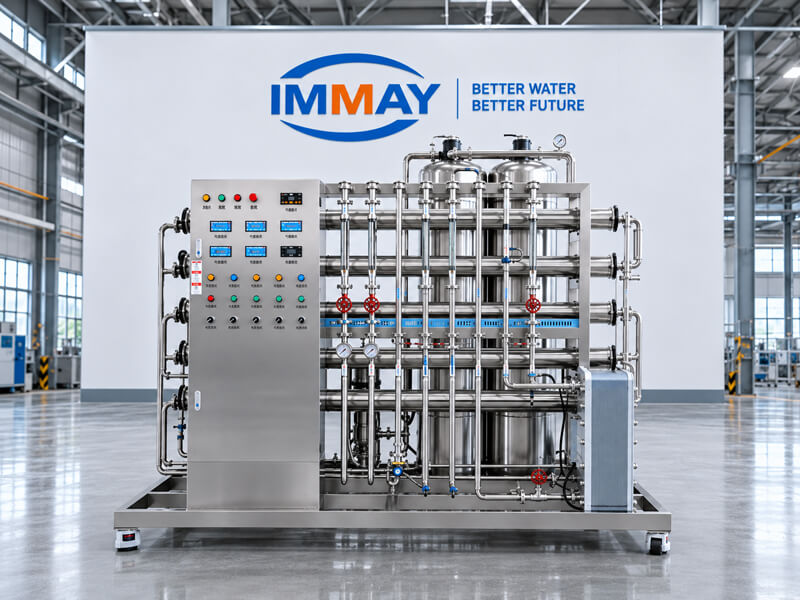
A double-pass reverse osmosis (RO) system with electrodeionization (EDI) uses successive treatment stages to reduce dissolved impurities in water. The first RO pass removes a large proportion of dissolved salts and other contaminants. The second pass further reduces the remaining dissolved impurities, providing feed water with a lower ionic load for EDI. EDI then removes residual ions through ion exchange and selective membranes under an electric field.
The treatment process commonly follows this sequence:
Pretreatment → First-Pass RO → Second-Pass RO → EDI → Additional Polishing, If Required
Pretreatment: Removes or reduces substances such as suspended solids, hardness, and residual chlorine that could affect RO membrane performance. The specific pretreatment steps depend on the incoming water quality.
First-Pass RO: Uses a semipermeable membrane to reduce most dissolved salts and other contaminants that the membrane can reject.
Second-Pass RO: Treats the first-pass permeate to further reduce dissolved impurities and lower the ionic load entering EDI.
EDI: Uses ion-exchange resins, selective ion-exchange membranes, and an electric field to remove residual ions from the RO permeate. The electric field supports continuous resin regeneration during operation.
Additional Polishing: If the final water quality requirements call for further treatment, additional processes can be incorporated to address specific contaminants that remain after EDI.
Double-pass reverse osmosis (RO) combined with electrodeionization (EDI) can produce high-purity water for many electronics manufacturing applications. However, whether the treated water meets a specific process requirement depends on the incoming water quality, system design, operating conditions, and water quality specifications at the point of use. Some applications can use water treated by this combination alone, while others require additional treatment to control specific contaminants.
After double-pass RO and EDI treatment, the water contains substantially fewer dissolved ions than the incoming water. Electrical resistivity and conductivity are commonly used to assess ionic purity, but they do not represent every aspect of water quality.
The required water quality depends on the manufacturing process. In addition to ionic contamination, some applications require specific limits for silica, boron, total organic carbon (TOC), particles, or microorganisms. The treated water must be assessed against the relevant specifications to determine whether it is suitable for its intended use.
RO and EDI primarily target dissolved impurities, but their removal performance varies among substances. RO membranes reject most dissolved salts, although rejection rates depend on the substance, membrane characteristics, and operating conditions. EDI removes residual ions through ion exchange and selective membranes under an electric field.
Silica and boron require particular attention because, near neutral pH, they exist largely as weakly ionized or neutral species. Their removal depends on factors such as pH, chemical form, membrane characteristics, and EDI module design. Dissolved carbon dioxide can also pass through RO membranes relatively readily and increase the ionic load entering EDI.
For these reasons, high electrical resistivity alone cannot confirm that silica, boron, TOC, particles, or microorganisms meet their respective limits. These parameters need to be measured separately when they are relevant to the application.
Additional treatment is needed when double-pass RO and EDI alone cannot meet one or more of the specified water quality requirements. The choice of treatment depends on the contaminant that needs further control and its effect on the process.
Mixed-Bed Polishing: A mixed bed containing cation- and anion-exchange resins can further reduce residual ions after EDI. It can also help remove residual silica and boron under suitable conditions. Whether this stage is needed depends on the target water quality and the performance of the main treatment system.
UV Oxidation for TOC Reduction: UV treatment at 185 nm can oxidize certain organic compounds and help reduce TOC. Its effectiveness depends on the organic compounds present and the system configuration. Additional treatment is needed to remove oxidation products.
Membrane Degassing: Dissolved carbon dioxide can increase the ionic load entering EDI and affect its operation. When CO₂ removal is required, a membrane degasser is often installed upstream of EDI. Degassing can also be incorporated elsewhere in the system when dissolved gases affect downstream processes or the required water quality.
Final Filtration and Ultrafiltration (UF): Final filters remove particles that remain in or enter the water downstream of the main purification stages. UF provides finer particle removal and can act as a barrier to many microorganisms, depending on membrane characteristics and system integrity. These processes are relevant when the application has strict particle or microbial control requirements.
UV Treatment for Microbial Control: UV systems operating at 254 nm are commonly used to inactivate microorganisms as water passes through the UV unit. Effective microbial control also depends on the hygiene of the storage and distribution system, since UV treatment does not provide a lasting disinfectant residual.
These treatment stages are not all required in every electronics manufacturing water system, and they do not necessarily follow EDI in a fixed sequence. The final configuration depends on the target water quality, the contaminants that remain after the main treatment stages, and the requirements at the point of use. Each additional treatment stage should address a specific water quality requirement.
Selecting a double-pass RO and EDI system depends on the incoming water quality, the required treated water quality, and the facility's water demand. These factors provide the basis for determining the system configuration and treatment capacity.
Before system design, electronics manufacturers should provide the water treatment supplier with an incoming water quality analysis report. The supplier can use the results to determine a suitable system configuration for the available water source.
The required treated water quality depends on the intended use of the water within the facility. Electronics manufacturers should specify their target water quality so the supplier can assess whether double-pass RO and EDI are sufficient or whether additional treatment is needed.
If there are specific requirements for parameters such as silica, boron, total organic carbon (TOC), particles, or microorganisms, the supplier can design additional treatment stages to address them.
Electronics manufacturers should provide the supplier with their estimated daily water consumption, peak water demand, and operating schedule. This information helps the supplier determine the treatment capacity needed to meet the facility's water demand.
The final system design should reflect the facility's actual water quality requirements and consumption needs, providing a suitable basis for selecting the treatment process and equipment capacity.
High-purity water plays an important role in electronics manufacturing, where water quality can directly affect component cleanliness and product quality. Double-pass RO with EDI provides a treatment solution for reducing dissolved impurities, with additional purification stages used when specific applications require further contaminant control.
As electronic components become more sensitive to contamination, water purification becomes an important part of manufacturing quality control. The right water treatment system helps provide the water quality required by each application and supports consistent manufacturing outcomes.