(0086)18936474568                           sales@immay-auto.com

Vacuum Emulsifying Mixer

Elevate Your Cream and Lotion Manufacturing Process with IMMAY's Vacuum Emulsifying Mixer

IMMAY is a leading manufacturer of high quality vacuum emulsifying mixers in China. As a reliable partner, we provide tailored solutions for industries such as cosmetics, food, pharmaceuticals, and chemicals. Our mixers are designed to meet your specific requirements and deliver exceptional performance.
Vacuum-Mixer-Machine
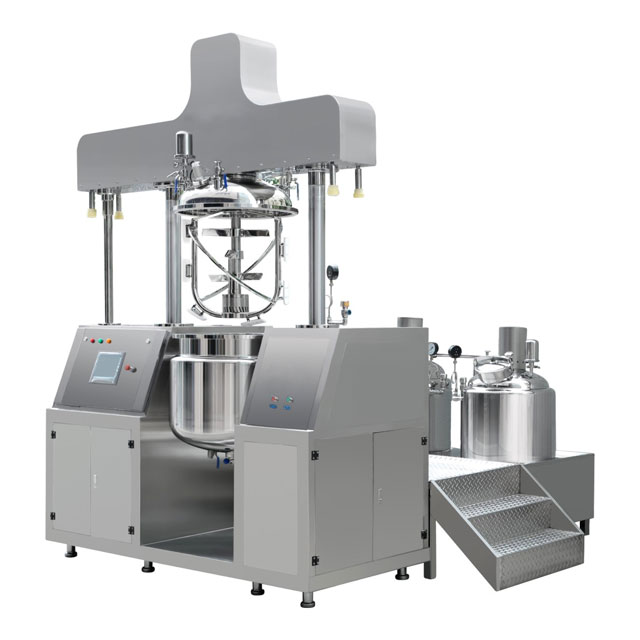
Hydraulic Lifting Vacuum Homogenizer
Usually used for 30L-500L mixing volume
Homogenizer Mixer Machine
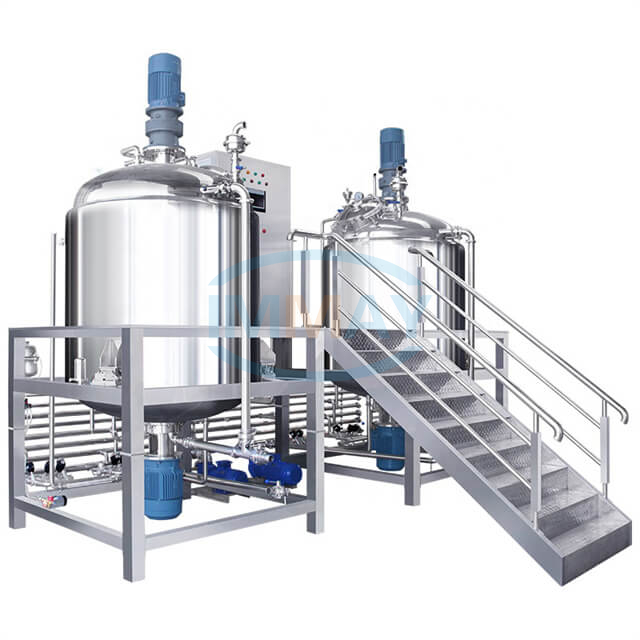
Vacuum Emulsifying Mixer
Usually used for 200L-10000L mixing volume
 
Mixing + Homogenization = IMMAY COMMIX
IMMAY COMMIX system technology sets the standard for high-quality product production! Our innovative mixing and homogenization solutions cover the full spectrum from lab research to large-scale cream production, providing unmatched production efficiency and product quality across various industries.

In industries like cosmetics, pharmaceuticals, chemicals, and food, vacuum processing technology is essential. It allows for the creation of diverse product lines. Whether it's lightweight emulsions, rich gels, or fluid products with varying viscosities, IMMAY’s vacuum mixer unit can adapt to different production environments, meeting diverse needs from bulk industrial production to custom small batches.

While traditional production methods can theoretically manufacture these products, they often struggle to maintain consistent high quality within tight deadlines. The strength of IMMAY COMMIX lies in the synergy of its unique homogenizer and stirrer. This innovative combination not only optimizes the ointment production process but also ensures that every batch of products meets the highest quality standards.

The core advantage of IMMAY COMMIX lies in its flexibility and precision. It can adjust process parameters based on product characteristics and production requirements, ensuring product quality while improving production efficiency. This attention to detail and commitment to quality make IMMAY COMMIX the ultimate choice for producing high-end products in the cosmetics and pharmaceutical industries etc..

Through the IMMAY COMMIX system, manufacturers can achieve rapid product development and market responsiveness while ensuring consumers experience consistent and efficient products. That's what IMMAY COMMIX is all about—not just mixing and homogenization, but also a synonym for successful production.

Not sure which one suits you?

Have questions or need a quote? Reach out to our experts for a prompt response.
Model Effective
Capacity
Homogenizer Mixing Dimension
(mm)
Heating
(KW)
Limited
Vacuum
(Mpa)
Power
(KW)
Speed
(RPM)
Power
(KW)
Speed
(RPM)
Length
(mm)
Width
(mm)
Height
(mm)
Electric
heating
Steam
heating
IMA-5S1B 5L 0.37 0~3000 0.18 0~63 1260 540 1600/1850 5 2 -0.08
IMA-10S1B 10L 0.55~0.75 0~3000 0.37~0.55 0~63 1300 580 1600/1950 6 3 -0.08
IMA-30S1B 30L 1.1~2.2 0~3000 0.55~0.75 0~63 1800 1000 1750/2300 18 9 -0.08
IMA-50S1B 50L 2.2~3 0~3000 0.75~1.1 0~63 2430 1230 1850/2600 18  9 -0.08
IMA-100S1B 100L 3~5.5 0~3000 1.1~1.5 0~63 2800 1500 2000/2750 32 13 -0.08
IMA-200S1B 200L 4~7.5 0~3000 1.5~2.2 0~63 2800 1850 2300/3300 45 15 -0.08
IMA-300S1B 300L 5.5~7.5 0~3000 2.2~3 0~63 3000 1950 2400/3450 45 18 -0.08
IMA-500S1B 500L 7.5~11 0~3000 3~4 0~63 3300 2100 2750/3900 50 27 -0.08
IMA-1000S1B 1000L 11~15 0~3000 5.5~7.5 0~63 4200 3600 3250/4800 85 30 -0.08

Something You might want to know

Have questions or need a quote? Reach out to our experts for a prompt response.

  • What Is a Vacuum Emulsifying Mixer?

    A vacuum emulsifying mixer is an industrial processing machine used to manufacture creams, lotions, gels, ointments, toothpaste, mayonnaise, and other emulsified products. It combines high-shear homogenization, mechanical mixing, heating, cooling, and vacuum processing in a single system.
     
    The high-speed homogenizer breaks down oil droplets and solid particles into fine sizes, helping create a smooth and stable emulsion. At the same time, the mixing system continuously circulates materials within the vessel to ensure uniform distribution of ingredients.
     
    During production, the vacuum system removes air introduced during mixing, reducing bubbles in the final product and improving appearance, texture, and product stability.
     
    Vacuum emulsifying mixers are widely used in cosmetic, pharmaceutical, food, and chemical manufacturing processes where consistent product quality and fine emulsification are required.
     
    Depending on production requirements, the equipment can be configured as either a hydraulic lifting type or a fixed type, with working capacities ranging from laboratory-scale units to large industrial production systems.
  • Main Components of a Vacuum Emulsifying Mixer

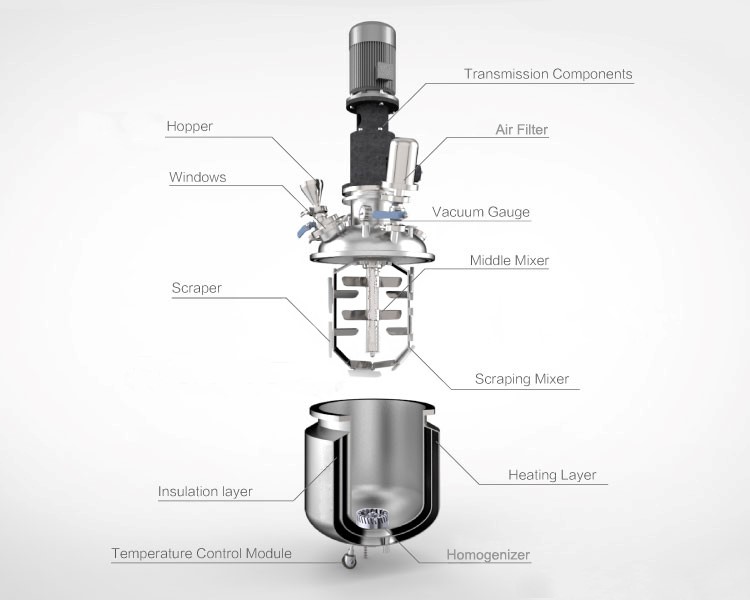
    A vacuum emulsifying mixer consists of several integrated components designed for heating, mixing, homogenizing, and vacuum processing.
     
    Main Emulsifying Tank
    The main vessel is manufactured from stainless steel and serves as the primary processing chamber. It is equipped with a heating and cooling jacket to control product temperature during emulsification.
     
    Bottom Homogenizer
    The high-speed homogenizer generates strong shear force to reduce particle size and create a uniform emulsion. It is particularly important for cream, lotion, gel, and ointment production.
     
    Anchor Mixing System
    The anchor agitator continuously scrapes and mixes materials along the tank wall, improving heat transfer efficiency and preventing product buildup.
     
    Vacuum System
    The vacuum unit removes air from the vessel during processing, helping reduce bubbles and improve product appearance and stability.
     
    Water Phase Tank and Oil Phase Tank
    These auxiliary tanks are used to preheat and prepare water-soluble and oil-soluble ingredients before transferring them into the main emulsifying tank.
     
    Electric Control Cabinet
    The control system manages mixing speed, homogenizer operation, temperature, vacuum level, and other processing parameters through a centralized interface.
  • How Does a Vacuum Emulsifying Mixer Work?

    A vacuum emulsifying mixer operates through a combination of heating, mixing, homogenization, and vacuum deaeration to produce uniform and stable products.
     
    Step 1: Material Preparation
    Water-soluble ingredients are prepared in the water phase tank, while oil-soluble ingredients are processed in the oil phase tank. Both phases can be heated to the required temperature before entering the main emulsifying vessel.
     
    Step 2: Materials Mixing
    After the materials are transferred into the main tank, the anchor agitator continuously mixes the product to ensure even circulation and heat distribution throughout the vessel.
     
    Step 3: High-Shear Homogenization
    The bottom homogenizer rotates at high speed to generate strong shear force, reducing droplet and particle size. This process helps create a fine and stable emulsion with a smooth texture.
     
    Step 4: Vacuum Deaeration
    After homogenization, the vacuum system removes air trapped in the product. This reduces bubbles and improves the appearance, consistency, and stability of the final product.
     
    Step 5: Cooling and Discharge
    After processing is completed, the product can be cooled through the jacket system and discharged for filling or further production steps.
     
    Through these integrated processes, a vacuum emulsifying mixer can efficiently produce creams, lotions, gels, ointments, toothpaste, and other emulsified products with consistent quality.
  • The Role of the Homogenizer in a Vacuum Emulsifying Mixer

    The homogenizer is one of the most important components of a vacuum emulsifying mixer. Its primary function is to reduce droplet and particle size, allowing different ingredients to be evenly distributed throughout the product.
     
    Using a high-speed rotor–stator structure, the homogenizer generates strong shear force that breaks down oil droplets, solid particles, and agglomerates into much finer sizes. This process is essential for producing smooth and stable emulsions.
     
    For products such as cosmetic creams, lotions, gels, ointments, toothpaste, and mayonnaise, effective homogenization helps improve texture, appearance, and product consistency. It also supports long-term stability by reducing the tendency of ingredients to separate during storage.
     
    The homogenizer works together with the mixing system and vacuum system to achieve uniform emulsification and dispersion. Through repeated circulation and high-shear processing, the final product can obtain a finer structure and a more consistent quality.
     
    The homogenizer speed can be adjusted according to product requirements, formulation characteristics, and the desired level of emulsification.
  • How to Choose the Right Vacuum Emulsifying Mixer?

    Choosing the right vacuum emulsifying mixer depends on several factors related to your product, production requirements, and factory conditions.
     
    1. Product Type
    Different products require different processing conditions. Creams, lotions, gels, ointments, toothpaste, and mayonnaise require different homogenization intensity, mixing speed, and heating configurations.
     
    2. Batch Size and Production Capacity
    Select the mixer capacity according to the required working volume and daily production output. Common capacities range from 50L to 5000L or larger for industrial production.
     
    3. Product Viscosity
    Higher-viscosity products generally require stronger mixing systems and higher homogenizer power to achieve efficient emulsification and uniform mixing.
     
    4. Heating Method
    Vacuum emulsifying mixers can be equipped with electric heating or steam heating systems. The appropriate option depends on factory utilities, production scale, and energy costs.
     
    5. Machine Configuration
    Customers can choose between hydraulic lifting and fixed-type designs according to cleaning requirements, production volume, and operational preferences.
     
    6. Factory Space and Installation Conditions
    Ceiling height, available floor space, and production line layout should be considered before equipment selection to ensure smooth installation and operation.
     
    7. Future Expansion Plans
    When planning equipment capacity, it is often beneficial to consider future production growth to avoid replacing equipment as demand increases.
  • Can Vacuum Emulsifying Mixers Be Customized?

    Yes, vacuum emulsifying mixers can be customized according to specific product formulations, production capacity requirements, and factory conditions.
     
    Common customization options include:
    Working Capacity
    The equipment can be designed with different working volumes, ranging from small laboratory and pilot-scale units to large industrial production systems.
     
    Heating Method
    Customers can choose electric heating or steam heating based on available utilities and production requirements.
     
    Mixing and Homogenizing Configuration
    Mixing speed, homogenizer power, and homogenizer design can be selected according to product viscosity and emulsification requirements.
     
    Control System
    The machine can be equipped with standard push-button controls, PLC systems with touchscreen controls for different levels of automation.
     
    Material Handling System
    Additional configurations such as vacuum powder feeding, transfer pumps, discharge pumps, and CIP cleaning systems can be integrated into the equipment.
     
    Electrical Standards
    Voltage, frequency, and electrical components can be configured to meet local factory standards.
     
    By selecting the appropriate configuration, the vacuum emulsifying mixer can be adapted to a wide range of cosmetic, pharmaceutical, food, and chemical manufacturing applications.
     
  • How Much Does a Vacuum Emulsifying Mixer Cost?

    The price of a vacuum emulsifying mixer depends on factors such as working capacity, machine configuration, automation level, and customization requirements.
    As a general reference:

    Working Capacity Price Range
    50L–100L $5,000–18,000
    200L–500L $18,000–35,000
    1000L–2000L $35,000–120,000
    3000L–5000L+ Custom Quotation
    *Actual prices vary depending on technical specifications and optional features.
     
    Factors That Affect Vacuum Emulsifying Mixer Price
    Production Capacity
    Larger working volumes require larger vessels, stronger frames, higher-power motors, and more robust vacuum systems, which increase equipment cost.
     
    Heating System
    Electric heating and steam heating systems have different installation requirements and costs.
     
    Homogenizer Configuration
    Homogenizer power, speed, and design specifications significantly influence the final equipment price.
     
    Automation Level
    Machines can be configured with standard button controls, PLC systems with touchscreen controls, recipe management functions, and other automation features.
     
    Additional Options
    Optional systems such as vacuum powder feeding, CIP cleaning, transfer pumps, load cells, and automated ingredient dosing can further affect pricing.
     
    How to Get an Accurate Quotation
    To receive an accurate quotation, you should provide information about:
    ·Product type
    ·Batch size
    ·Required working volume
    ·Product viscosity
    ·Heating requirements
    ·Factory utilities (electricity and steam availability)
    ·Preferred automation level
     
    Based on these requirements, the most suitable machine configuration and quotation can be provided.

  • Why Choose IMMAY Vacuum Emulsifying Mixers?

    Efficient Emulsification
    High shear homogenization technology helps achieve fine particle dispersion and stable emulsions for creams, lotions, gels, and similar products.
     
    Flexible Equipment Configurations
    Different production processes require different equipment designs. IMMAY offers multiple vessel capacities, homogenizer arrangements, heating methods, and automation options to meet various manufacturing requirements.
     
    Vacuum Deaeration for Improved Product Quality
    The vacuum system helps remove entrapped air and foam generated during mixing and homogenization. Effective deaeration contributes to a smoother product appearance, improved filling performance, and better stability of the final formulation.
     
    Hygienic Stainless Steel Construction
    Product-contact parts are manufactured from high quality stainless steel and designed according to sanitary production requirements.
     
    Integrated Heating and Cooling Functions
    The jacketed tank structure supports controlled heating and cooling, allowing greater flexibility for different production processes.
     
    Technical Support from Equipment Selection to Installation
    IMMAY provides equipment consultation, process recommendations, installation guidance, and after-sales technical support to help you implement suitable production solutions.
  • Applications of Vacuum Emulsifying Mixers

    Vacuum emulsifying mixers are widely used in industries that require the production of stable emulsions, creams, gels, and high-viscosity formulations. The equipment combines mixing, homogenization, heating, cooling, and vacuum deaeration in a single system.
     
    Cosmetic Products
    Vacuum emulsifying mixers are commonly used in cosmetic manufacturing for products that require smooth texture and uniform ingredient distribution, including:
    · Face creams
    · Moisturizing creams
    · Body lotions
    · Sunscreen creams
    · Hair conditioners
    · Facial masks
    · Cosmetic gels
     
    Personal Care Products
    Many personal care formulations require effective mixing and homogenization to achieve consistent product quality.
     
    Common products include:
    · Shampoo concentrates
    · Shower gels
    · Hand creams
    · Liquid soaps
    · Hair treatment products

    Pharmaceutical Products
    In pharmaceutical production, vacuum emulsifying mixers are used for semi-solid formulations that require controlled processing conditions.
     
    Common applications include:
    · Ointments
    · Creams
    · Medicated gels
    · Topical emulsions

    Food and Related Products
    For suitable food-grade configurations, the equipment can be used in the production of products such as:
    · Mayonnaise
    · Salad dressings
    · Sauces
    · Cream-based food products

    Chemical Products
    The system is also suitable for various industrial and daily chemical formulations, including:
    · Detergent concentrates
    · Cleaning creams
    · Polishing compounds
    · Specialty emulsions
  • Key Factors Affecting Emulsification Quality

    The quality of an emulsion depends not only on the equipment itself but also on several processing parameters. Proper control of these factors helps achieve better product texture, stability, and production efficiency.
     
    1. Homogenization Speed
    The homogenizer plays a critical role in reducing particle and droplet size. Appropriate homogenization speed helps achieve finer dispersion and more uniform emulsification. Excessively low or high speeds may affect product quality.
     
    2. Processing Temperature
    Temperature influences material viscosity, ingredient solubility, and emulsification efficiency. Proper temperature control helps ensure stable processing conditions and consistent product characteristics.
     
    3. Vacuum Deaeration Performance
    The vacuum system helps remove entrapped air and foam generated during mixing and homogenization. Effective deaeration contributes to a smoother product appearance, improved filling performance, and enhanced formulation stability.
     
    4. Material Addition Sequence
    The order in which ingredients are introduced into the vessel can affect emulsification efficiency and product consistency. Following an appropriate addition sequence helps improve process stability.
     
    5. Processing Time
    Sufficient mixing and homogenization time allows materials to be properly dispersed and emulsified. Processing time should be adjusted according to formulation requirements and batch size.
     
    6. Product Viscosity
    Different viscosity ranges require different mixing and homogenization conditions. Equipment configuration and operating parameters should be selected according to the characteristics of the product being manufactured.
     
    7. Equipment Configuration
    Factors such as homogenizer design, agitator type, heating method, and vessel structure can influence overall processing performance and final product quality.

Cream And Liquid Processing Equipment Manufacturer

 
As a leading manufacturer of cream and liquid processing equipments, we have developed a variety of machines, including reverse osmosis water treatment equipment, vacuum homogenizer mixer, lqiuid mixing tank, stainless steel storage tank, filling machine, capping machine, packaging machine and labeling machine..
 
IMMAY has rich experience and professionalism, and we are committed to solving the mixing needs of different products.

Industries We Serve

Vacuum Emulsifier Homogenizer mixers are widely used to make cream, ointment, lotion, and emulsion in cosmetic, pharmaceutical, food and chemical industries.

Get in Touch

We are available 24/7 by fax, e-mail or by phone. You can also use our quick contact form to ask a question about our services. We would be pleased to answer your questions.
阿斯达是===sBUfVmAYJTzZ
nPAfKrhvMonO hufsqkGNEYAM
Contact us
GET SOCIAL
PHONE
(0086)18936474568 ​​​​​​​
ADDRESS
No.107 Zhongxin Ave,Chengnan New District,Gaoyou,Jiangsu Province,China​​​​​​​
OPENING HOURS
work every day 9:00–17:00
IMMAY
Your World-Class CREAM/LIQUID PROCESSING SOLUTION Provider and Equipment Manufacturer
Leave a Message
Contact us