-
A vacuum emulsifying mixer is a type of industrial mixing equipment used to produce stable emulsions and uniform mixtures by combining high-shear homogenization with mechanical mixing under vacuum conditions.
It is primarily designed for processing liquid–liquid systems and liquid–powder mixing processes, where powders need to be dispersed into a liquid phase to form a consistent and uniform product.
During operation, the high-shear homogenizer reduces droplet or particle size to achieve fine dispersion, while the vacuum system removes entrapped air after mixing, helping improve product smoothness and structural stability.
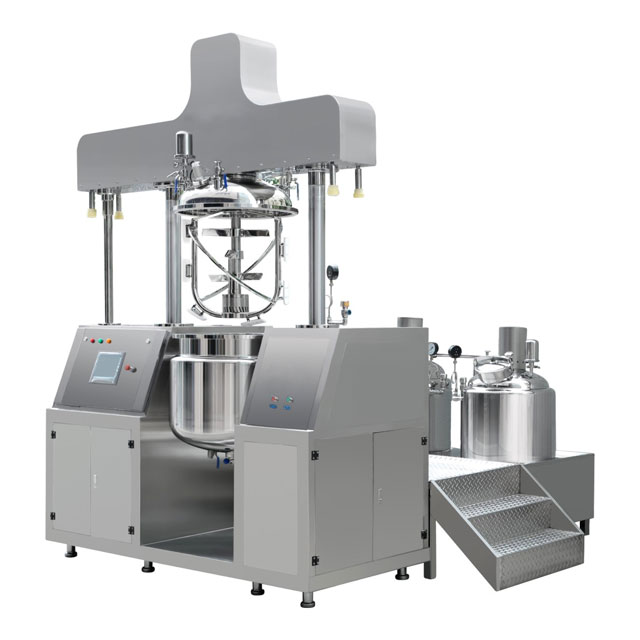
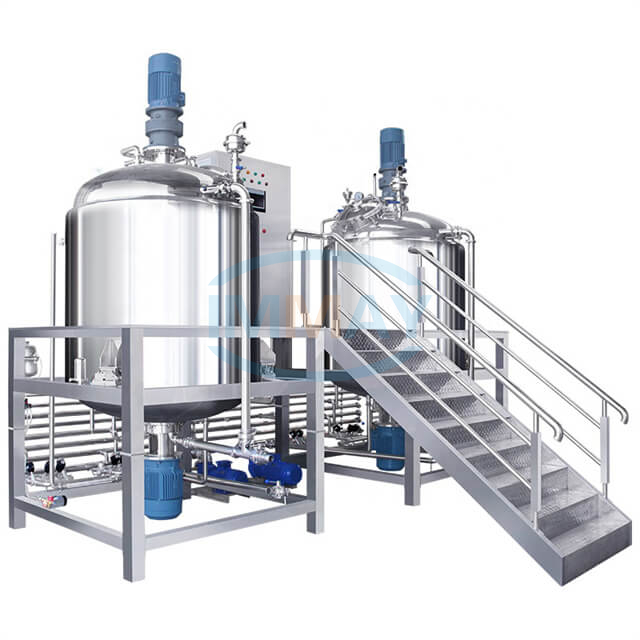
Vacuum emulsifying mixers are generally available in two structural types: hydraulic lifting type and fixed type. The lifting type is typically used for small to medium batch production, with capacities ranging from 30L to 500L, while the fixed type is designed for larger-scale production, with capacities from 200L up to 10,000L.
This type of equipment is widely used in the production of creams, lotions, gels, foundation, toothpaste, ointments, and mayonnaise.
-
A vacuum emulsifying mixer works by combining mechanical mixing with high-shear homogenization to process multi-phase materials into a uniform and stable system.
During operation, different phases such as oil and water are gradually combined under controlled mixing conditions. The high-shear homogenization step plays a key role by reducing droplet or particle size, allowing the components to be evenly distributed throughout the system and supporting the formation of a stable emulsion.
In liquid–powder mixing processes, powders are added into the liquid phase in a controlled manner. The subsequent mixing and high-shear action help break down agglomerates and ensure that solid particles are evenly dispersed within the mixture.
After the mixing and homogenization stages, vacuum is applied to remove entrapped air from the product. This step helps improve the smoothness of the final product and contributes to more consistent structural stability during storage.
Through this process, the system is able to produce materials with uniform consistency and stable performance across different applications.
-
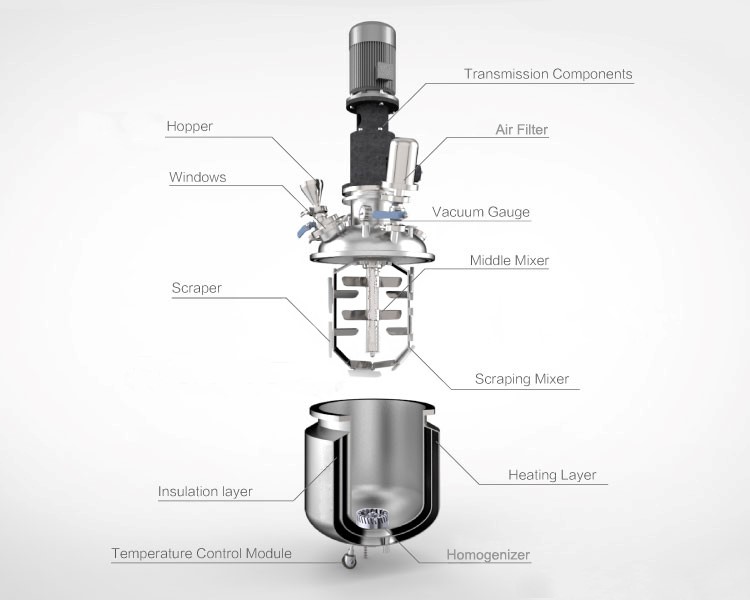
The vacuum emulsifying mixer is built around a vacuum-resistant stainless steel mixing vessel equipped with a heating and cooling jacket, which allows precise temperature control during the production process.
The complete system integrates multiple functional units, including an electric control system, hydraulic lifting system, mixing system, vacuum system, and temperature control system. It is also equipped with auxiliary units such as an oil phase tank and a water phase tank to support pre-dispersion of different materials.
All operations are managed through a centralized control panel, which allows operators to control key functions such as heating, vacuum, and mixing in a coordinated manner.
-
The high shear homogenizer plays a central role in a vacuum emulsifying mixer by reducing droplet or particle size and ensuring uniform distribution of different phases within the formulation.
It operates based on a rotor–stator structure. As the rotor rotates at high speed, materials are forced through the narrow gap between the rotor and stator, where they are subjected to intense shear, turbulence, and mechanical forces. This process breaks down larger droplets or agglomerates into finer particles, allowing immiscible phases such as oil and water to form a stable and uniform emulsion.
Through continuous circulation and repeated shear action, the homogenizer helps improve product consistency and supports the formation of a finer internal structure, which contributes to overall stability.
In vacuum emulsifying mixers, the high shear homogenizer is typically operated within a speed range of 0–3000 rpm. The speed can be adjusted according to process requirements to achieve the desired level of emulsification and dispersion.
-
Selecting a suitable vacuum emulsifying mixer requires evaluating several key factors related to production requirements and installation conditions.
1. Production capacity
Required output is a primary factor in determining the appropriate equipment size. The mixer capacity should be selected based on batch size and daily production targets. For small to medium-scale production, lifting-type machines are commonly used, typically ranging from 30L to 500L. For larger-scale production, fixed-type systems are more suitable, with capacities ranging from 500L to 5000L or higher.
2. Factory layout and space constraints
The available installation space will influence the equipment design and configuration. Factors such as ceiling height, floor area, and material flow direction should be considered to ensure the mixer can be properly installed and integrated into the production line.
3. Power supply requirements
The equipment must be compatible with local electrical standards, including voltage and frequency. Ensuring proper power supply specifications is necessary for stable operation and system reliability.
-
Yes, vacuum emulsifying mixers can be customized to meet specific production requirements, as different formulations and processes often require variations in equipment configuration.
Customization is typically based on factors such as product type, viscosity, batch size, and process conditions. For example, formulations with higher viscosity or complex phase structures may require different mixing configurations.
Common customization options include working volume, heating method (such as electric heating or steam heating), control system configuration and mixing system design. These parameters can be adjusted to match the specific needs of the production process.
By aligning the equipment configuration with actual application requirements, the mixing process can achieve more consistent results and better process stability.
-
IMMAY is a manufacturer specializing in industrial mixing equipment for cosmetic, pharmaceutical, and daily chemical production. With experience in process-oriented equipment design, our vacuum emulsifying mixers are developed to support stable and efficient production conditions.
Compared with conventional mixing equipment, vacuum emulsifying mixers offer several key advantages in processing performance and product consistency.
1. Consistent and stable mixing performance
The combination of high-shear homogenization and mechanical agitation ensures uniform distribution of liquid and solid phases, helping achieve consistent batch quality.
2. Improved emulsification efficiency
The high-speed rotor–stator system reduces particle and droplet size efficiently, supporting faster emulsification and better process efficiency.
3. Effective air removal under vacuum conditions
The vacuum system removes entrapped air during and after processing, helping improve product smoothness and structural stability.
4. Enhanced product texture and stability
Fine dispersion of materials contributes to improved texture, consistency, and long-term stability of the final formulation.
5. Hygienic and process-oriented design
The equipment is designed with sanitary production requirements in mind, making it suitable for applications in cosmetics, pharmaceuticals, and food-related formulations.
6. Wide application range
It is suitable for producing creams, lotions, gels, toothpaste, ointments, and other similar semi-solid or emulsion-based products.
7. Easy operation and maintenance
The system is designed for stable operation and convenient maintenance, helping support continuous production efficiency.
-
The price of a vacuum emulsifying mixer varies depending on technical configuration, production capacity, and customization requirements. In general, the cost can range from several thousand dollars for small-scale equipment to tens of thousands of dollars for large industrial systems.
Several factors influence the final price of the equipment. The most important factor is production capacity, as larger volume systems require stronger structural design and higher-power components. In addition, the level of automation, mixing system design, heating and cooling method, and control system type can also affect the overall cost.
Since vacuum emulsifying mixers are often customized according to different production processes, final pricing is usually determined based on specific technical requirements rather than a fixed standard model.
IMMAY provides customized vacuum emulsifying mixer solutions based on application needs, helping users select suitable configurations according to their production scale and process requirements.
-
Proper operation of a vacuum emulsifying mixer is essential to ensure stable performance, safe working conditions, and consistent product quality. The following precautions should be observed during operation.
1. Pre-operation inspection
Before starting the equipment, check that all components are correctly installed and in proper working condition. Ensure the mixing system, vacuum system, and control functions are ready for operation.
2. Operator preparation
Operators should be familiar with the equipment manual before use. Appropriate protective equipment such as gloves and workwear should be worn depending on the production environment.
3. Controlled material loading
Materials should be added according to the designed batch capacity. Overloading the system may affect mixing efficiency and equipment stability.
4. Process parameter control
Mixing speed and operating parameters should be adjusted according to material properties and process requirements to ensure stable emulsification and dispersion performance.
5. Vacuum system monitoring
During operation, vacuum levels should be monitored to ensure stable conditions, which helps improve product consistency and reduce entrapped air in the mixture.
6. Safe operation practices
All operational procedures should be followed strictly to ensure safe equipment use and prevent operational risks during production.
7. Cleaning and post-operation handling
After each production cycle, the equipment should be properly cleaned and prepared for the next batch to maintain stable long-term performance.
-
The operation process of a vacuum emulsifying mixer may vary depending on the specific model, but the general working procedure follows a standard sequence of preparation, parameter setting, mixing, and discharge.
1. Preparation
Before operation, ensure that all required raw materials are prepared according to the production formula. The equipment should be properly cleaned and ready for use.
2. Parameter setting
Start the system and set key process parameters such as mixing speed, homogenization speed, and temperature according to the product requirements.
3. Material feeding
Add materials into the mixing vessel in the required sequence based on the formulation design. Ensure that the feeding process follows the correct batch ratio.
4. Mixing and homogenization
Activate the mixing and high-shear homogenization system to process the materials. The combination of mechanical mixing and rotor–stator shear helps achieve uniform dispersion of components and stable emulsification.
5. Vacuum operation and process control
Apply vacuum conditions during or after mixing to remove entrapped air from the product. Process parameters such as temperature and vacuum level should be maintained within the required range throughout the operation.
6. Discharge
After the process is completed, the vacuum condition should be released and the system returned to atmospheric pressure. Once pressure is stabilized, the finished product can be discharged from the mixing vessel for further storage or downstream processing.