- Home
- Equipment
- Industries
- We Immay
- Resource
- Contact
Author: Site Editor Publish Time: 2026-02-15 Origin: Site
Producing cosmetic creams is a complex process that involves more than simply combining oil and water. These products are structured emulsions, where two immiscible phases should be carefully integrated to create a stable internal network. Achieving the desired texture, viscosity, and sensory performance requires precise control over droplet size, phase distribution, and rheological properties throughout the entire manufacturing process.
Conventional mixing methods are often insufficient for cosmetic cream production. While they can move bulk material and distribute ingredients on a macro scale, they do not provide the localized shear necessary to break down droplets or create a uniform emulsion. As a result, creams mixed this way may exhibit inconsistent texture, uneven distribution of active ingredients, and reduced long-term stability.
High shear mixing technology addresses these challenges by delivering intense mechanical energy in a controlled and precise manner. Through rotor–stator mechanisms, high shear mixers can produce fine and uniform droplets, optimize emulsion structure, and ensure that active ingredients are evenly dispersed. This enables manufacturers to consistently produce cosmetic creams with superior texture, stability, and performance, meeting both industrial production standards and consumer expectations.
Cosmetic creams are not simple blended liquids. They are structured emulsified systems in which two immiscible phases are mechanically organized into a stable arrangement. The internal architecture formed during mixing directly determines texture, stability, and functional performance.
Most cosmetic creams are designed either as Oil-in-Water (O/W) systems, where oil droplets are dispersed within a continuous water phase, or Water-in-Oil (W/O) systems, where water droplets are dispersed within a continuous oil phase. The choice between these two structures affects absorption behavior, sensory feel, occlusiveness, and compatibility with active ingredients. However, in both cases, the final product depends on controlled droplet formation rather than simple ingredient blending.
Droplet size is one of the most decisive structural parameters. Smaller and more uniformly distributed droplets increase interfacial area and improve physical stability. Fine droplet distribution contributes to smoother skin feel, improved spreadability, and more consistent appearance. Larger droplets, by contrast, tend to create uneven texture and reduce long-term stability.
Cream viscosity is not fixed at the start of production. It evolves throughout the emulsification process. During high shear mixing, droplets are progressively reduced in size, internal structures begin to form, and the system transitions from a fluid mixture into a structured semi-solid network. The rheological properties of the cream are therefore engineered during mixing rather than determined solely by formulation composition.
Traditional agitators primarily generate macro-level circulation inside the tank. Their function is to move bulk material and promote overall blending. While this circulation is necessary for uniform temperature distribution and ingredient incorporation, it does not generate sufficient localized shear force to break droplets into fine particles.
There is a critical difference between macro circulation and micro-scale droplet disruption. Macro circulation moves the phases through the vessel. Micro disruption, on the other hand, requires intense mechanical energy concentrated within a narrow zone to overcome interfacial tension and fragment dispersed droplets into smaller units.
When shear intensity is insufficient, the emulsion remains coarse. Droplet size distribution becomes broad and uneven. This leads to several structural weaknesses: inconsistent texture, reduced smoothness, and higher risk of phase separation over time. Even when emulsifiers are correctly selected, inadequate mechanical input can prevent the system from reaching its designed structure.
In industrial cream production, relying solely on conventional agitation often results in variability between batches. The absence of controlled high shear energy makes it difficult to achieve reproducible droplet size and stable rheological behavior.
High shear mixing transforms emulsification from a passive blending step into an active structural design process. By delivering controlled mechanical energy through a rotor–stator mechanism, the mixer generates intense velocity gradients within a confined gap. This environment forces the dispersed phase to undergo repeated deformation and fragmentation.
Controlled energy input is essential. Excessively low shear fails to create sufficient droplet refinement, while uncontrolled energy application can introduce instability or excessive heat buildup. Industrial high shear systems allow adjustment of speed, shear rate, and processing time to achieve a targeted droplet size distribution.
As droplets are broken into smaller units, the total interfacial area between phases expands significantly. This expansion allows emulsifiers to stabilize newly created surfaces more effectively, strengthening the internal structure of the cream. The result is a more cohesive and uniform system.
The formation of fine and uniformly distributed droplets is not merely a visual improvement. It defines the cream’s texture, flow behavior, sensory performance, and storage stability. In this sense, shear is not only a mechanical action—it is the primary tool for engineering the internal structure of cosmetic creams at industrial scale.
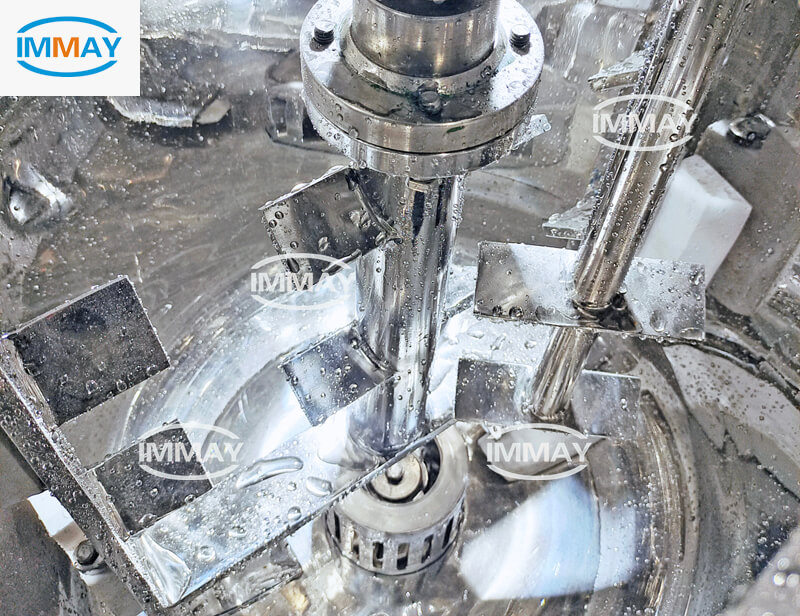
At the core of a high shear mixer used in cosmetic cream production is the rotor–stator assembly. This mechanism is specifically engineered to generate intense mechanical forces within a confined processing zone, allowing controlled droplet disruption and structural formation.
The rotor rotates at high speed inside a stationary stator. As the rotor spins, it draws material into the mixing head and accelerates it radially outward. The rapid rotation creates strong velocity gradients and localized turbulence. This is fundamentally different from conventional impeller mixing, which primarily moves bulk material without concentrating energy in a defined shear zone.
The narrow shear gap between the rotor and stator is critical. Within this small clearance, material experiences extremely high shear rates. As the dispersed phase passes through the gap, it is subjected to intense mechanical stress. The combination of shear, turbulence, and hydraulic forces stretches and deforms droplets, ultimately breaking them into smaller fragments.
Mechanical fragmentation of the dispersed phase occurs repeatedly as material circulates through the rotor–stator zone. Each pass further reduces droplet size and improves distribution uniformity. Over time, the system transitions from a coarse mixture into a fine and structured emulsion suitable for cosmetic cream applications.
The droplet size reduction process in cosmetic cream production is progressive rather than instantaneous. It develops through distinct stages that collectively determine the final emulsion structure.
The process begins with initial macro mixing. During this stage, oil and water phases are combined and distributed throughout the vessel. The goal is to create a preliminary dispersion in which one phase is broadly distributed within the other. At this point, droplet size is relatively large and uneven, and the system remains fluid.
As high shear is applied, progressive refinement begins. Droplets are repeatedly drawn into the rotor–stator zone, where they undergo deformation and fragmentation. Larger droplets are divided into smaller ones, and the size distribution becomes narrower. This refinement stage is where most structural transformation occurs.
In the final stage, structural stabilization takes place. Once the target droplet size range is reached, further high shear mixing ensures uniformity across the entire batch. Emulsifiers fully occupy the expanded interfacial area, helping stabilize the dispersed droplets. The system develops increased viscosity and begins to exhibit the rheological characteristics associated with finished cosmetic creams.
Shear rate directly influences the internal structure of cosmetic creams and, consequently, their sensory and functional properties. The mechanical energy applied during mixing determines how fine the droplets become and how the internal network develops.
As droplet size decreases under sufficient shear, the total interfacial area increases. This promotes stronger interactions within the system and contributes to viscosity development. The cosmetic cream gradually transforms from a fluid dispersion into a structured semi-solid with defined rheological behavior.
Flow behavior control is also closely tied to shear conditions. Properly engineered shear input leads to consistent droplet size distribution, which supports predictable flow characteristics during filling, packaging, and application. Inconsistent shear input may result in variations in thickness or instability during storage.
Smoothness and spreadability are ultimately structural outcomes. Fine and uniform droplets reduce perception of graininess and improve tactile performance on the skin. A well-controlled shear rate ensures that the cosmetic cream exhibits balanced firmness and ease of application. In industrial cosmetic cream manufacturing, managing shear rate is therefore essential not only for stability but also for achieving the intended texture and user experience.
Selecting a high shear mixer for cosmetic cream production requires evaluating both mechanical performance and process integration. The goal is not only to generate sufficient shear, but to ensure structural consistency, thermal control, and repeatable batch results at industrial scale.
Mixer speed directly determines shear intensity inside the rotor–stator zone. As motor speed increases, rotar speed rises, and the velocity gradient within the shear gap becomes stronger. This increase in mechanical energy enhances droplet deformation and fragmentation.
Shear intensity should be matched to the formulation requirements. Cream systems containing higher oil content, waxes, or structured emulsifiers often require stronger shear input to achieve adequate droplet refinement. However, excessively high speed without process control can generate unnecessary heat and disrupt structural balance.
Droplet size is closely linked to shear conditions. Higher shear rates generally produce smaller droplets and narrower size distribution, which contribute to improved stability and smoother texture. When evaluating a mixer, it is important to assess not only maximum speed but also speed adjustability, as different cream formulations may require different shear profiles during various production stages.
Batch capacity selection should be based primarily on current production requirements, while allowing reasonable headroom for future expansion. This approach ensures that the equipment operates within its intended working range under normal production conditions, while retaining flexibility to accommodate moderate increases in output.
Material selection is essential for cosmetic manufacturing environments. High-quality stainless steel, particularly grades suitable for hygienic processing, provides corrosion resistance and mechanical durability during long-term operation.
Cream formulations often contain water, oils, emulsifiers, and active ingredients that may challenge material stability. Stainless steel with appropriate composition helps maintain structural integrity and surface quality over time.
Hygienic surface finish is equally important. Smooth internal surfaces reduce material retention and support efficient processing. A properly finished interior surface helps maintain product consistency between batches and supports operational cleanliness standards within cosmetic production facilities.
High shear mixing in cosmetic cream production is combined with thermal and vacuum control. Integration with a jacketed heating and cooling system allows precise temperature management during emulsification and stabilization phases.
Heating supports melting of waxes and oil-phase components prior to emulsification. Controlled cooling after droplet refinement allows the internal structure of the cream to develop gradually, contributing to final viscosity and texture formation. Temperature precision is therefore directly linked to structural repeatability.
A vacuum deaeration system is also an important consideration. During high shear mixing, air may become entrained in the product. Vacuum integration helps remove trapped air, improving structural uniformity and surface appearance.
When selecting a high shear mixer for cosmetic creams, evaluating speed capability, tank volume, material construction, and system integration ensures that the equipment supports not only emulsification efficiency but also long-term production consistency.
High shear mixers play a central role across a wide range of cosmetic cream types. Their ability to generate uniform emulsions, fine droplet distribution, and stable viscosity makes them essential for producing creams with consistent texture, sensory performance, and long-term stability. Different cream formulations have distinct structural and functional requirements, and the mixing process should be tailored to meet these specifications.
Moisturizing creams are designed to hydrate and soften the skin by delivering water, humectants, and emollients in a stable emulsion. The smooth, spreadable texture that consumers expect relies on finely dispersed oil droplets and a consistent semi-solid network. High shear mixing ensures uniform incorporation of oil and water phases while reducing droplet size, which enhances the cream’s ability to retain moisture and maintain a pleasant skin feel. Controlled shear also allows for the gentle integration of sensitive active ingredients, such as glycerin or hyaluronic acid, without destabilizing the emulsion.
Anti-aging creams often include multiple active ingredients, such as peptides, antioxidants, or plant extracts, which should be evenly distributed throughout the product. High shear mixing is crucial for achieving a homogeneous dispersion of these ingredients at micro or nano-scale, ensuring consistent performance in each application. Additionally, the fine droplet structure produced by high shear mixers contributes to smoothness and absorption, enhancing the overall efficacy and consumer perception of the cream.
Sunscreen creams require uniform distribution of UV filters, which are typically oil-soluble compounds prone to aggregation. Uneven dispersion can reduce protection efficacy and affect texture. High shear mixers provide the energy necessary to break down particle clusters and maintain a stable emulsion, ensuring that both active ingredients and the base cream remain uniform. This results in consistent SPF performance, a smooth application, and minimal greasiness or streaking on the skin.
Functional treatment creams include products such as brightening, soothing, or acne-targeted formulations. These creams often combine multiple actives, pigments, or botanical extracts with specific rheological requirements. High shear mixing enables precise control over droplet size and phase distribution, which is critical for maintaining stability and achieving the desired functional effects. The process ensures that all components are fully integrated without phase separation, delivering reliable performance and a high-quality texture that meets consumer expectations.
In summary, producing high-quality cosmetic creams is not simply a matter of combining ingredients. The microstructure, droplet size, and rheological properties of an emulsion should be carefully engineered to achieve consistent texture, stability, and performance. High shear mixing technology plays a central role in this process, providing the precise mechanical energy needed to create fine, uniform droplets, optimize emulsion structure, and ensure even dispersion of active ingredients across all cream types.
By implementing high shear mixers, manufacturers can reliably produce creams that meet both industrial standards and consumer expectations, from moisturizers and anti-aging formulations to sunscreens and functional treatment products. The controlled application of shear transforms emulsification from a passive blending step into an active structural design process, ensuring reproducibility, smoothness, and optimal sensory characteristics.
For companies seeking to elevate their cosmetic cream production, consulting with experts at IMMAY can help optimize equipment selection, processing parameters, and overall workflow. Leveraging IMMAY’s high shear mixing solutions enables consistent, scalable, and high-quality manufacturing, ensuring that every batch of cream delivers the desired performance and meets the expectations of today’s demanding market.
Contact IMMAY today to optimize your cosmetic cream production with our high shear mixers.