- Home
- Equipment
- Industries
- We Immay
- Resource
- Contact
Author: Site Editor Publish Time: 2025-12-11 Origin: Site
As a professional manufacturer of cosmetic emulsion mixers, IMMAY understands that cosmetic emulsions are among the most widely used dosage forms in modern skincare, combining water and oil phases to deliver hydration, moisturization, and active ingredients effectively. The performance, texture, and stability of every emulsion product depend not only on formulation but also on precise control of the production process.
Understanding the differences between O/W (Oil-in-Water) and W/O (Water-in-Oil) emulsions is essential for cosmetic manufacturers. These two emulsion types differ in phase composition, emulsifier selection, texture, and functional properties, which in turn influence product feel, absorption rate, and shelf-life. Manufacturers must carefully consider these factors to ensure consistent quality, prevent phase separation, and meet consumer expectations.
This guide explores the structural differences, formulation characteristics, applications, and production considerations for O/W and W/O cosmetic emulsions. By understanding these principles, cosmetic manufacturers can make informed decisions about formulation and process parameters, ensuring their products deliver the desired performance and consumer experience.
Cosmetic emulsions are among the most common dosage forms in modern skincare products. They combine the benefits of both water and oil phases, providing hydration, moisturization, and an effective delivery system for active ingredients. In industrial production, a thorough understanding of emulsions is essential for scientific formulation, proper equipment selection, and process optimization, ensuring product stability, texture, and performance.
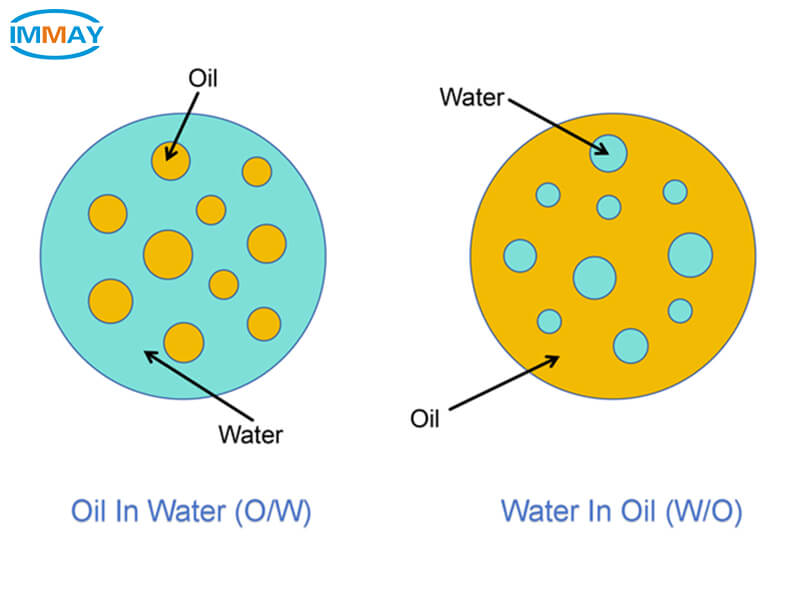
An emulsion is a dispersed system composed of two immiscible liquids, where one liquid is dispersed as microscopic droplets within the continuous phase of the other liquid. In cosmetics, these two phases are typically water and oil. Based on the continuous and dispersed phases, emulsions can be classified into two main types:
O/W (Oil-in-Water) Emulsion: Oil droplets dispersed in the water phase, with water as the continuous phase
W/O (Water-in-Oil) Emulsion: Water droplets dispersed in the oil phase, with oil as the continuous phase
Hydration and Moisturization
The water phase provides immediate hydration to the skin
The oil phase forms a protective layer, reducing water evaporation and prolonging moisturization
Carrier for Active Ingredients
Emulsions can dissolve and distribute both water-soluble and oil-soluble active ingredients
Ensures uniform concentration throughout the product for consistent performance in every application
Improved Skin Feel
Proper water-oil ratio adjusts the texture from light and fast-absorbing to rich and protective
O/W emulsions: typically lightweight, fast-absorbing
W/O emulsions: typically thicker, richer, with stronger occlusive properties
Enhanced Product Stability and Appearance
Proper emulsifier choice and dispersion system prevent phase separation, sedimentation, or formulation failure
Smooth and uniform appearance enhances consumer perception and experience
Hand Creams: Often O/W emulsions, lightweight and fast-absorbing for daily use
Face Creams: Can be O/W or W/O depending on the desired moisturization and richness
Lotions: Typically high water content, light texture for everyday skincare
Sunscreens: Mostly O/W emulsions, allowing quick absorption and even application
Oil-in-water (O/W) emulsions are a type of cosmetic formulation in which microscopic oil droplets are uniformly dispersed within a continuous water phase. This structure allows the product to feel light and hydrating, making it suitable for everyday skincare. The water phase serves as the main carrier for active ingredients, while the oil droplets provide essential lipids that enhance skin barrier function and moisture retention.
Key structural features
Dispersed oil phase: Micron-sized droplets evenly distributed in water
Continuous water phase: Provides hydration, facilitates delivery of water-soluble actives
Stability mechanisms: Emulsifiers with high Hydrophilic-Lipophilic Balance (HLB) stabilize the interface, preventing coalescence of oil droplets
O/W emulsions typically contain 50–80% water phase and 5–40% oil phase, depending on the product type and desired skin feel. Their formulation is optimized to be lightweight, quickly absorbed, and suitable for daily skincare routines.
Formulation insights
Water phase: High proportion of water ensures hydration, supports solubilization of water-soluble actives, and influences viscosity
Oil phase: Contains emollients and lipophilic actives that enhance skin barrier function, typically in smaller amounts than the water phase
Emulsifiers: High HLB (hydrophilic) surfactants are used to stabilize the oil droplets in water
Thickeners and stabilizers: Polymers or gums may be added to adjust viscosity, improve texture, and enhance shelf stability
O/W emulsions are widely used in products where a lightweight, fast-absorbing texture is desired. Their applications include:
Daily moisturizers and body lotions: Hydrating without greasiness
Hand creams and facial creams: Easily absorbed while maintaining skin softness
Sunscreens: Smooth application with water-continuous base for even UV filter distribution
Baby skincare products: Gentle, non-greasy, and mild formulations
Water-in-oil (W/O) emulsions are a type of cosmetic formulation in which microscopic water droplets are uniformly dispersed within a continuous oil phase. This structure allows the product to feel rich, protective, and long-lasting on the skin, making it suitable for high-moisturization or water-resistant products. The oil phase serves as the main carrier, providing an occlusive barrier that locks in moisture, while the water droplets deliver hydration and water-soluble actives.
Key structural features
Dispersed water phase: Micron-sized droplets evenly suspended in oil
Continuous oil phase: Provides a protective, occlusive layer on the skin and supports delivery of oil-soluble actives
Stability mechanisms: Emulsifiers with low Hydrophilic-Lipophilic Balance (HLB) stabilize the interface, preventing coalescence of water droplets and phase separation
3.2 Formulation Characteristics of W/O Emulsions
W/O emulsions typically contain 50–90% oil phase and 10–50% water phase, depending on product type and desired richness. Their formulation is optimized to provide a protective, moisturizing layer on the skin, ideal for formulations that need prolonged hydration or water resistance.
Formulation insights
Oil phase: High proportion ensures thick, occlusive texture, improves skin barrier protection, and carries oil-soluble active ingredients
Water phase: Provides hydration and supports water-soluble actives but is present in smaller amounts than oil
Emulsifiers: Low HLB (lipophilic) surfactants are used to stabilize water droplets in oil
Thickeners and stabilizers: Waxes, gums, or polymers may be added to enhance texture, viscosity, and long-term stability
W/O emulsions are typically used in products where a rich, protective, and long-lasting skin feel is required. Their applications include:
High-moisturization creams and ointments: Provide deep hydration and skin barrier protection
Protective hand creams and body balms: Maintain skin softness in harsh or dry environments
Water-resistant sunscreens and sunblocks: Thick, occlusive texture resists sweat and water
Lip balms and medicated ointments: Occlusive barrier locks in moisture and active ingredients
Feature | O/W Emulsion (Oil-in-Water) | W/O Emulsion (Water-in-Oil) |
Continuous Phase | Water | Oil |
Dispersed Phase | Oil droplets | Water droplets |
Water Phase Proportion | 50–80% | 10–50% |
Oil Phase Proportion | 5–40% | 50–90% |
Emulsifier Type | High HLB (hydrophilic) | Low HLB (lipophilic) |
Texture | Light, fast-absorbing | Thick, rich, occlusive |
Industrial Equipment | Vacuum emulsifying mixer for cosmetic emulsions | Vacuum emulsifying mixer for cosmetic emulsions |
Applications | Daily moisturizers, hand creams, light sunscreens | Protective creams, water-resistant sunscreens, lip balms |
Stability Considerations | Sensitive to pH, electrolytes | More resistant to water and storage conditions |
Producing O/W (Oil-in-Water) and W/O (Water-in-Oil) cosmetic emulsions requires tailored process control, as their formulations, physical properties, and stability characteristics differ significantly. Understanding these differences ensures consistent texture, long shelf-life, and optimal product performance.
O/W emulsions: Water is the continuous phase (50–80%), oil is dispersed (5–40%). High water content supports hydration and makes the emulsion lightweight and fast-absorbing. High HLB (hydrophilic) emulsifiers stabilize the oil droplets.
W/O emulsions: Oil is the continuous phase (50–90%), water is dispersed (10–50%). This creates a thicker, more occlusive texture. Low HLB (lipophilic) emulsifiers stabilize the water droplets.
O/W emulsions
Moderate heating of both the oil and water phases is generally sufficient to reduce viscosity and facilitate droplet dispersion in the continuous aqueous phase. Elevated temperatures can improve droplet breakup and reduce average droplet size; however, excessive heat may compromise heat‑sensitive ingredients or alter emulsifier behavior, leading to destabilization.
W/O emulsions
For W/O systems, careful temperature control is also essential. Heating the oil phase can reduce viscosity, supporting proper dispersion of water droplets within the continuous oil phase. At elevated temperatures, changes in interfacial behavior may occur, which can either stabilize or destabilize the emulsion depending on the emulsifier and formulation. Therefore, precise temperature control during mixing and emulsification is crucial to avoid coalescence or phase inversion.
O/W emulsions
Apply controlled, moderate shear to uniformly disperse oil droplets within the continuous water phase. Both the strength and duration of shear affect droplet size: too low shear results in large droplets and unstable products, while excessive shear or prolonged shearing may induce heat and foam, undermining emulsion stability.
W/O emulsions
For W/O systems, the emulsification process must deliver sufficient energy to disperse water droplets uniformly within the oil phase. It is not simply about increasing shear magnitude; rather, a balance of shear intensity and exposure time is needed. Excessive shear or overly long emulsification can disrupt droplet integrity, increase coalescence, and compromise stability.
For both O/W and W/O emulsions, vacuum deaeration is applied after emulsification to remove entrapped air for improving product smoothness.
The distinction between O/W and W/O cosmetic emulsions extends beyond formulation—it directly impacts texture, stability, and consumer experience. O/W emulsions offer lightweight, fast-absorbing hydration, while W/O emulsions provide rich, occlusive protection. Understanding their differences and carefully managing phase ratios, temperature, shear, and vacuum deaeration are essential for high quality, consistent products.
Beyond understanding formulation and process variables, selecting the right equipment and optimizing process parameters are equally critical. IMMAY’s advanced vacuum emulsifying mixers for cosmetic emulsions empower manufacturers to achieve precise droplet distribution, efficient deaeration, and optimal emulsion stability, supporting both R&D and large-scale production.
By integrating scientific formulation with professional cosmetic emulsion mixer, cosmetic brands can consistently deliver products that meet consumer expectations for performance and luxury. Contact IMMAY today to explore customized cosmetic emulsion mixing machines that elevate your emulsion production and ensure your skincare products achieve their full potential.