- Home
- Equipment
- Industries
- We Immay
- Resource
- Contact
Author: Site Editor Publish Time: 2026-02-11 Origin: Site


Industrial emulsification is not simply a matter of blending ingredients together. In industrial production, oil and water phases do not combine just because they are placed in the same tank. Common mechanical agitation alone cannot overcome the physical forces that keep immiscible liquids separated. True emulsification requires the deliberate creation of a dispersed droplet structure, controlled at the microscopic level, through sufficient energy input and interfacial stabilization. Without this structural transformation, what appears to be “mixed” is only temporarily combined and will eventually separate.
When emulsions fail in industrial settings, the cause is often attributed to raw material quality or emulsifier selection. While formulation factors do play a role, instability is frequently the result of unmet process conditions. Inadequate shear intensity, improper temperature control, insufficient interfacial tension reduction, or poor flow patterns inside the mixing vessel can all prevent the formation of a stable droplet network. In many cases, the formulation is theoretically sound, but the necessary physical and mechanical conditions for emulsification were not fully achieved during production.
Understanding emulsification, therefore, requires shifting the focus from ingredients alone to the conditions under which those ingredients are processed. Emulsion stability is not corrected after mixing; it is established during the moment droplets are formed and stabilized. The structure created during this stage determines whether the system remains uniform, resists coalescence, and maintains consistent performance over time.
This article systematically examines the necessary conditions for emulsification in industrial production. It analyzes the physical principles behind emulsion formation, outlines the mechanical and thermal requirements that must be satisfied, and explains how these conditions can be reliably achieved at large scale. By linking the science of emulsion formation with real production conditions, we can better understand what truly determines whether emulsification works consistently at an industrial scale.
Industrial emulsification begins with understanding what an emulsion truly is at a structural level. It is not simply a mixture of liquids, nor is it defined by visual uniformity. An industrial emulsion is a deliberately engineered system in which one immiscible liquid is dispersed into another in the form of microscopic droplets. Its performance, stability, and functionality depend on how this internal structure is created and maintained under controlled processing conditions.
Oil and water do not naturally dissolve into one another. Their molecular structures differ in polarity, which causes them to separate into distinct phases when combined. Even if mechanical agitation temporarily blends them, the system will quickly return to separation once the agitation stops.
The reason lies in interfacial tension. At the boundary between oil and water, molecular forces resist contact. This interfacial tension acts as a physical barrier that prevents spontaneous dispersion. To create an emulsion, external energy must be applied to break one liquid into fine droplets while simultaneously overcoming this interfacial resistance. Without sufficient energy input and interfacial stabilization, droplets will rapidly coalesce and the system will separate.
In industrial production, overcoming interfacial tension is not optional—it is the fundamental physical requirement for droplet formation.
An emulsion consists of two distinct structural components: the continuous phase and the dispersed phase. The continuous phase forms the surrounding matrix, while the dispersed phase exists as droplets distributed throughout that matrix.
This structural arrangement determines the type of emulsion, such as oil-in-water (O/W) or water-in-oil (W/O). The selection of continuous phase influences viscosity, flow behavior, sensory characteristics, and application performance. More importantly, the stability of the entire system depends on how uniformly the dispersed droplets are distributed within the continuous phase.
If droplets cluster, settle, or rise due to density differences, the structural integrity of the emulsion weakens. Therefore, emulsification is not only about forming droplets but about creating a stable spatial distribution that resists separation over time.
In industrial emulsification, the objective is not simply to mix two liquids—it is to generate a controlled droplet structure with defined characteristics. Droplet size and size distribution directly influence the physical stability of the emulsion.
Smaller droplets generally reduce the rate of gravitational separation and limit the likelihood of coalescence. However, uniformity is just as important as size. A narrow droplet size distribution indicates that mechanical energy has been applied consistently throughout the system. In contrast, a wide distribution often signals uneven shear conditions, localized over-processing, or insufficient energy density.
From a production perspective, droplet structure is the measurable outcome of whether emulsification conditions were properly achieved. Stability, texture, and long-term performance all originate from this microscopic architecture formed during the mixing stage.
Emulsification does not occur by chance. It is the result of specific physical and mechanical conditions being satisfied at the same time. If even one of these conditions is insufficient, droplet formation will be incomplete, interfacial stabilization will be weak, and long-term stability will be compromised. Understanding these core requirements is essential for achieving consistent results in industrial production.
An emulsion cannot form without external energy. Because oil and water naturally resist dispersion, mechanical force must be applied to deform and break one phase into fine droplets within the other.
Shear force plays a central role in this process. When liquid passes through high-velocity gradients—such as those generated by rotor–stator systems—intense shear stress stretches and fragments larger droplets into smaller ones. The efficiency of this breakup process depends on the energy density applied per unit volume. Higher energy density generally leads to smaller droplet sizes, provided that the system is properly stabilized.
Conventional low-speed agitation typically generates bulk circulation but not sufficient localized shear intensity. While it can blend ingredients visually, it cannot consistently overcome interfacial forces to produce fine and uniform droplets. As a result, the mixture may appear homogeneous during mixing but will separate over time. Stable emulsification requires controlled and concentrated mechanical energy, not just movement within the tank.
Even with strong mechanical input, droplets will rapidly merge if interfacial tension remains high. This is where emulsifiers become essential.
Emulsifiers function by migrating to the oil–water interface and forming a protective molecular layer around newly created droplets. This adsorption reduces interfacial tension and lowers the energy required to maintain droplet separation. In effect, emulsifiers stabilize the new surface area created during shear-induced breakup.
Without sufficient reduction in interfacial tension, droplets will coalesce immediately after formation. Mechanical energy alone cannot maintain stability. Successful emulsification therefore requires both droplet fragmentation and interfacial stabilization to occur simultaneously. These two mechanisms must operate in balance throughout the process.
The relative proportion of oil and water significantly influences emulsion structure. The ratio determines which phase becomes continuous and which becomes dispersed. Systems designed as oil-in-water behave differently from water-in-oil systems in terms of viscosity, flow behavior, and stability mechanisms.
In industrial production, the sequence of addition also affects droplet formation. Gradual incorporation of the dispersed phase under controlled shear promotes uniform droplet breakup and stabilization. Rapid or uncontrolled addition can overwhelm the system, leading to uneven droplet sizes or incomplete dispersion.
Phase ratio and feeding strategy are therefore structural variables, not minor operational details. They directly shape the internal architecture of the emulsion and influence whether the system develops into a stable configuration.
Temperature exerts multiple influences on emulsification. It affects viscosity, interfacial tension, and emulsifier activity simultaneously.
As temperature increases, viscosity typically decreases, allowing easier droplet deformation under shear. Lower viscosity can enhance droplet breakup efficiency. At the same time, temperature changes can alter interfacial tension and the solubility behavior of emulsifiers. If temperature is too low, dispersion may be inefficient. If too high, structural integrity or emulsifier performance may be compromised.
In industrial systems, precise thermal control ensures that mechanical energy is applied under optimal physical conditions. Temperature management is therefore not simply a heating step—it is a structural control parameter that directly impacts droplet formation and stabilization.
Mixing duration alone does not guarantee stability. Extending processing time without sufficient shear intensity does not improve droplet refinement. Emulsification depends more on energy distribution and flow dynamics than on elapsed time.
Effective systems generate controlled circulation patterns that continuously move material through high-shear zones. This ensures uniform exposure to mechanical forces across the entire batch. Without proper flow design, dead zones may form inside the vessel, where droplets remain larger or poorly stabilized. These localized inconsistencies can compromise the stability of the entire system.
Uniform flow patterns and adequate residence time within shear zones are therefore critical. Emulsification is achieved when the entire volume experiences consistent mechanical and interfacial conditions—not when the mixture has simply been agitated for a long period.
Together, these conditions define the operational framework required for reliable industrial emulsification. When mechanical energy, interfacial control, phase management, temperature regulation, and flow dynamics work in coordination, stable droplet structures can be consistently achieved.
Emulsification that performs well in a laboratory environment does not automatically translate to stable results in large-scale production. The transition from small test batches to industrial volumes introduces mechanical, thermal, and structural complexities that directly affect droplet formation and stability.
At larger scale, the physical environment inside the vessel changes. Energy distribution becomes less uniform, flow patterns become more difficult to control, and viscosity increases alter how shear forces interact with the material. Understanding these scale-dependent effects is essential for maintaining consistent emulsification in industrial manufacturing.
One of the most critical differences between laboratory and industrial production is energy density—the amount of mechanical energy delivered per unit volume.
In laboratory setups, small batch sizes allow high shear devices to apply concentrated energy throughout the entire system. The distance between the shear zone and the bulk material is minimal, making it easier to achieve uniform droplet breakup. As a result, fine and consistent droplet structures can often be achieved with relatively short processing times.
At industrial scale, however, batch volumes increase dramatically while energy input does not always increase proportionally. If mixing systems are not properly engineered, the effective energy per unit volume decreases. This reduction in energy density can lead to larger droplet sizes, broader size distributions, and weaker structural stability.
Maintaining consistent emulsification during scale-up therefore requires careful consideration of shear intensity, circulation efficiency, and system geometry. Simply enlarging the tank without redesigning the mixing mechanism often leads to compromised results.
Another challenge at industrial scale is the progressive increase in viscosity during emulsification.
As droplets become smaller and more uniformly distributed, the internal structure of the emulsion becomes more complex. In many formulations—such as creams, sauces, and semi-solid systems—viscosity rises significantly as the dispersed phase interacts with the continuous phase. Thickening agents, emulsifiers, and temperature changes can further amplify this effect.
Higher viscosity alters flow behavior inside the vessel. Shear forces become more difficult to transmit efficiently through the material, and circulation slows. In high-viscosity systems, localized shear zones may remain effective, but the overall batch may not pass through these zones frequently enough to ensure uniform droplet refinement.
Industrial equipment must therefore be capable of handling viscosity changes dynamically throughout the process. Systems that perform well with low-viscosity liquids may struggle as the product structure develops and resistance to flow increases.
In large-capacity tanks, achieving structural uniformity becomes more complex. Flow distribution inside the vessel is influenced by tank geometry, impeller design, and material properties.
Without proper circulation, certain regions—particularly near vessel walls, corners, or bottom surfaces—may receive less exposure to high shear zones. These boundary areas can contain larger droplets or partially processed material, which compromises overall stability. Even a small fraction of poorly emulsified material can affect texture, appearance, and long-term consistency.
Ensuring uniform droplet structure across large batches requires coordinated mixing strategies. Bulk agitation must continuously move material toward high-energy regions, while shear mechanisms must operate at sufficient intensity to refine droplets consistently throughout the entire volume.
For manufacturers evaluating mixing systems, these scale-related factors are highly relevant. Successful industrial emulsification depends not only on formulation and laboratory validation, but on whether production equipment can maintain energy density, manage viscosity changes, and ensure structural uniformity across every batch.
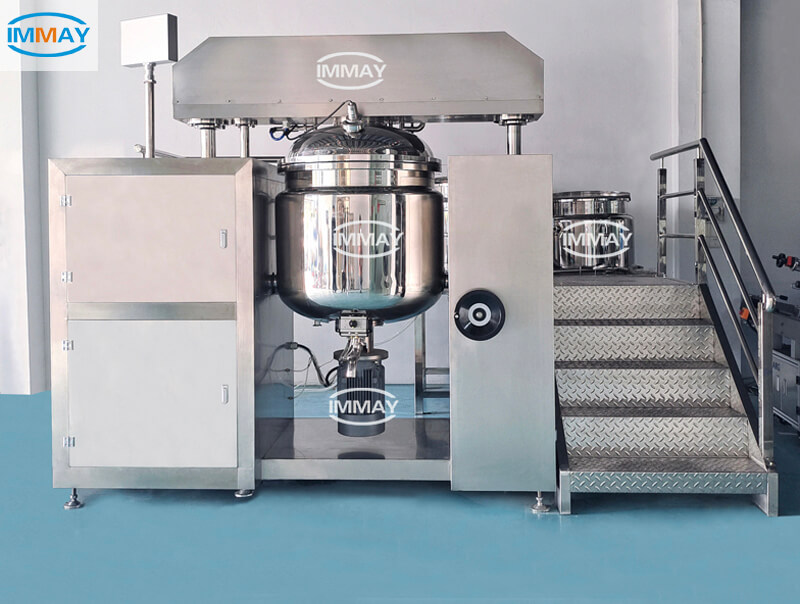
Industrial emulsification is not just about formulation—it is also about the equipment used to translate theory into consistent, reproducible results. Vacuum emulsifying mixer machines are specifically designed to create the conditions necessary for stable droplet formation and long-term emulsion stability. By combining precise mechanical action, thermal control, and vacuum management, these systems bridge the gap between laboratory science and large-scale production.
At the core of vacuum emulsifying mixers are high shear rotor–stator assemblies. These components generate intense localized shear forces that break larger droplets into uniformly fine particles. As material passes through the narrow gaps between the rotor and stator, energy density reaches levels sufficient to overcome interfacial tension and deform the dispersed phase efficiently.
The rotor–stator structure ensures that shear is concentrated where it is most effective, creating a controlled microenvironment for droplet formation. Unlike conventional agitators, which produce bulk flow without targeted energy zones, high shear rotors provide the precise mechanical input required to achieve consistent droplet size and distribution at industrial scale.
Vacuum is a key feature of these emulsifying systems, primarily used after emulsification to remove entrapped air and surface foam. Once droplets have been formed and the emulsion structure is established, applying vacuum helps collapse any foam or air pockets, ensuring a smooth, uniform product with consistent texture.
By reducing the internal pressure after mixing, vacuum accelerates the release of trapped gases without disrupting the delicate droplet structure. This step is particularly important for high-viscosity formulations or sensitive emulsions, where foam retention could affect appearance, stability, and downstream processing.
Temperature control is integral to achieving stable emulsions. Vacuum emulsifying mixer machines include a jacketed vessel that allows precise heating or cooling of the product during processing.
Heating can lower viscosity and reduce interfacial tension, making droplets easier to deform under shear. Cooling, on the other hand, can stabilize emulsions by solidifying structural components at the optimal stage. This integrated thermal management ensures that energy input and material properties are aligned throughout the mixing process, contributing directly to emulsion consistency.
For large industrial batches, achieving uniformity requires more than high shear at a single point. Vacuum emulsifying mixers incorporate frame-mounted scraping or wall-sweeping agitators that move material along vessel surfaces and prevent dead zones.
These agitation systems continuously circulate product from the walls and bottom into high shear regions, ensuring that every portion of the batch experiences sufficient mechanical input. By combining high shear action with controlled bulk flow, the mixing machine guarantees uniform droplet distribution and consistent emulsion stability, even in high-viscosity or large-volume formulations.
Together, the high shear rotor, vacuum environment, thermal control, and advanced agitation mechanisms make vacuum emulsifying mixer machines uniquely capable of meeting the stringent conditions required for industrial emulsification. They transform theoretical process requirements into practical, reproducible results at scale.
Understanding the necessary conditions for emulsification is essential, but the true value becomes clear when applied to real-world industrial production. Emulsions are widely used across cosmetics, food, and pharmaceutical sectors, each with specific requirements for stability, texture, and performance. Optimizing emulsification conditions ensures product consistency and quality in large-scale manufacturing.
Cosmetic formulations such as creams, lotions, and serums rely heavily on stable emulsions to achieve the desired texture, appearance, and performance. The internal droplet structure determines viscosity, spreadability, and absorption properties.
In these products, emulsification must create a uniform distribution of oil and water phases while preventing phase separation over time. High shear mixing combined with precise temperature control ensures droplets are fine and consistently dispersed, contributing to long-term stability and a smooth, appealing texture for consumers.
In the food industry, emulsions are critical for sauces, dressings, and condiments. Oil-in-water emulsions form the basis of salad dressings, mayonnaise, and many cream-based sauces. Stability is crucial not only for visual appeal but also for texture, mouthfeel, and shelf life.
Industrial emulsification ensures that oil droplets are finely dispersed and coated with stabilizers or emulsifiers, preventing separation or creaming. Proper control of shear, temperature, and mixing sequence enables scalable production while maintaining consistent product quality across batches.
Semi-solid pharmaceutical formulations, such as creams, ointments, and gels, require highly controlled emulsification to achieve structural uniformity. The stability of the internal droplet network affects dosage consistency, therapeutic efficacy, and patient experience.
In these systems, improper emulsification can lead to phase separation or inconsistent texture, which may compromise both safety and performance. Industrial emulsifying equipment ensures reproducible droplet size distribution and homogeneous composition, meeting the exacting standards necessary for pharmaceutical applications.
Across these industries, consistent emulsification conditions—mechanical energy, interfacial control, temperature, and flow dynamics—are the foundation for high-quality, reliable products. Industrial-scale equipment, such as vacuum emulsifying mixer machines, plays a crucial role in translating laboratory principles into large-volume manufacturing without sacrificing stability or performance.
Emulsification is not a random event. Achieving a stable, high-quality emulsion requires that specific physical and mechanical conditions are met. In industrial production, formulation alone is not enough—the equipment used plays a decisive role in whether these conditions can be consistently applied and maintained at scale.
Stable emulsions are created during the mixing process, not corrected afterward. Proper energy input, interfacial control, temperature management, and flow dynamics all work together to define the final product’s structure and performance.
For manufacturers seeking reliable emulsification solutions, choosing the right industrial emulsifying machine is critical. IMMAY’s vacuum emulsifying mixer machines are designed to deliver the precise shear, temperature, and vacuum control necessary for consistent, large-scale emulsion production.
Contact IMMAY today to optimize your emulsification process and ensure stable, high-quality products every batch.