- Home
- Equipment
- Industries
- We Immay
- Resource
- Contact
Author: Site Editor Publish Time: 2026-07-23 Origin: Site
Many industrial reverse osmosis (RO) system users notice that water production changes throughout the year, even when the equipment and feed water source remain the same. One of the most common reasons is a change in feed water temperature. Unlike many other operating conditions, seasonal temperature fluctuations directly affect how water passes through the RO membranes.
Feed water temperature influences water viscosity and membrane permeability, making it one of the most important factors affecting RO system performance. Changes in temperature can impact water production, operating pressure, and salt rejection. Understanding how temperature affects an industrial RO system helps manufacturers maintain stable water production and optimize system operation throughout the year.
The performance of an industrial reverse osmosis (RO) system depends on pressure forcing water through a semi-permeable membrane. Feed water temperature directly influences how easily water moves through the membrane, making it one of the key factors affecting overall system performance. Even when the feed water quality and operating pressure remain unchanged, a change in water temperature can result in noticeable differences in water production.
As feed water temperature decreases, the water becomes more viscous, meaning it flows less easily through the RO membrane. This reduces the amount of purified water that the system can produce. Conversely, warmer water has lower viscosity, allowing water molecules to pass through the membrane more easily and increasing water production.
RO membranes become more permeable as water temperature increases, allowing water molecules to pass through the membrane more readily. At lower temperatures, membrane permeability decreases, reducing permeate flow. This is why the same industrial RO system can produce different amounts of purified water during different seasons, even under otherwise similar operating conditions.
Reverse osmosis relies on pressure to move water through the membrane while rejecting dissolved salts and other contaminants. When feed water is colder and more viscous, greater resistance to water flow reduces the amount of water passing through the membrane under the same operating pressure. As the water temperature rises, resistance decreases, allowing the system to produce more purified water without changing the basic operating principle.
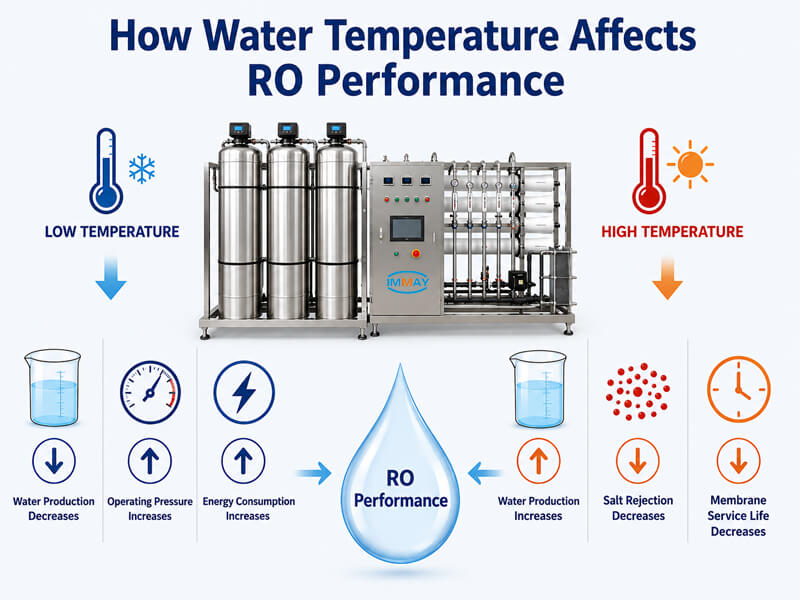
Low feed water temperature is one of the most common reasons for changes in industrial RO system performance, especially during colder seasons. As water temperature decreases, water flows through the membrane less easily, affecting several operating parameters even when the feed water quality and system configuration remain unchanged.
A reduction in water production is usually the most noticeable effect of low feed water temperature. Colder water has higher viscosity and passes through the RO membrane more slowly, reducing permeate flow. As a result, an industrial RO system may produce significantly less purified water in winter than under warmer operating conditions.
As colder water creates greater resistance to flow through the membrane, the system often operates at a higher pressure to maintain production. Higher operating pressure places additional load on the high-pressure pump and other system components, making stable operating conditions more difficult to maintain over extended periods.
When the RO system operates at higher pressure to overcome the increased resistance caused by colder water, energy consumption generally increases. Producing the same amount of purified water under low-temperature conditions often requires more energy than under normal operating temperatures.
Feed water temperature also influences the overall operating performance of the RO system, including its recovery characteristics. As permeate flow decreases at lower temperatures, the actual system recovery differs from the design conditions. Monitoring operating parameters during seasonal temperature changes helps maintain stable system performance and consistent water production.
Higher feed water temperature generally allows water to pass through the RO membrane more easily, which can improve water production. However, excessively high temperatures also affect membrane performance and long-term reliability. For this reason, industrial RO systems should always operate within the temperature range recommended for the membrane.
As feed water temperature rises, water viscosity decreases and membrane permeability increases. Water molecules pass through the membrane more easily, resulting in higher permeate flow. Under the same operating pressure, an industrial RO system typically produces more purified water at higher temperatures than at lower temperatures.
Although higher temperatures increase water production, they can also reduce the membrane's salt rejection performance. As membrane permeability increases, a greater amount of dissolved salts may pass through the membrane, leading to a slight increase in the conductivity or total dissolved solids (TDS) of the purified water. This is one of the reasons why feed water temperature is an important operating parameter for industrial RO systems.
RO membranes are designed to operate within a specified temperature range. Continuous operation with excessively high feed water temperatures places additional stress on the membrane material and can accelerate membrane aging. Operating the system within the recommended temperature range helps maintain stable performance and extend membrane service life.
When manufacturers specify the production capacity of an industrial reverse osmosis (RO) system, the stated water output is typically based on standard operating conditions. One of the most important reference conditions is a feed water temperature of 25°C (77°F). Using a standard temperature allows users to compare the performance of different RO systems under the same conditions.
In actual operation, feed water temperature often changes with the seasons. Because temperature directly affects water viscosity and membrane permeability, the actual water production may be lower than the rated capacity in colder conditions and higher in warmer conditions. This is a normal characteristic of RO systems and should be considered when evaluating system performance throughout the year.
Seasonal changes in feed water temperature are unavoidable, but their impact on an industrial RO system can be managed through proper system operation and maintenance. Monitoring key operating conditions and operating the system within its design parameters help maintain consistent water production throughout the year.
Feed water temperature should be monitored regularly as part of routine system operation. Recording seasonal temperature changes helps explain variations in water production and provides valuable information when evaluating overall system performance. Understanding temperature trends also helps operators distinguish normal seasonal fluctuations from equipment-related issues.
When selecting an industrial RO system, seasonal feed water temperature should be considered during capacity planning. Designing the system based on the lowest expected feed water temperature helps provide sufficient water production throughout the year, even during colder months when membrane permeability decreases.
Stable operating pressure is essential for consistent RO performance. Large pressure fluctuations can affect water production and membrane performance, making it more difficult to maintain reliable operation. Regular monitoring of operating pressure helps keep the system running under its intended design conditions.
Effective pretreatment protects the RO membranes from suspended solids, hardness, chlorine, and other contaminants that can reduce performance. Maintaining multimedia filters, activated carbon filters, water softeners (when required), and cartridge filters helps preserve membrane efficiency and supports stable RO performance regardless of seasonal temperature changes.
Feed water temperature is one of the most important factors affecting industrial RO performance. Changes in temperature influence water viscosity, membrane permeability, water production, operating pressure, and salt rejection, even when all other operating conditions remain the same.
Understanding seasonal temperature changes and operating the RO system within its design conditions helps maintain stable water production, protect the membranes, and improve long-term system performance.