- Home
- Equipment
- Industries
- We Immay
- Resource
- Contact
Author: Site Editor Publish Time: 2026-10-01 Origin: Site
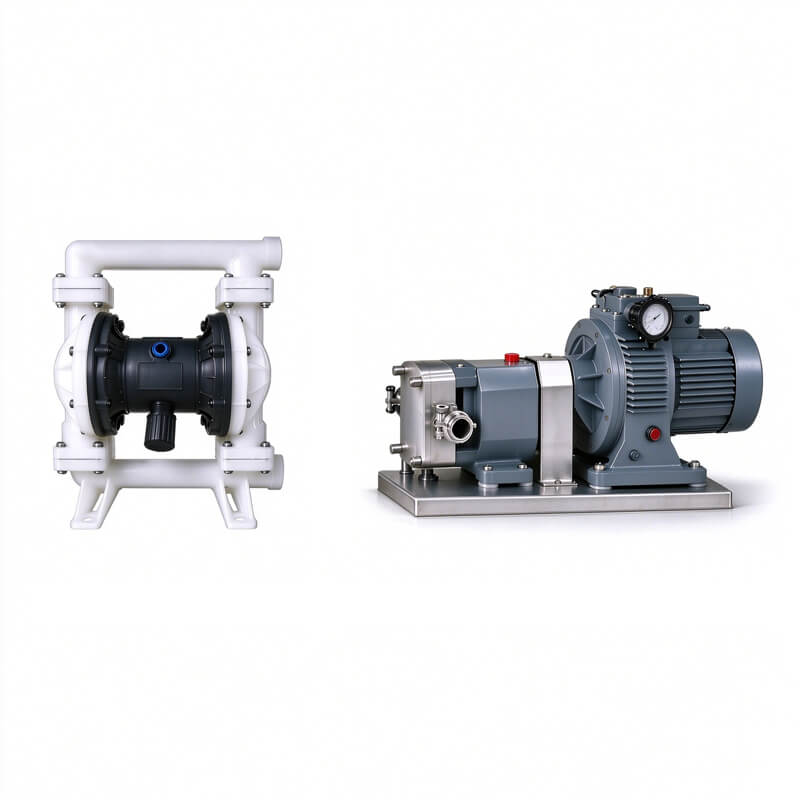
Liquid transfer is an important part of many liquid product manufacturing processes. After mixing is completed, the product needs to move from the mixing tank to a storage tank or another production stage. In a common process, the transfer is arranged as Mixing Tank → Pump → Storage Tank.
Choosing the pump for this step depends on how the product needs to be transferred. Different liquids have different viscosities and flow characteristics, while the production process can also require different transfer rates, distances, and operating conditions. Air Operated Double Diaphragm Pumps and Rotary Lobe Pumps are both used for liquid transfer, so choosing between them can require a closer look at their actual pumping characteristics.
Before comparing the two, it is useful to start with the Air Operated Double Diaphragm Pump and understand its role in liquid transfer.
An air operated double diaphragm pump is a positive displacement pump powered by compressed air. It uses two diaphragms to move liquid through the pump, making it suitable for transferring a wide range of liquid products between different stages of a production process.
During operation, compressed air moves the two diaphragms back and forth. This alternating movement creates suction on one side of the pump and discharge on the other, drawing liquid into the pump chamber and pushing it toward the outlet. As the diaphragms continue to move, the pump produces a pulsating flow. The pumping rate can be adjusted through the air supply and operating conditions.
AODD pumps can be used to transfer products such as perfume, shampoo, liquid soap, detergent, vodka, oils, and suspensions. The actual pumping performance depends on the viscosity and characteristics of the liquid, the diaphragm and valve configuration, and the conditions of the transfer system.
A rotary lobe pump is a positive displacement pump that uses two rotating lobes to move liquid through the pump. The lobes rotate inside the pump chamber and transfer the product from the inlet to the discharge outlet, making the pump suitable for a wide range of liquid products.
During operation, the rotating lobes create spaces that draw liquid into the pump chamber. As the lobes continue to rotate, the liquid is carried around the chamber and pushed toward the outlet. The continuous rotary movement provides a steady flow, while the pump speed can be adjusted to match the required transfer rate and operating conditions.
Rotary lobe pumps can be used to transfer products such as shampoo, shower gel, liquid soap, creams, lotions, toothpaste, milks, oils, syrups, sauces, chocolate, and other viscous liquids. Actual pumping performance depends on the liquid viscosity and characteristics, pump size, rotor design, operating speed, pressure, and the conditions of the transfer system.
Comparison | Air Operated Double Diaphragm Pump | Rotary Lobe Pump |
Pumping Principle | Diaphragm reciprocation | Rotary displacement |
Drive Method | Compressed air (Explosion-Proof) | Electric motor |
Flow Characteristic | Pulsating | Continuous |
Flow Control | Air supply and air pressure | Motor speed |
Transfer Movement | Reciprocating | Rotary |
Viscosity Capability | Wide range, depending on model and conditions | Wide range, including high-viscosity liquids |
Typical Transfer | Flexible liquid transfer | Continuous liquid transfer |
The main difference between the two pumps lies in how they move the liquid. An AODD pump uses the reciprocating movement of two diaphragms, while a rotary lobe pump uses rotating lobes to transfer the product. These different pumping methods result in different flow characteristics and affect how each pump performs in a liquid transfer system.
The required flow rate is an important part of liquid transfer planning. The actual flow a pump can deliver depends on the pump size, operating speed, liquid viscosity, discharge pressure, pipeline resistance, and other operating conditions. As these factors vary from one production system to another, the pump needs to be selected according to the required transfer rate of the process.
For example, a mixing tank transferring a batch to a storage tank may require a different flow rate from a pump feeding liquid continuously to the next production stage. The required flow rate should therefore be considered together with the batch volume, transfer distance, and production schedule.
The two pumps produce different flow characteristics because they use different pumping movements. An air operated double diaphragm pump uses the alternating movement of its diaphragms, which produces a pulsating flow. A rotary lobe pump uses rotating lobes to move the liquid through the pump, providing a continuous flow.
This difference can affect how the product moves through the transfer line and how the pump works with downstream equipment. The appropriate flow characteristic depends on the requirements of the production process and the equipment connected to the transfer system.
Transfer time is directly related to the volume of liquid being moved and the actual flow rate. For a 1,000 L batch, the theoretical transfer time would be 10 minutes at 100 L/min, 4 minutes at 250 L/min, or 2 minutes at 500 L/min.
Volume | Flow Rate | Theoretical Transfer Time |
1,000 L | 100 L/min | 10 min |
1,000 L | 250 L/min | 4 min |
1,000 L | 500 L/min | 2 min |
These figures are theoretical calculations. Actual transfer time can change with liquid viscosity, pipeline resistance, pressure, pump operating conditions, and the rest of the transfer system. For production planning, the required transfer time should be considered together with batch size and the overall production schedule.
When a pump supplies liquid continuously to the next stage of production, its transfer rate and flow characteristics need to match the requirements of the process. A continuous production line may require a steady supply of liquid, while batch production may involve transferring a defined volume between two stages before the next batch begins.
The pump therefore needs to work at a flow rate that fits the production schedule and the equipment receiving the liquid. The connection between the pump, pipeline, and downstream equipment also becomes important when planning continuous liquid transfer.
The first consideration is the liquid being transferred. Viscosity, flowability, shear sensitivity, and chemical characteristics all affect pump selection. Different products behave differently during pumping, so the pump needs to match the properties of the liquid and the conditions of the transfer process.
Both air operated double diaphragm pumps and rotary lobe pumps can handle a wide range of liquid viscosities. The suitable pump depends on the product characteristics, the required transfer performance, and the way the pump will operate in the production system.
The required transfer performance should be considered together with the production schedule. Required flow rate, transfer time, batch size, and whether the liquid is transferred continuously or intermittently all affect the pump specification.
The flow characteristic also matters. An air operated double diaphragm pump produces a pulsating flow, while a rotary lobe pump provides a continuous flow. This difference can affect how the liquid moves through the transfer line and how the pump works with downstream production equipment.
The pump should fit into the actual production process. In a simple arrangement such as **Mixing Tank → Pump → Storage Tank**, the pump needs to move the product from the mixing tank to the storage tank at the required rate and under the conditions of the transfer system.
The same consideration applies when the pump feeds another processing or filling stage. The source of the liquid, the destination, the transfer method, and the equipment connected before and after the pump all affect the required pump configuration.
The available factory utilities also need to be considered. An air operated double diaphragm pump requires a suitable compressed air supply, while a rotary lobe pump is normally driven by an electric motor.
The pump should fit the utilities available at the production site and the way the equipment will be installed and operated.
Pump selection should also take the complete transfer system into account. Pipeline diameter and length, inlet and outlet connections, installation position, pressure conditions, and the equipment connected to the pump can all affect actual pumping performance.
The pump, pipeline, and connected equipment should work together as part of the same liquid transfer system.
Choosing between an air operated double diaphragm pump and a rotary lobe pump is part of planning the liquid transfer process. The pump needs to work with the product, transfer requirements, pipeline, and connected equipment so that the entire transfer process fits the production operation.
A well-planned transfer system gives the pump a clear role within the production line and allows the equipment to work together according to the actual manufacturing process.