- Home
- Equipment
- Industries
- We Immay
- Resource
- Contact
Author: Site Editor Publish Time: 2026-02-04 Origin: Site
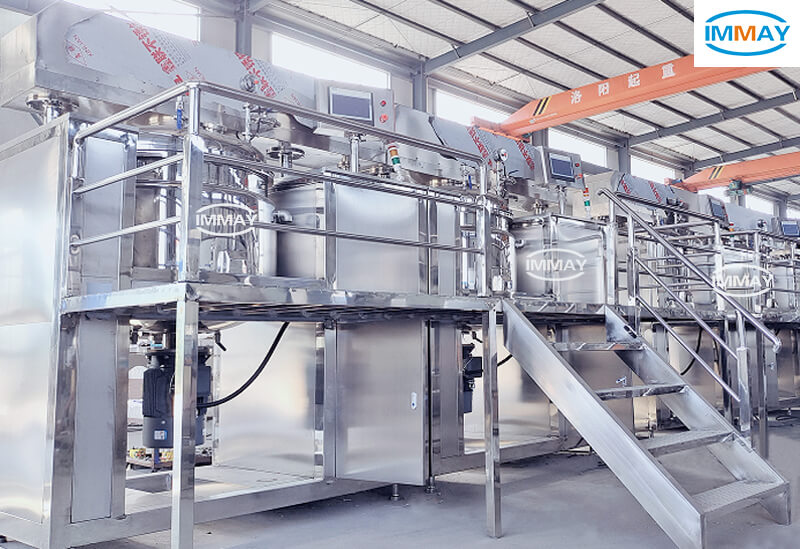
In small-batch production, mixing is often treated as an operational task. As long as ingredients are added in the correct order and mixed for a sufficient duration, acceptable results can usually be achieved. Operators rely on visual cues, experience, and manual adjustments to assess whether a batch is adequately mixed. This approach can work reasonably well when volumes are limited and formulations are relatively forgiving.
As production scales up, however, the nature of mixing changes fundamentally. Larger batch sizes increase the distance over which materials must be circulated within the vessel. Higher viscosities reduce bulk flow and limit natural self-leveling, while more complex formulations introduce components that respond differently to shear, residence time, and thermal history. Under these conditions, increasing mixing time or intensity alone does not necessarily improve overall uniformity. Instead, it often amplifies differences in local shear exposure and increases sensitivity to operator-dependent adjustments, leading to local over-shearing and greater batch-to-batch variation.
At this stage, mixing can no longer be managed as an operator-driven activity. It becomes a system-level engineering challenge that depends on well-defined and repeatable process parameters rather than individual effort. Mixing performance at scale is determined by how consistently shear, flow patterns, and mixing time are delivered throughout the entire batch. In other words, at scale, mixing performance is no longer determined by effort, but by process control.
Manual and semi-automatic mixing processes rely heavily on individual operator judgment. Decisions such as when to adjust mixing speed, how long to extend mixing time, or when a batch is considered complete are often made based on observation rather than fixed criteria. While this approach may be sufficient at small scales, it introduces variability as batch sizes grow.
At larger scales, differences in experience and technique between operators or across shifts begin to accumulate. The same formulation may be exposed to different mixing histories, resulting in noticeable batch-to-batch variation. Extending mixing time does not necessarily compensate for these differences, especially in complex or high-viscosity systems.
As batch size and viscosity increase, simply mixing longer or applying more force no longer guarantees better results. Reduced material mobility limits bulk circulation, and uniform shear distribution becomes harder to achieve. Consequently, mixing outcomes become increasingly sensitive to how the process is executed, highlighting the importance of consistent process control to maintain uniformity.
High-viscosity liquid and paste systems are particularly prone to uneven mixing. Local variations in shear and circulation can occur even under careful supervision, demonstrating that manual or semi-automatic processes become less predictable as scale increases. The core issue is not that the methods are inherently inadequate, but that their performance becomes harder to stabilize under large-scale production conditions.
In large-scale liquid and paste production, maintaining batch-to-batch consistency is one of the primary engineering challenges. Even small differences in mixing execution—such as variations in speed, duration, or the order of ingredient addition—can lead to noticeable differences in the final product. At scale, relying on manual or semi-automatic processes increases the likelihood of variability, especially when multiple operators or shifts are involved.
Automated mixing systems address these issues by ensuring that critical parameters—such as impeller speed and mixing time—are consistently applied for every batch. By defining and controlling these parameters, the process removes reliance on operator judgment and experience.
By standardizing execution, automated systems systematically eliminate variability introduced by different operators. This allows the process to be repeatable and predictable regardless of batch size or complexity.
From a manufacturing standpoint, consistency becomes a controllable outcome rather than a variable. Operators no longer need to rely on observation or experience to judge mixing quality, and batch-to-batch uniformity can be reliably maintained even under large-scale production conditions.
At high production volumes, the ability to standardize the mixing process becomes critical. Automated systems ensure that mixing parameters—such as impeller speed and mixing time—are consistently applied across all batches. This reduces the variability that arises from human intervention and allows the process to behave in a repeatable, predictable manner.
Predictable execution of mixing parameters translates into a more stable production rhythm. Operators can plan downstream processes with confidence, as the time required for mixing and batch readiness becomes consistent. This stability is particularly important when dealing with high-viscosity liquids or complex formulations, where minor deviations in mixing conditions can otherwise lead to variability.
Automated mixing also enables scale-up without a proportional increase in manpower. Because the process parameters are precisely controlled and the system operates consistently, production can be expanded to higher throughput while maintaining uniformity and efficiency. This allows facilities to achieve higher output without adding additional operators for manual oversight, reducing operational complexity and potential for error.
From a manufacturing standpoint, the advantage of automated mixing at high throughput is not simply faster mixing, but predictable, repeatable efficiency. Production outcomes become less dependent on individual operators or shifts, and more determined by well-defined process parameters.
High-viscosity pastes present unique challenges in large-scale production. Reduced material mobility limits bulk circulation, making uniform shear distribution difficult to achieve. Traditional manual or semi-automatic methods are highly sensitive to operator technique, batch size, and timing, which can result in local over-shearing, under-mixed regions, or batch-to-batch variability.
Automated mixing systems allow precise control over critical parameters such as impeller speed and mixing time. By executing these parameters consistently for each batch, the system minimizes the influence of human variability. This ensures that even highly viscous materials are subjected to predictable shear conditions, improving overall mixing homogeneity.
In high-viscosity paste systems, automated processes make it possible to implement optimized mixing strategies. For example, adjusting agitator speed, controlling shear exposure time, and target temperature can all be standardized. These strategies help prevent local over- or under-mixed zones, reduce energy waste, and maintain the physical integrity of sensitive components.
Automated control also allows high-viscosity systems to be scaled up without proportionally increasing labor. By ensuring that process parameters are repeatable and predictable, facilities can handle larger batch volumes while maintaining consistent product quality. The predictable handling of viscous materials reduces operational uncertainty and allows downstream processes to operate on a stable schedule.
From a manufacturing standpoint, the ability to manage high-viscosity pastes consistently is a major advantage of automated mixing. The combination of precise parameter control and optimized process strategy ensures that mixing outcomes are reproducible, predictable, and independent of operator experience.
Automation is not merely a feature upgrade; it is a process necessity at large scale. As batch size, viscosity, and formulation complexity increase, manual and semi-automatic mixing approaches become less predictable and more sensitive to operator variability. Automated systems ensure repeatable execution of critical parameters—such as speed, duration, and target temperature—allowing batch-to-batch consistency, predictable throughput, and reliable handling of high-viscosity materials.
From an engineering standpoint, consistency and predictability are no longer variables left to chance—they become controllable outcomes. IMMAY’s expertise in industrial mixing equipment enables manufacturers to implement automated processes effectively, ensuring that complex formulations are mixed efficiently, consistently, and at scale. For companies aiming to scale production while maintaining product quality, partnering with IMMAY provides a practical, engineering-driven solution.
Contact IMMAY today to discuss how your fluid mixing processes can be optimized and automated for consistent, high-quality results.