- Home
- Equipment
- Industries
- We Immay
- Resource
- Contact
Author: Site Editor Publish Time: 2026-02-20 Origin: Site
When planning to start a cosmetic manufacturing facility, one of the first questions engineers and formulators face is how the choice of water affects production. Unlike general commercial or household uses, water in industrial cosmetic manufacturing is not just a filler — it plays an active role in the product’s structure and performance.
Among the many potential water sources, municipal tap water is one of the most readily accessible. Before evaluating whether municipal tap water can meet industrial cosmetic standards, it is essential to first understand why water quality is critical in industrial cosmetic production. Examining its role in formulation, mixing, and stability provides the foundation for any discussion about water source suitability.
In industrial cosmetic manufacturing, water is not a neutral background ingredient. It is a structural component that directly influences formulation behavior, processing performance, and long-term product consistency. Understanding the role of water goes beyond purity — it involves recognizing how water quality interacts with emulsifiers, thickeners, active ingredients, and processing equipment.
For cosmetic manufacturers aiming at scalable and repeatable production, water quality becomes a process variable that should be controlled, not assumed.
In many cosmetic categories — including emulsions, creams, lotions, and serums — water represents the largest percentage of the formula. In oil-in-water systems, water forms the continuous phase that supports dispersed oil droplets. In gels and serums, it acts as the dispersion medium for polymers and functional ingredients.
Because of its high proportion in the formulation, even small variations in water composition can significantly influence the final product. Dissolved minerals, residual disinfectants, and conductivity levels can all alter how ingredients hydrate, disperse, or emulsify.
From a formulation standpoint, water is not simply a carrier. It is an active participant in defining the physical architecture of the product.
Water directly affects how cosmetic structures are built during mixing and emulsification.
In emulsion systems, interfacial tension and droplet formation depend on the interaction between water and emulsifiers. The ionic content of water can influence:
Droplet size distribution
Emulsion stability
Interfacial film strength
In gel systems, the hydration behavior of polymers is highly sensitive to ionic strength and pH conditions. Variations in mineral content can change swelling behavior, resulting in differences in viscosity and texture.
In other words, water contributes to structure formation, not just dilution. The internal network of a cosmetic product is partially defined by the characteristics of the water phase.
Mixing stability during industrial production is closely linked to water quality in cosmetic manufacturing.
When water composition fluctuates, several process issues may arise:
Inconsistent dispersion of powders
Variable emulsification efficiency
Fluctuating homogenization performance
Changes in mixing time requirements
Hardness ions such as calcium and magnesium may interact with surfactants, altering their efficiency. Dissolved salts can affect conductivity, which in turn influences how charged ingredients behave during blending.
In high-shear mixing systems, stable process conditions depend on predictable fluid properties. If the water phase varies from batch to batch, the mechanical energy applied during mixing may not yield identical results.
This is why cosmetic production water requirements often specify limits for hardness, conductivity, and total dissolved solids.
Viscosity is one of the most sensitive quality indicators in cosmetic production.
The rheological structure of creams and lotions is determined by:
Polymer hydration
Emulsion droplet interaction
Thickener performance
Electrolyte balance
Variations in water mineral content can alter the ionic environment of the formulation. Even slight changes in electrolyte concentration may modify the internal gel network or emulsion packing structure.
The result can be:
Different apparent viscosity
Altered spreadability
Changes in texture perception
Inconsistent pump or filling performance
For large-scale manufacturing, controlling water composition helps ensure that viscosity remains within a defined and repeatable range.
Accurate pH adjustment is essential for cosmetic stability and ingredient compatibility.
Water quality influences buffering behavior and acid–base balance. If the incoming water has variable alkalinity or dissolved ions, achieving precise pH control becomes more complex.
Unstable pH conditions can impact:
Active ingredient performance
Thickener efficiency
Emulsion stability
Preservative functionality
Because many cosmetic systems are sensitive to narrow pH windows, consistent water chemistry is fundamental to maintaining formulation integrity.
Preservative systems operate within specific chemical environments. Variations in water quality may affect their solubility, distribution, and long-term performance.
Higher mineral content or unexpected contaminants can:
Interfere with preservative dispersion
Alter microbial control efficiency
Increase formulation variability
In industrial settings, cosmetic production water requirements typically aim to reduce these variables to support predictable preservative behavior over the product’s intended shelf life.
In laboratory development, small adjustments can compensate for water variability. In industrial manufacturing, however, repeatability is essential.
Production is not measured by a single successful batch. It is measured by the ability to reproduce identical physical and functional properties across hundreds of batches.
For this reason, water quality in cosmetic manufacturing should meet criteria that support:
Batch-to-batch consistency
Controlled mixing performance
Stable viscosity profiles
Water becomes a controlled raw material rather than a general utility input.
In modern cosmetic factories, water should be treated as a defined process parameter — similar to temperature, shear rate, or mixing time.
When water quality is standardized and stable, manufacturers gain:
Predictable formulation behavior
Reduced process adjustments
Improved production efficiency
Greater long-term consistency
Understanding and managing cosmetic production water requirements is therefore not only a formulation issue, but also a manufacturing strategy.
Water is the foundation of many cosmetic systems. Its quality directly influences structure, stability, and scalability. Controlling it is an essential step toward achieving industrial-level consistency in cosmetic production.
Municipal tap water is treated water supplied through public distribution systems for residential and commercial use. It is designed to meet drinking water standards that ensure safety for human consumption.
However, drinking water safety criteria are different from industrial formulation requirements. In cosmetic production, water is not only consumed — it becomes part of the product structure. Understanding municipal water composition is therefore essential when evaluating its suitability for manufacturing.
Municipal water undergoes treatment processes such as filtration, sedimentation, and disinfection. While these processes make the water safe to drink, they do not eliminate all dissolved substances. The final composition can include minerals, residual disinfectants, and trace elements that may influence cosmetic processing.
Hardness (Calcium and Magnesium Ions)
One of the most important parameters in municipal water composition is hardness, primarily caused by calcium (Ca⊃2;⁺) and magnesium (Mg⊃2;⁺) ions.
Water hardness varies significantly depending on the geographic source. Groundwater-rich regions often contain higher mineral levels, while surface water sources may show lower hardness.
In cosmetic production, tap water hardness in cosmetics can influence:
Surfactant efficiency
Thickener hydration behavior
Mixing performance
Foam characteristics in cleansing products
Hardness ions may interact with functional ingredients, altering their performance or requiring formulation adjustments.
Residual Chlorine
Municipal water systems typically use chlorine or chloramine as disinfectants. A small amount of residual chlorine remains in the water to prevent microbial growth during distribution.
While safe for drinking, residual chlorine can:
React with certain active ingredients
Affect fragrance stability
Influence preservative systems
Contribute to oxidation reactions
In cosmetic manufacturing, even low concentrations may introduce variability in sensitive formulations.
Total Dissolved Solids (TDS)
Total dissolved solids (TDS) represent the combined concentration of inorganic salts and small amounts of organic matter dissolved in water.
TDS levels vary widely between municipalities. These dissolved solids may include:
Sodium
Potassium
Calcium
Magnesium
Chlorides
Sulfates
High or fluctuating TDS levels can affect conductivity and ionic strength in formulations. Since many cosmetic structures depend on controlled electrolyte balance, changes in TDS may influence viscosity, clarity, or mixing behavior.
Trace Metals
Municipal water may contain trace amounts of metals such as iron, copper, or manganese. These are typically present within drinking water limits, but even small quantities can impact cosmetic products.
Trace metals may:
Affect color stability
Catalyze oxidation reactions
Interact with active ingredients
Influence long-term product appearance
Although concentrations are usually low, their presence can become significant in high-volume industrial production.
pH Variability
Municipal water pH is adjusted during treatment to reduce pipe corrosion and maintain distribution stability. However, pH levels can fluctuate depending on treatment processes and source water chemistry.
Variations in incoming water pH may require additional correction during formulation. For products that rely on precise pH control, even minor shifts can introduce extra processing steps or adjustments.
Unlike purified industrial water systems, municipal water is subject to external variables. These fluctuations are normal in public supply systems but may create challenges in manufacturing environments.
Seasonal Changes
Rainfall patterns, drought conditions, and temperature variations can alter source water composition. Seasonal shifts may change mineral concentration, organic content, and turbidity levels.
As treatment plants adjust processes to accommodate these changes, the final municipal water composition may vary throughout the year.
Differences in Water Sources
Municipal systems may draw water from multiple sources, including rivers, reservoirs, and groundwater wells. When supply conditions change, the system may switch between sources.
Each source has a distinct mineral profile, meaning that tap water hardness in cosmetics can fluctuate depending on which supply is active.
Distribution Network Aging
Water travels through extensive pipe networks before reaching industrial facilities. Aging infrastructure may contribute:
Minor metal leaching
Sediment introduction
Variations in residual disinfectant levels
Although these variations remain within drinking water limits, they can influence industrial mixing consistency.
Changes in Disinfection Dosage
To maintain microbial control, municipalities may adjust disinfectant levels based on seasonal demand or regulatory guidelines.
These adjustments can alter residual chlorine concentration, affecting formulation stability in cosmetic production.
It is important to distinguish between water that is safe to drink and water that is optimized for cosmetic manufacturing.
Municipal tap water is designed to meet public health standards. Its primary objective is safety for human consumption.
Cosmetic production water requirements, however, focus on:
Chemical stability
Structural consistency
Controlled ionic composition
Batch-to-batch repeatability
Drinking water compliance does not automatically guarantee suitability for industrial formulation.
For manufacturers, understanding municipal water composition is the first step in determining whether additional treatment is necessary to achieve stable and predictable cosmetic production.
From a regulatory perspective, municipal tap water is considered safe for consumption. From a manufacturing perspective, however, safety is not the only requirement. Cosmetic production demands structural stability, controlled mixing behavior, and long-term batch repeatability.
To determine whether municipal water can be used directly in industrial cosmetic manufacturing, it is necessary to evaluate how its composition interacts with formulation systems and processing conditions.
Water hardness, primarily caused by calcium (Ca⊃2;⁺) and magnesium (Mg⊃2;⁺) ions, is one of the most influential variables in cosmetic processing — especially in products that involve emulsification.
Influence on Emulsifier Performance
Many emulsifiers rely on specific ionic environments to function efficiently. Hardness ions can:
Interact with surfactant molecules
Alter hydrophilic–lipophilic balance behavior
Reduce emulsifier efficiency
When surfactants bind with calcium or magnesium ions, their ability to stabilize dispersed oil droplets may decrease. This can require higher emulsifier concentrations or longer mixing times to achieve the desired structure.
Effect on Interfacial Tension
Stable emulsions depend on controlled interfacial tension between oil and water phases. Hardness ions can modify the interfacial properties of the aqueous phase, affecting droplet formation during mixing.
If interfacial tension is not properly controlled:
Droplet size distribution may become inconsistent
Homogenization efficiency may vary
Long-term physical stability may decline
In industrial production, these effects may not always appear immediately but can influence product stability over storage time.
Risk of Structural Instability
Variations in hardness from batch to batch may lead to:
Phase separation tendencies
Changes in texture
Differences in viscosity development
Because municipal water hardness can fluctuate depending on source and season, directly using it introduces an uncontrolled variable into emulsion-based formulations.
Municipal water typically contains residual chlorine or chloramine to maintain microbial safety during distribution. While acceptable for drinking, these disinfectants may interact with cosmetic ingredients.
Impact on Active Ingredients
Certain actives, botanical extracts, vitamins, and fragrances are sensitive to oxidation. Residual chlorine can:
Accelerate degradation reactions
Alter ingredient stability
Affect color or odor over time
Even low levels may contribute to gradual changes in sensitive formulations.
Oxidation Risks in Industrial Processing
During large-scale mixing, increased surface exposure and mechanical energy can enhance chemical interactions. In such conditions, oxidizing agents present in the water may have a more pronounced effect.
Potential consequences include:
Reduced active ingredient effectiveness
Changes in product appearance
Variations in long-term stability
Because residual disinfectant levels can fluctuate, this introduces additional uncertainty in process control.
Total dissolved solids (TDS) reflect the overall concentration of salts in municipal water. These dissolved electrolytes directly influence the ionic strength of the formulation.
Influence on Rheological Structure
Many cosmetic systems depend on controlled electrolyte balance. Dissolved salts can affect:
Polymer hydration
Gel network formation
Thickener efficiency
Electrostatic interactions between dispersed particles
Changes in ionic strength may modify how structural networks develop during mixing.
Batch Variability in Viscosity
In industrial production, viscosity is a key quality parameter. If dissolved salt levels vary:
Final viscosity may shift outside the target range
Mixing time may need adjustment
Shear response may change
These fluctuations can complicate process standardization and increase the need for formulation corrections.
Industrial cosmetic manufacturing is built on repeatability. A process should consistently produce identical physical and functional characteristics over extended production cycles.
When municipal tap water is used directly, variability in hardness, residual disinfectants, dissolved salts, and pH can collectively lead to:
Unpredictable mixing performance
Inconsistent structural development
Additional process adjustments
Greater quality control intervention
Even if individual parameters remain within drinking water limits, their cumulative variation may affect production consistency.
Therefore, municipal tap water is engineered for human consumption, not for formulation precision.
In small-scale or less structure-sensitive products, direct use may be feasible under controlled conditions. However, in industrial-scale cosmetic manufacturing — particularly for emulsions, structured creams, gels, and performance-driven formulations — relying solely on untreated municipal water often makes long-term stability and batch repeatability more difficult to maintain.
For manufacturers seeking consistent mixing behavior and controlled product structure, municipal water is typically a starting point rather than a finalized production solution.
In cosmetic manufacturing, the decision to implement additional industrial water treatment depends on production scale, product positioning, and process stability requirements.
For small-scale operations or low-structure formulations, municipal water may be usable with monitoring and adjustment. However, in large-scale production or in the development of high-performance cosmetic products, more controlled water quality becomes essential.
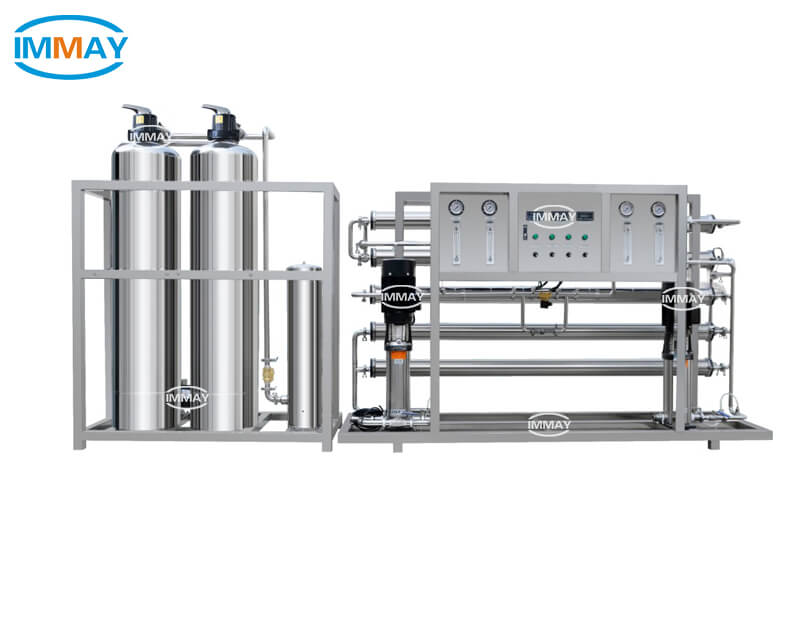
In these situations, industrial 1 stage or 2 stage reverse osmosis (RO) water purification machines are commonly adopted to stabilize and standardize the water supply.
As production volume increases, the tolerance for variability decreases.
In industrial environments:
Batch sizes are larger
Raw material quantities are scaled proportionally
Mixing parameters are standardized
Any fluctuation in water composition at this scale can have amplified effects. A small variation in hardness or conductivity may result in noticeable differences in viscosity, mixing time, or structural behavior.
Industrial RO systems help reduce variability by:
Removing dissolved salts
Reducing hardness
Lowering conductivity
Stabilizing input water chemistry
By providing consistent water parameters, manufacturers can maintain predictable mixing performance across continuous production cycles.
Premium cosmetic products often require tighter control over physical structure and ingredient performance.
Formulations such as:
Structured creams
Functional serums
Sensitive active-based products
High-viscosity gels
are more sensitive to ionic strength, trace metals, and residual disinfectants.
Industrial 1 stage or 2 stage RO water purification systems support higher formulation precision by significantly reducing:
Total dissolved solids (TDS)
Calcium and magnesium ions
Residual chlorine
Trace metal content
With lower and more stable conductivity levels, formulators can better control:
Thickener hydration
pH adjustment
Active ingredient stability
Structural consistency
This improves repeatability during scale-up and long-term production.
A 1 stage RO water purification system removes a high percentage of dissolved salts and impurities through a semi-permeable membrane.
For many cosmetic factories, 1 stage RO water treatment system is sufficient to:
Reduce hardness to low levels
Lower conductivity significantly
Improve consistency compared to untreated municipal water
It is commonly used in medium-scale production or in formulations that require moderate control over ionic composition.
By standardizing the incoming water, 1 stage RO water treatment systems reduce the need for frequent formulation corrections during mixing.
A 2 stage RO water purification system further purifies the water by passing it through an additional membrane stage.
This configuration achieves:
Lower conductivity levels
Greater reduction of dissolved solids
More stable water chemistry over time
In high-volume factories or facilities producing structure-sensitive cosmetic products, 2 stage RO water treatment systems provide enhanced control over water composition.
This level of purification is particularly beneficial when:
Formulations are highly electrolyte-sensitive
Product viscosity should remain within narrow tolerances
Active ingredients require stable chemical environments
Long production runs demand minimal variability
The additional purification stage increases consistency, which supports reliable mixing and stable product structure.
Beyond formulation performance, industrial RO water filtration systems contribute to overall manufacturing efficiency.
Consistent purified water helps:
Standardize mixing times
Maintain predictable rheological development
Reduce batch adjustment frequency
Enhance long-term production repeatability
When water quality is stabilized, the mixing system operates under more controlled conditions. This supports smoother scale-up from pilot to full production and reduces unexpected process deviations.
Implementing industrial 1 stage or 2 stage RO water purification is not merely a quality upgrade — it is a process control decision.
For manufacturers operating at industrial scale or aiming to produce high-quality cosmetic products with stable structure and consistent performance, additional water treatment becomes a foundational element of production design.
In this condition, water is no longer treated as a basic utility. It becomes a defined and controlled raw material that directly supports stable mixing behavior, predictable structure formation, and long-term manufacturing consistency.
Municipal tap water is designed to meet public health standards. It is suitable for daily consumption and general commercial use. However, cosmetic manufacturing operates under a different set of priorities.
In industrial cosmetic production, water is not only consumed — it becomes part of the formulation structure. It influences mixing behavior, viscosity development, pH control, and long-term product stability. For this reason, the standard required for drinking water is not the same as the standard required for formulation precision.
Large-scale production demands consistency.
Industrial cosmetic manufacturers should ensure:
Stable ionic composition
Controlled conductivity
Predictable mixing performance
Repeatable batch results
When water quality fluctuates, product structure may fluctuate as well. Over time, this variability affects production efficiency and formulation stability.
Stable water supply leads to stable product performance.
By implementing industrial 1 stage or 2 stage reverse osmosis systems, cosmetic manufacturers can standardize water parameters and reduce process uncertainty. This improves structural consistency, supports scalable mixing operations, and strengthens overall manufacturing control.
Selecting the right industrial cosmetic water treatment machine is therefore not simply an equipment decision. It is a strategic step in upgrading production capability and ensuring long-term operational reliability.
At IMMAY, we provide industrial 1 stage and 2 stage reverse osmosis water treatment machines designed for cosmetic manufacturing environments. Our systems are engineered to deliver stable water quality that supports consistent mixing performance and controlled product structure across continuous production cycles.
For cosmetic manufacturers aiming to enhance production stability and product consistency, evaluating your water treatment strategy is an important step forward. Consulting equipment experts at IMMAY can help optimize your industrial water purification configuration according to your production scale and formulation requirements.