- Home
- Equipment
- Industries
- We Immay
- Resource
- Contact
Author: Site Editor Publish Time: 2026-02-12 Origin: Site
Industrial emulsions are essential across a wide range of sectors, from cosmetics and personal care to food and specialty chemicals. Unlike simple liquid mixtures, these emulsions are carefully constructed systems in which the oil and water phases coexist as dispersed droplets within a continuous medium. Achieving the desired droplet size, structural stability, and flow behavior requires deliberate control of the oil–water interface rather than relying on ingredients alone.
Emulsifiers play a central role in stabilizing these interfaces, working together with mechanical energy to ensure consistent droplet formation. Understanding this interplay allows industrial manufacturers to produce high-quality emulsions reliably and at scale.
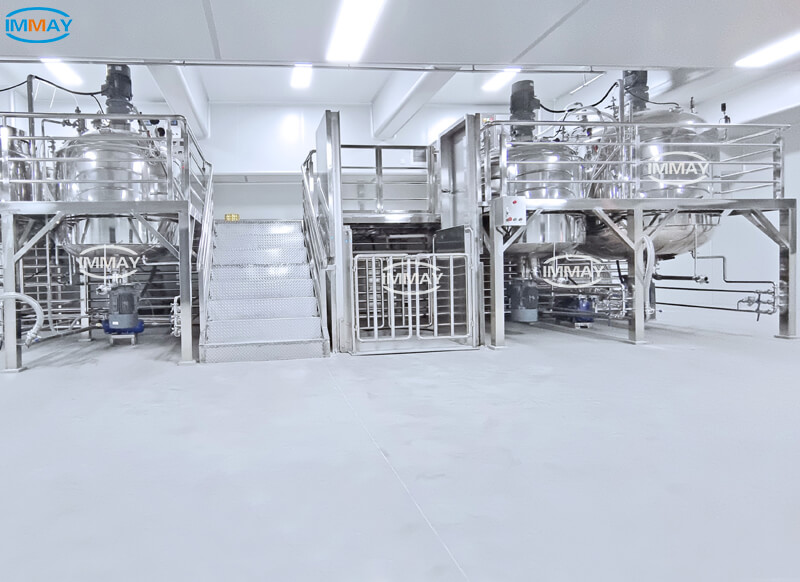
IMMAY, as a provider of industrial mixing and vacuum emulsifying equipment, enables these controlled processes, supporting precise droplet generation, interface stabilization, and scalable production. Understanding the fundamental structure of emulsions—the interface-dominated architecture—sets the stage for exploring emulsifier behavior, HLB selection, and structural stability in detail.
An industrial emulsion is a structured system formed by dispersing one immiscible liquid phase into another. In most industrial contexts, these phases are oil and water, which are thermodynamically incompatible and do not mix spontaneously. When combined without intervention, they separate into distinct layers to minimize interfacial energy. An emulsion, therefore, is not simply a mixture—it is a deliberately constructed dispersed system.
Within this system, one phase becomes the continuous phase, forming a three-dimensional medium throughout the entire volume. The other becomes the dispersed phase, existing as droplets distributed within that continuous matrix. The defining feature of an emulsion is not just the presence of droplets, but the creation of a stable interfacial boundary between the two liquids.
The interface is the true structural core of an emulsion. Every droplet introduces a new interfacial area, and the total interfacial surface in industrial emulsions can be extremely large. The physical behavior of the product—its viscosity, texture, flow pattern, optical appearance, and long-term stability—is governed by how these interfaces are formed, protected, and maintained.
Rheological properties emerge from the spatial organization of droplets within the continuous phase. As droplet size decreases and droplet concentration increases, interactions between droplets begin to influence flow resistance and mechanical response. Stability likewise depends on the integrity of the interfacial layer that prevents coalescence, flocculation, and phase separation. In this sense, an industrial emulsion is fundamentally an interface-controlled material system.
Oil and water naturally separate because combining them increases the total interfacial free energy of the system. Creating small droplets dramatically expands interfacial area, which is energetically unfavorable. Without intervention, the system will always move toward phase separation in order to minimize energy.
To form an emulsion, this energy barrier must be overcome. The interfacial tension between the two liquids must be reduced so that new surface area can be generated. At the same time, sufficient mechanical energy must be supplied to physically break one phase into fine droplets and distribute it within the other.
Even after droplets are formed, the system remains inherently unstable from a thermodynamic perspective. The emulsion persists only because kinetic barriers prevent the droplets from merging back together. This is why industrial emulsions are described as thermodynamically unstable but kinetically stabilized systems.
The structure of an emulsion is therefore established during the process of energy input. Droplet size distribution, interfacial coverage, and phase continuity are determined at the moment of dispersion. Once formed, these structural characteristics define the product’s macroscopic performance.
Understanding industrial emulsions through the lens of interfacial science clarifies an essential principle: an emulsion is not a passive blend of liquids, but an engineered interfacial network constructed under controlled conditions.
Emulsifiers function because of their amphiphilic molecular structure. Each molecule contains two distinct segments: a hydrophilic group that interacts favorably with water, and a lipophilic group that interacts with oil. This dual affinity enables the molecule to position itself at the boundary between immiscible liquids.
When oil and water are brought into contact, the interfacial region is energetically unfavorable. Molecules at the boundary experience asymmetric molecular interactions, which increases the system’s free energy. Interfacial tension is a direct manifestation of this energetic imbalance. The higher the interfacial tension, the more strongly the system resists the creation of new surface area.
When an emulsifier is introduced, its molecules migrate toward the oil–water interface. The hydrophilic portion orients toward the aqueous phase, while the lipophilic portion anchors into the oil phase. By occupying the boundary, emulsifier molecules replace direct oil–water contact with more energetically favorable interactions. This rearrangement lowers the interfacial free energy and reduces interfacial tension.
Lower interfacial tension makes it physically easier to deform and fragment one phase into droplets during mechanical mixing. In industrial emulsification, this reduction in interfacial tension is essential because droplet formation requires continuous generation of new surface area. Without emulsifiers, the energy required to create fine droplets would be substantially higher, and the resulting dispersion would be unstable and short-lived.
In this way, emulsifiers do not merely assist mixing—they modify the energetic landscape of the system, enabling the formation of dispersed structures that would otherwise collapse.
Once emulsifier molecules adsorb at the oil–water boundary, they form an interfacial film around each droplet. This film represents the structural barrier that separates dispersed droplets from one another and prevents them from merging.
In many systems, the film begins as a monomolecular layer. Each molecule arranges in a tightly packed orientation, creating a coherent boundary between phases. Depending on concentration, molecular structure, and environmental conditions, multilayer adsorption may also occur. In such cases, secondary molecular interactions—hydrogen bonding, electrostatic attraction, or hydrophobic association—can reinforce the interfacial region.
The mechanical properties of this interfacial film are critical. A mechanically weak film may rupture under droplet collision, allowing coalescence. A stronger, more elastic interfacial layer can deform during collisions and then recover without breaking. This mechanical resilience directly influences long-term emulsion stability.
Beyond mechanical resistance, the interfacial film provides stabilization through two primary mechanisms. Electrostatic stabilization arises when charged emulsifier molecules create repulsive forces between droplets, preventing close approach. Steric stabilization occurs when large molecular chains extend into the surrounding phase, forming a physical barrier that hinders droplet contact. In many industrial emulsions, both effects may contribute simultaneously.
The stability of the emulsion therefore depends not only on the presence of an emulsifier, but on the structural integrity and functional properties of the interfacial film it forms.
Emulsifier adsorption at the interface is a dynamic process rather than an instantaneous event. During high-shear mixing, new droplet surfaces are continuously generated. Emulsifier molecules must rapidly migrate from the bulk phase to the expanding interface in order to cover it effectively.
If adsorption is too slow relative to droplet formation, newly created surfaces remain partially unprotected. These exposed droplets are prone to recoalescence before a complete interfacial film is established. For this reason, adsorption kinetics play a decisive role in determining final droplet size distribution.
As emulsifier concentration increases, the interface approaches a saturation point. Once the surface is fully covered, additional emulsifier molecules remain in the bulk phase. Beyond this saturation threshold, further reduction in droplet size becomes increasingly dependent on mechanical energy rather than on additional emulsifier.
This dynamic interplay between droplet generation, molecular diffusion, and interfacial saturation defines the early stages of emulsion structure formation. The final architecture of an industrial emulsion—its droplet size, distribution uniformity, and stability profile—is established during this transient but critical period.
Understanding these interfacial mechanisms clarifies a central principle: emulsifiers operate by constructing and protecting interfaces. The stability and performance of an industrial emulsion are ultimately determined by how effectively this interfacial network is formed and maintained.
Bancroft’s rule provides a foundational guideline for predicting which phase will become the continuous phase in an emulsion. According to this principle, the phase in which the emulsifier is more soluble is more likely to form the continuous medium. In other words, if the emulsifier preferentially dissolves in water, water tends to be the continuous phase, producing an oil-in-water (O/W) emulsion. Conversely, if the emulsifier is more soluble in oil, oil is more likely to form the continuous phase, resulting in a water-in-oil (W/O) system.
While simple in concept, Bancroft’s rule captures a critical aspect of industrial emulsion design: the choice of emulsifier is a primary factor in directing structural formation, even when the proportions of the two phases differ substantially.
Emulsifiers with high Hydrophilic–Lipophilic Balance (HLB) values are predominantly hydrophilic. When used in emulsification, these molecules favor solubility in the aqueous phase. During droplet formation, the emulsifier molecules migrate to the oil–water interface, stabilizing oil droplets dispersed within the water phase. High HLB emulsifiers thus naturally support the formation of O/W emulsions, even in systems where oil may constitute a large fraction of the total volume.
The continuous water phase, reinforced by the hydrophilic emulsifier, provides both structural integrity and stability. The emulsifier forms an interfacial film around each oil droplet, preventing coalescence and supporting the long-term maintenance of the emulsion structure.
Conversely, low HLB emulsifiers are predominantly lipophilic and dissolve more readily in the oil phase. In such systems, water droplets are dispersed within an oil-continuous matrix, producing a W/O emulsion. The interfacial film formed by the lipophilic emulsifier prevents water droplets from merging and supports the structural stability of the oil-rich continuous phase.
Low HLB emulsifiers are therefore particularly useful in applications such as water-resistant creams, lubricants, and industrial oil-based formulations, where a water-in-oil structure is desirable.
It is a common misconception that the phase present in larger proportion automatically becomes the continuous phase. High internal phase emulsions (HIPEs) serve as a key example where the dispersed phase can occupy more than 74% of the total volume, yet the smaller continuous phase still defines the overall structure.
In HIPEs, the continuous phase forms a thin network surrounding tightly packed droplets of the internal phase. The result is a system in which the dispersed phase dominates volume but does not dictate continuity.
Phase inversion refers to a transition where the continuous and dispersed phases swap roles. This can occur when the internal phase fraction increases beyond a critical point (catastrophic inversion) or when external factors such as temperature or surfactant composition change the system’s interfacial properties (transitional inversion). Understanding these mechanisms is essential in industrial emulsion design, as they explain why emulsions may unexpectedly switch structure even when the phase ratio appears to favor one type.
The rate at which emulsifier molecules adsorb to newly formed droplet surfaces plays a pivotal role in determining droplet size. During emulsification, mechanical energy generates new interfacial area as one phase is broken into droplets. If emulsifier molecules migrate to and cover these fresh surfaces rapidly, droplets are stabilized almost immediately, preventing coalescence.
Insufficient or slow adsorption allows droplets to merge before full coverage, leading to larger, unevenly sized droplets and an unstable emulsion. Therefore, the dynamic interplay between droplet formation rate and emulsifier adsorption kinetics directly governs the droplet size distribution and uniformity, which are critical parameters for product texture, flow behavior, and overall performance in industrial applications.
Emulsifier concentration is another major determinant of droplet stability. Adequate concentration ensures that the interface of every droplet is fully covered, forming a protective layer that resists coalescence and aggregation.
When emulsifier concentration is too low relative to the total interfacial area, droplets remain partially exposed. These exposed droplets are susceptible to coalescence, flocculation, or phase separation. Conversely, an excess of emulsifier beyond the point of interfacial saturation contributes little to droplet size reduction but can influence viscosity and bulk phase interactions. Optimal concentration is therefore essential to maintain interfacial integrity while avoiding unnecessary cost or formulation complications.
Once droplets are covered by emulsifier molecules, stabilization is achieved through two primary mechanisms: electrostatic and steric repulsion.
Electrostatic stabilization occurs when emulsifier molecules carry a charge, creating a repulsive electric field between adjacent droplets. This prevents close approach and merging, particularly important in low-viscosity systems.
Steric stabilization arises when bulky molecular chains or polymeric segments extend from the droplet surface into the surrounding phase. These chains physically hinder droplets from coming into close contact, reducing the likelihood of coalescence. In many industrial emulsions, electrostatic and steric mechanisms act together, reinforcing droplet separation and enhancing long-term stability.
In summary, emulsifiers influence droplet size and structural stability by controlling how quickly and completely the interface is covered, ensuring the integrity of interfacial films, and providing electrostatic and steric barriers. Effective selection and optimization of emulsifiers allow industrial emulsions to achieve consistent texture, predictable flow behavior, and reliable long-term stability under production and storage conditions.
Although this article primarily focuses on emulsifiers, it is important to briefly address their interplay with mechanical energy to complete the conceptual framework of industrial emulsion formation. Understanding this synergy helps clarify the distinct yet complementary roles each factor plays in producing a stable emulsion.
Emulsifiers alone are incapable of generating droplets. The physical input of energy through high shear homogenizer mixer is essential to break one liquid phase into fine droplets dispersed within another. Without sufficient mechanical energy, the phases remain largely separate, regardless of the presence or concentration of emulsifiers. Emulsifiers reduce interfacial tension and stabilize droplets, but they cannot create the interface themselves.
The size and distribution of droplets are fundamentally controlled by the mechanical energy applied during emulsification. Higher shear rates produce smaller droplets and a larger total interfacial area, while lower energy input results in larger, uneven droplets. The droplet formation process is purely a mechanical phenomenon; emulsifiers only interact after these droplets exist. In industrial settings, vacuum emulsifying mixer machine selection is key factor in controlling droplet generation.
Once droplets are formed, emulsifiers become critical in maintaining their integrity. By rapidly adsorbing to the newly created interfaces, emulsifiers prevent coalescence and aggregation, effectively “locking in” the droplet structure. They control droplet stability over time, influencing both shelf life and performance characteristics such as viscosity, texture, and flow behavior.
Mechanical energy is responsible for creating the interface, while emulsifiers are responsible for stabilizing the interface. Both are necessary for industrial emulsion formation, but they perform complementary roles: one generates the structural framework, and the other maintains it.
In industrial emulsions, selecting the right emulsifier is a practical task that directly influences product performance, stability, and process efficiency. Proper selection requires consideration of the chemical properties of the system, the desired rheological characteristics, and the end-use requirements of the product.
The polarity of the emulsion system is a primary factor in emulsifier selection. Hydrophilic emulsifiers (high HLB values) are suited for oil-in-water (O/W) systems where the aqueous phase is continuous. Lipophilic emulsifiers (low HLB values) are preferred for water-in-oil (W/O) systems with oil as the continuous phase. Choosing an emulsifier whose HLB value aligns with the polarity of the target system ensures effective interface adsorption, droplet stabilization, and long-term structural integrity.
Viscosity of the continuous phase and the overall system also guides emulsifier selection. Higher viscosity systems require emulsifiers that can rapidly migrate to and cover newly formed droplet surfaces despite the slower molecular diffusion in a viscous medium. In low-viscosity systems, emulsifiers must provide sufficient interfacial stabilization to prevent rapid coalescence. Matching the emulsifier to the viscosity profile ensures consistent droplet size distribution and prevents phase separation during production and storage.
Beyond polarity and viscosity, the desired rheological behavior of the final product determines how emulsifiers are used to structure the interface. In creams and lotions, interfacial films must support shear-thinning flow while maintaining droplet stability. In sauces or spreads, emulsifiers must maintain uniform texture, prevent oiling off, and withstand thermal or mechanical stress during processing. By tailoring the interfacial architecture with appropriate emulsifiers, industrial formulators can achieve target flow, spreadability, and sensory properties.
Cosmetic Creams and Lotions: Emulsifiers are selected to maintain smooth texture, prevent droplet coalescence, and support long shelf life under varying temperature conditions.
Food Sauces and Dressings: Emulsifiers stabilize oil-rich sauces, control pourability, and maintain uniform appearance.
Industrial Emulsions: In lubricants, coatings, or chemical dispersions, emulsifiers ensure structural integrity under high shear or thermal stress while enabling controlled droplet size and uniformity.
Careful selection and optimization of emulsifiers across these parameters enable industrial formulations to achieve consistent performance, stability, and desired functional properties in their respective applications.
Industrial emulsions are not simply mixtures of oil and water. They are engineered interfacial systems, where the structure and stability are dictated by the adsorption and behavior of emulsifiers at the oil–water boundary. Droplet formation, distribution, and long-term stability are outcomes of both thermodynamic tendencies and kinetic control during emulsification.
The interplay between emulsifiers, mechanical energy, and other processing conditions ensures that the emulsion’s structure is established at the moment of formation, rather than corrected afterward. Understanding this principle allows formulators to design emulsions with predictable texture, flow, and stability for a wide range of industrial applications.
For manufacturers and formulators seeking reliable industrial emulsification solutions, consulting with equipment and emulsification experts can optimize the process from droplet generation to long-term stability. IMMAY provides professional guidance and advanced mixing solutions to help design and implement industrial emulsions with consistent performance and efficiency.
Contact IMMAY today to learn how our expertise can enhance your emulsion production.