- Home
- Equipment
- Industries
- We Immay
- Resource
- Contact
Author: Site Editor Publish Time: 2026-06-08 Origin: Site
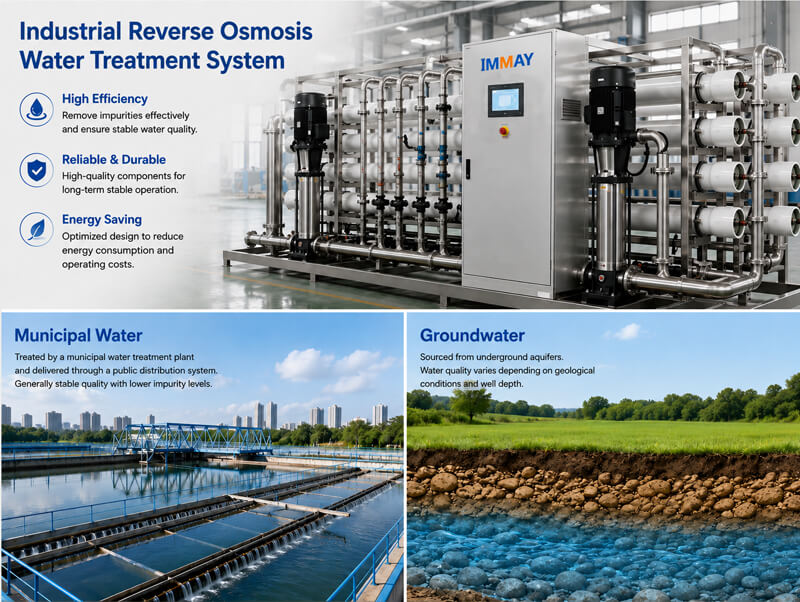
When evaluating an industrial reverse osmosis (RO) water treatment system, many buyers focus primarily on production capacity, such as 500 L/h, 1,000 L/h, or 5,000 L/h.
However, in actual system design, raw water quality often has a greater impact than production capacity.
Even when two factories require the same amount of purified water per hour, their RO systems may still differ significantly in pretreatment configuration, operating pressure, membrane selection, and maintenance requirements. These differences are mainly determined by the characteristics of the incoming water.
Municipal water and groundwater are two of the most common raw water sources used in industrial water treatment applications. Although both can be treated using reverse osmosis technology, their water quality differences require different system designs and pretreatment strategies.
Understanding these differences helps select a more suitable system configuration and supports more stable long-term operation.
Municipal water refers to water supplied through a public distribution network managed by local authorities. It is typically treated before delivery and may originate from surface water sources such as rivers, lakes, reservoirs, or in some cases groundwater.
Groundwater differs from municipal water in that it does not undergo centralized treatment before use. Instead, its quality is naturally formed as water moves through soil and rock layers over time.
For industrial reverse osmosis applications, municipal water usually has relatively stable baseline quality. However, its actual characteristics may still vary depending on regional treatment processes and pipeline conditions.
Groundwater refers to water that is stored beneath the Earth's surface in underground aquifers. It is typically extracted through deep wells or boreholes for industrial and municipal use.
Groundwater, however, does not undergo centralized treatment before use. Instead, its quality is naturally formed as water moves through soil and rock layers over time.
As a result, groundwater composition can vary significantly depending on local geological conditions and well depth.
When discussing industrial reverse osmosis system design, many people focus on whether the raw water comes from a municipal supply or a groundwater source. While the water source provides useful background information, it is not the most important factor in determining how an RO system should be configured.
In practice, two municipal water supplies can have very different water quality characteristics. Likewise, two groundwater wells located in different regions may contain completely different levels of dissolved minerals, hardness, and suspended solids.
Industrial RO system design should be based on actual water quality parameters rather than water source classification.
A detailed water analysis provides the information needed to select appropriate pretreatment equipment, determine membrane operating conditions, and predict long-term system performance.
Municipal water is often assumed to be easier to treat than groundwater. While this may be true in many cases, it is not a universal rule.
For example, a municipal water supply with elevated TDS levels may require a more robust RO configuration than a groundwater source with relatively low mineral content.
Similarly, some groundwater sources contain very little iron or hardness, while others may require extensive pretreatment before entering the RO system.
This is because different water sources still present significant variations in key water quality indicators.
Several water quality indicators directly affect the design, operation, and maintenance requirements of an industrial reverse osmosis system.
Total Dissolved Solids (TDS)
TDS represents the concentration of dissolved minerals and salts in the water.
Higher TDS levels increase the osmotic pressure that the RO system must overcome, which can influence:
Operating pressure
Membrane selection
Recovery rate
Energy consumption
As TDS levels increase, system design requirements often become more demanding.
Hardness
Water hardness is primarily caused by dissolved calcium and magnesium ions.
High hardness levels increase the risk of scale formation on membrane surfaces. Over time, scaling can reduce water production, increase operating pressure, and affect membrane service life.
When hardness levels are elevated, pretreatment methods such as water softening may be incorporated into the system design.
Iron Content
Iron is a common concern in many groundwater applications.
Excessive iron can accumulate on membrane surfaces and internal equipment components, contributing to membrane fouling and reduced system performance.
The presence of iron often influences pretreatment requirements and equipment selection.
Manganese Content
Manganese can create challenges similar to iron.
If not properly managed, manganese deposits may contribute to fouling within the RO system and increase maintenance requirements.
Groundwater sources containing manganese frequently require additional pretreatment before the reverse osmosis process.
Turbidity
Turbidity measures the concentration of suspended particles within the water.
Elevated turbidity levels increase the load on filtration equipment and may contribute to membrane fouling if not adequately controlled.
The level of turbidity often influences the design of pretreatment filtration stages.
pH Value
Water pH affects the chemical behavior of dissolved substances and can influence scaling tendencies within the RO system.
Although RO membranes can operate across a range of pH conditions, abnormal pH values may require additional treatment considerations depending on the overall water chemistry.
Conductivity
Conductivity is commonly used as an indicator of dissolved ionic content in water.
Higher conductivity generally corresponds to higher dissolved mineral concentrations and is often evaluated alongside TDS when designing industrial water treatment systems.
Conductivity data can help estimate treatment requirements and expected RO performance.
Because each water source has unique characteristics, industrial RO systems should be designed using actual water quality data whenever possible.
A complete water analysis allows engineers to determine:
Whether pretreatment equipment is required
Which pretreatment technologies are appropriate
Whether a 1 stage or 2 stage RO system is more suitable
Expected operating conditions
Long-term maintenance considerations
For this reason, IMMAY often requests a water analysis report before recommending a system configuration.
The most successful RO projects are not designed around the water source name alone. They are designed around the specific water quality parameters that determine how the system will perform over time.
Industrial reverse osmosis systems designed for municipal water applications are generally considered more stable in operation compared with systems using untreated groundwater. However, even municipal water requires a properly designed pretreatment process to ensure consistent performance and long membrane service life.
The design of an RO system is directly influenced by the characteristics of municipal water, particularly the presence of residual disinfectants, moderate dissolved solids, and fine suspended particles that may enter the distribution network.
Although municipal water has already undergone centralized treatment, it is still not suitable for direct feeding into a reverse osmosis system. A pretreatment stage is required to protect the RO membrane from fouling, scaling, and chemical damage.
A typical industrial RO pretreatment system for municipal water may include the following components:
Quartz Sand Filter
Activated Carbon Filter
Security Filter (Cartridge Filter)
Each of these stages plays a specific role in preparing the water for reverse osmosis treatment.
The quartz sand filter is responsible for removing suspended solids and reducing turbidity. This helps prevent particulate matter from reaching downstream equipment and improves overall system stability.
The activated carbon filter plays a critical role in removing residual chlorine and organic compounds present in municipal water. This step is particularly important because oxidizing agents such as free chlorine can negatively affect the performance of polyamide RO membranes.
The security filter provides a final filtration barrier before the high-pressure RO system. It captures fine particles that may bypass earlier filtration stages and ensures that the feed water entering the membrane elements is within an acceptable particle range.
One of the most important considerations in municipal water RO system design is the presence of residual chlorine.
Municipal water suppliers commonly use chlorine-based disinfectants to control microbial growth within distribution pipelines. While this approach is effective for maintaining water hygiene, residual chlorine must be carefully managed before the water enters the reverse osmosis system.
Most industrial RO membranes are made from polyamide composite materials, which are sensitive to oxidizing agents such as free chlorine. Continuous exposure to chlorine can gradually degrade the membrane structure, leading to reduced salt rejection performance and shortened service life.
For this reason, chlorine removal is a critical step in the pretreatment process. Activated carbon filtration is widely used in municipal water RO systems due to its ability to effectively reduce chlorine levels and protect downstream membrane elements.
In some system designs, additional chemical dechlorination methods may also be considered depending on feed water conditions and operational requirements.
A standard industrial reverse osmosis system for municipal water is typically designed as a multi-stage treatment process to ensure stable operation and consistent water quality output.
A common system flow may be structured as follows:
Municipal Water
→ Quartz Sand Filter
→ Activated Carbon Filter
→ Security Filter
→ High Pressure Pump
→ Reverse Osmosis Membrane System
→ Pure Water Storage Tank
This configuration provides a balanced approach between pretreatment efficiency and system simplicity, making it suitable for a wide range of industrial applications such as cosmetics production, food processing, pharmaceutical preparation, and general manufacturing processes.
The exact configuration may vary depending on raw water quality parameters such as TDS, turbidity, and chlorine concentration, as well as the required product water quality standards.
In practical engineering applications, municipal water should not be assumed to have a uniform quality level. Even within the same region, seasonal variations and pipeline conditions can influence water parameters.
This is why water analysis is typically used as the starting point for selecting pretreatment and system configuration. This ensures that the pretreatment system and membrane configuration are properly matched to actual operating conditions, improving system reliability and reducing long-term maintenance requirements.
Groundwater is widely used as a raw water source for industrial reverse osmosis systems, especially in regions where municipal water supply is limited or unavailable. However, Groundwater applications often present more complex water quality conditions that directly affect system design.
Because groundwater quality is strongly influenced by local geological conditions, even two wells located within the same area may produce water with significantly different chemical compositions. For this reason, groundwater-based RO systems are typically designed with greater flexibility in pretreatment and membrane protection strategies.
One of the most common challenges in groundwater applications is water hardness, which is mainly caused by dissolved calcium (Ca²⁺) and magnesium (Mg²⁺) ions.
When groundwater contains high levels of hardness, these minerals can precipitate and form scale on the surface of reverse osmosis membranes during operation. This scaling phenomenon gradually blocks membrane pores and reduces effective filtration area.
As a result, the system may experience:
Increased operating pressure
Reduced permeate flow rate
Decreased system efficiency
Shortened membrane service life
In severe cases, scaling can significantly affect long-term system stability and increase maintenance frequency.
To reduce scaling risks, groundwater RO system designs often include additional pretreatment steps such as water softening or hardness reduction processes, depending on the results of the raw water analysis.
Iron and manganese are naturally occurring elements frequently found in groundwater sources. While they are not always present at high concentrations, elevated levels can create serious operational challenges for reverse osmosis systems.
When iron or manganese is present in the feed water, it may oxidize and form insoluble particles. These particles can accumulate on membrane surfaces and within the system, leading to fouling and performance decline.
Typical impacts include:
Membrane fouling
Increased differential pressure across the system
Reduced permeate production
Higher cleaning frequency requirements
Over time, these effects can reduce system efficiency and increase operational costs.
To control iron and manganese levels, groundwater RO systems may incorporate specific pretreatment solutions such as oxidation-filtration units or dedicated removal filters, depending on water quality conditions.
Groundwater often contains higher total dissolved solids (TDS) compared with municipal water. TDS represents the total concentration of dissolved salts and minerals in the water, and it is one of the most important parameters in RO system design.
Higher TDS levels directly affect the operating conditions of the reverse osmosis system, particularly in terms of:
Operating pressure requirements
Recovery rate limitations
Energy consumption levels
As TDS increases, the system must generate higher pressure to overcome osmotic pressure and achieve effective separation. This may influence pump selection, membrane configuration, and overall system sizing.
In some cases, groundwater with elevated TDS levels may require multi-stage reverse osmosis configurations to achieve the required product water quality.
Because groundwater quality varies significantly depending on location and geological conditions, pretreatment systems are often customized based on detailed water analysis results.
Depending on the specific raw water conditions, additional pretreatment equipment may include:
Water Softener (for hardness reduction)
Iron Removal Filter
Manganese Removal Filter
Multimedia Filtration Systems
Cartridge Security Filtration
The final configuration is determined by actual water quality data rather than groundwater as a general category.
In industrial reverse osmosis system design, groundwater requires a more detailed evaluation compared with municipal water due to its variability and higher likelihood of containing scaling and fouling substances.
A complete water analysis is essential before finalizing system design parameters. Key indicators such as hardness, iron content, manganese concentration, TDS, turbidity, and conductivity are used to determine pretreatment requirements and overall system configuration.
A properly designed groundwater RO system can achieve stable long-term operation when pretreatment is correctly matched to raw water conditions and membrane protection strategies are appropriately implemented.
Industrial reverse osmosis system design is not based on a fixed structure. Instead, the final configuration is determined by raw water quality, which can vary significantly between municipal water and groundwater sources. Even when two systems are designed for the same production capacity, the pretreatment process and overall system layout may differ due to differences in water composition.
The following examples illustrate how raw water conditions directly influence system configuration and why proper water analysis is essential before final system design.
Raw Water Characteristics
TDS: 200–400 ppm
Relatively low hardness
Low suspended solids
Residual chlorine may be present
Municipal water is generally more stable and consistent in quality because it has already undergone centralized treatment. However, residual disinfectants and fine particles from distribution pipelines still need to be considered during system design.
System Configuration
Sand Filter
Carbon Filter
Security Filter
Reverse Osmosis System
Design Explanation
In this configuration, the pretreatment system is relatively simple. The sand filter is used to remove suspended particles and reduce turbidity. The carbon filter plays a key role in removing residual chlorine and protecting the RO membrane from oxidative damage. The security filter provides final protection before the high-pressure RO unit.
Because the water quality is relatively stable, no additional specialized pretreatment units are typically required in most municipal water applications. This results in a more compact and straightforward system design.
Raw Water Characteristics
TDS: around 1000 ppm
High hardness levels
Presence of iron
Variable water quality depending on location
Groundwater typically contains higher levels of dissolved minerals and naturally occurring elements such as calcium, magnesium, and iron. These components have a direct impact on membrane performance and system stability if not properly treated.
System Configuration
Sand Filter
Iron Removal Filter
Carbon Filter
Water Softener
Security Filter
Reverse Osmosis System
Design Explanation
Compared with municipal water systems, groundwater-based RO systems require more extensive pretreatment.
The iron removal filter is used to reduce iron content and prevent oxidation-related fouling. The carbon filter still plays an important role in removing organic matter and improving overall feed water quality. The water softener helps reduce hardness and minimize scaling risk on the RO membrane surface.
Due to higher TDS and increased scaling potential, groundwater systems often require more robust pretreatment to ensure stable long-term operation.
These examples show how differences in TDS, hardness, and trace elements directly affect pretreatment design and system configuration.
Even though both systems produce purified water using reverse osmosis technology, the internal configuration differs significantly due to variations in:
TDS levels
Hardness concentration
Iron content
Presence of oxidizing agents
Overall water stability
Understanding these differences helps ensure that the RO system is properly matched to actual operating conditions, resulting in improved performance, longer membrane lifespan, and more stable water production.
In industrial reverse osmosis system projects, the required production capacity (such as 500 L/h, 1,000 L/h, or 5,000 L/h) is often the first parameter considered by buyers. However, systems with the same output capacity may have significantly different costs depending on the raw water quality.
The main reason is that water quality directly determines system complexity, pretreatment requirements, membrane configuration, and overall equipment specifications. As a result, the total investment cost is not only related to capacity, but also closely linked to the characteristics of the feed water.
Raw water with higher levels of hardness, iron, manganese, or suspended solids often requires additional pretreatment stages before entering the reverse osmosis system.
Compared with systems using relatively clean municipal water, groundwater or lower-quality feed water may require extra components such as:
Water softeners for hardness reduction
Iron and manganese removal systems
Multimedia filtration units
Advanced filtration stages
Each additional pretreatment unit increases both equipment cost and system footprint. In addition, more complex pretreatment design may also require additional piping, valves, and control components.
Water quality also plays an important role in reverse osmosis membrane selection.
For example, higher TDS levels or more challenging feed water conditions may require membranes with different performance characteristics, such as higher pressure tolerance or enhanced fouling resistance.
In more demanding applications, the number of membrane elements or pressure vessels may also need to be increased to achieve the required water production and quality targets.
These adjustments directly influence the total system cost, even when the production capacity remains the same.
The high-pressure pump is one of the key components in an industrial RO system, and its specifications are strongly influenced by raw water conditions.
When TDS levels are higher, the system must generate higher operating pressure to overcome osmotic pressure. This requires:
Higher power pumps
More durable pump materials
Different pump sizing or configurations
As a result, systems treating more challenging water sources typically require more robust pumping solutions, which increases overall equipment cost and energy considerations.
Water quality also indirectly affects the complexity of the control system.
More complex pretreatment processes and multi-stage RO configurations require additional monitoring and control functions to ensure stable operation. This may include:
Multiple pressure monitoring points
Flow rate control across different stages
Conductivity monitoring for water quality verification
Automated protection and alarm functions
As system complexity increases, the control cabinet design becomes more advanced, contributing to higher overall system cost.
Although two industrial reverse osmosis systems may be designed for the same output capacity, their actual cost can vary significantly due to differences in raw water quality.
A system treating relatively clean municipal water typically requires fewer pretreatment stages and simpler configuration. In many groundwater systems, water with higher hardness, iron content, or TDS levels requires additional treatment steps and more robust equipment design.
This explains why two systems with the same capacity may still require different configurations and equipment levels. A proper water analysis helps ensure that the final system design is both technically appropriate and economically reasonable for the specific application.
In industrial reverse osmosis system design, one of the most important configuration decisions is whether to use a 1 stage RO system or a 2 stage RO system. This choice is not determined only by production capacity, but is closely related to raw water quality and the required final water quality.
Both configurations are widely used in industrial applications such as cosmetics production, food processing, pharmaceutical manufacturing, and general industrial water supply. However, each system type is suitable for different operating conditions.
Understanding the difference between 1 stage and 2 stage RO systems helps ensure stable water quality, efficient operation, and optimized system cost.
A 1 stage reverse osmosis system is typically used in applications where the raw water quality is relatively stable and the required product water quality is moderate.
Common conditions suitable for 1 stage RO systems include:
Municipal water with low to moderate TDS levels
Relatively stable feed water quality
Applications with standard industrial water requirements
Systems where space and investment cost need to be optimized
In a 1 stage RO system, water passes through the membrane process once. This configuration is generally sufficient when the feed water is not highly concentrated in dissolved solids and when the target water quality does not require extremely low conductivity levels.
The system design is relatively compact and straightforward, making it suitable for many standard industrial production environments.
A 2 stage reverse osmosis system is designed for more demanding water quality requirements or more challenging raw water conditions.
Typical situations where a 2 stage RO system is recommended include:
Groundwater with higher TDS levels
Applications requiring higher purity water
Industrial processes with stricter conductivity requirements
Feed water with more variable quality conditions
In a 2 stage RO system, water is treated through two sequential membrane stages. The second stage further reduces dissolved solids, resulting in improved water quality and more stable output performance.
This configuration is often selected when a higher level of purification is required or when raw water conditions place greater stress on the system.
Water conductivity is one of the key parameters used to determine whether a 1 stage or 2 stage RO system is required.
Higher conductivity in the raw water typically indicates a higher concentration of dissolved ions, which may require additional treatment stages to achieve the desired product water quality. In contrast, lower conductivity feed water can often be treated effectively using a single-stage RO system.
However, conductivity alone is not the only determining factor. Other parameters such as TDS, hardness, and overall water stability also play important roles in system selection.
For this reason, system design should always be based on a complete water analysis report rather than a single parameter.
IMMAY designs and manufactures both 1 stage and 2 stage industrial reverse osmosis systems for different water treatment requirements.
IMMAY 1 stage RO systems are commonly used for applications where municipal water is the primary feed source and stable industrial-grade water is required. These systems focus on compact design and efficient operation.
IMMAY 2 stage RO systems are designed for more demanding applications, including groundwater treatment and processes requiring higher purity water output. These systems are configured based on your detailed water quality analysis report to ensure stable long-term performance.
Both system types can be customized according to specific production capacity, water quality conditions, and application requirements, ensuring that each project is matched with an appropriate and efficient solution.
Industrial reverse osmosis system design begins with raw water quality analysis, not water source classification.
While municipal water and groundwater provide a useful initial classification, they do not determine the final system configuration. In real engineering practice, the actual design of an industrial RO system is driven by specific water quality parameters rather than the name of the water source.
Key factors such as total dissolved solids (TDS), hardness, iron content, manganese content, and required permeate water quality play a decisive role in selecting the appropriate pretreatment process and reverse osmosis system configuration.
A complete water analysis allows engineers to understand the true characteristics of the feed water and design a system that is properly matched to real operating conditions. Based on this data, the most suitable pretreatment solutions, membrane arrangements, and system structures can be selected.
As a result, industrial reverse osmosis systems designed based on accurate water quality analysis tend to achieve more stable long-term operation, improved membrane performance, and more consistent water production.
For this reason, professional industrial water purification system design should always begin with a detailed water analysis to ensure proper system configuration.