(0086)18936474568 sales@immay-auto.com

- Home
- Equipment
- Industries
- We Immay
- Resource
- Contact
Author: Site Editor Publish Time: 2026-02-23 Origin: Site
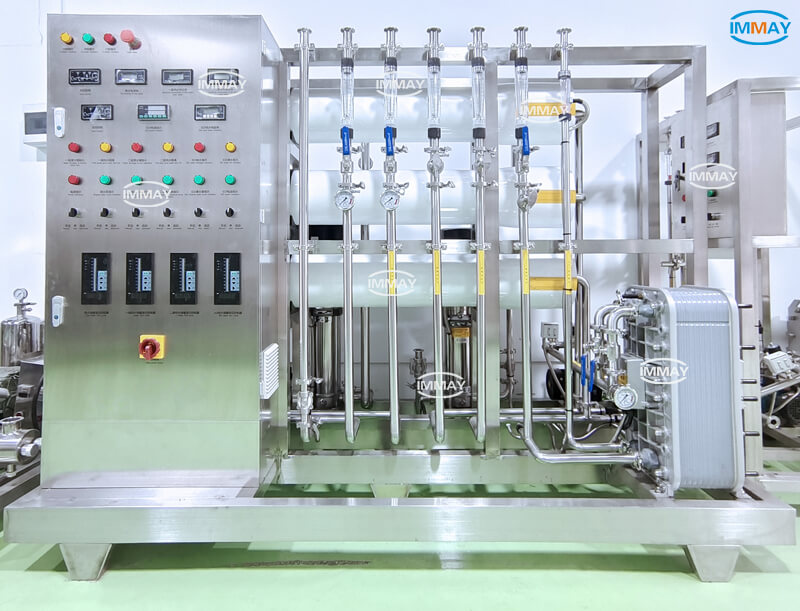
In industrial operations, purified water is a critical resource for processes ranging from cosmetics and food production to pharmaceuticals and electronics manufacturing. The design of an industrial reverse osmosis (RO) water purification system should ensure that water supply consistently meets production needs.
Accurately determining liters per hour (LPH) is essential, as it forms the foundation for membrane selection, pump sizing, and overall system configuration. Without proper LPH calculation, an industrial RO water treatment system may experience operational inefficiencies, unstable flow, or inadequate water supply—issues that directly impact production reliability.
This makes understanding how to calculate and apply the correct LPH the first and most critical step in designing a reliable industrial RO water purification system.
Determining the correct liters per hour (LPH) output is the foundational step in designing an industrial RO water purification system. This parameter defines the hydraulic structure, membrane configuration, pump selection, and overall system balance.
Without an accurate LPH calculation, system design becomes an estimate rather than an engineered solution.
In industrial environments, purified water is consumed continuously during production. If the system’s LPH output is lower than real-time demand, storage tanks may deplete faster than they are replenished.
This imbalance can result in:
Process interruptions
Reduced operational efficiency
Pressure fluctuations within the RO system
Accurate LPH calculation ensures that hourly production demand and permeate generation remain synchronized.
The required LPH directly determines:
Number of membrane elements
Array configuration
Feed flow rate
Operating pressure range
If LPH is underestimated, membranes may operate near maximum limits, increasing stress on the system. If overestimated, membranes may operate far below optimal design flow, reducing efficiency.
Proper LPH sizing ensures membranes operate within stable hydraulic conditions.
High-pressure pump capacity and pretreatment flow rates are calculated according to the target permeate output.
An inaccurate LPH estimate may lead to:
Oversized pump selection
Insufficient pretreatment flow
Unbalanced recovery rate
Because all upstream components are designed around permeate flow rate, LPH calculation forms the engineering baseline for the entire industrial RO water purification system.
Energy consumption, recovery rate, and membrane lifespan are influenced by flow design. When LPH aligns with real production demand, the system can operate within stable pressure and recovery parameters.
This improves long-term performance consistency and reduces operational variability.
Before selecting 1 stage or 2 stage configuration, before defining membrane count, and before evaluating system footprint, the required LPH should be clearly established.
It is not simply a specification value — it is the parameter that structures the entire industrial RO water purification system design.
Before calculating the required liters per hour (LPH) for an industrial RO water purification system, it is essential to determine the total daily purified water demand.
LPH is derived from daily volume, but daily demand should be defined accurately and realistically. This requires a structured evaluation of how purified water is consumed within the facility.
Daily water demand should never be estimated casually. It should be based on production data and operational conditions.
The primary component of daily demand is production process water. This includes purified water directly incorporated into products or used during processing stages.
In industrial environments such as cosmetic manufacturing, food processing, pharmaceutical production, or electronics assembly, purified water may be used for:
Formulation and mixing
Dilution processes
Equipment feed systems
Process support operations
Each process should be evaluated individually to determine the volume of purified water consumed per batch or per production hour.
Accurate production data is the foundation of reliable daily demand calculation.
Water consumption typically follows one of two patterns:
Batch-based production
Daily water demand equals:
Water per batch × Number of batches per day
Continuous production systems
Daily water demand equals:
Hourly water usage × Operating hours per day
Identifying whether the facility operates in batch mode or continuous flow mode ensures that total daily demand is calculated correctly.
In many industrial facilities, purified water is not limited to direct product formulation. It may also support auxiliary operations such as:
Equipment flushing
Tank filling
Process circulation systems
Although these volumes may appear secondary, they contribute to the total daily requirement and should be included in the calculation.
Daily demand depends not only on production volume but also on operating schedule.
A facility running 8 hours per day will require a different system configuration than one operating 20 hours per day, even if total daily output is similar.
Operating hours influence how daily volume is later converted into required LPH, so they should be defined accurately at this stage.
After compiling:
Production consumption
Auxiliary usage
Operating schedule
The result should be a clearly defined total daily purified water requirement, typically expressed in liters per day (LPD) or cubic meters per day (m³/day).
Only after this value is confirmed can the required LPH for the industrial RO water purification system be calculated with engineering accuracy.
Once the total daily purified water demand has been determined, the next step is to convert that daily volume into the required liters per hour (LPH) output for the industrial RO water purification system.
RO systems are engineered based on hourly production capacity, not daily totals. Therefore, converting daily demand into hourly flow rate is a critical step in system sizing.
Daily purified water demand is typically expressed in:
Liters per day (LPD)
Cubic meters per day (m³/day)
However, industrial RO water purification systems are specified in:
Liters per hour (LPH)
Cubic meters per hour (m³/h)
The required LPH represents the continuous permeate flow rate that the system should deliver during operating hours.
The fundamental conversion formula is:
Required LPH = Total Daily Water Demand ÷ Operating Hours per Day
Where:
Total Daily Water Demand = liters per day
Operating Hours per Day = actual system running hours
This calculation defines the base permeate production rate required from the industrial RO water purification system.
Assume a facility requires:
24,000 liters of purified water per day
RO system operates 12 hours per day
Calculation:
24,000 L ÷ 12 hours = 2,000 LPH
In this case, the industrial RO water purification system should be designed to produce 2,000 liters per hour under stable operating conditions.
Operating hours directly influence system size.
For example:
If the same 24,000 liters per day should be produced in:
24 hours → Required LPH = 1,000
8 hours → Required LPH = 3,000
Shorter operating schedules require higher hourly output, which affects:
Pump selection
Membrane quantity
System pressure requirements
This is why defining accurate operating hours before finalizing LPH is essential.
It is important to distinguish between:
Total daily consumption
Storage tank capacity
RO permeate production rate
The RO system should generate water fast enough to maintain stable tank levels during peak usage, not merely meet total daily volume in theory.
Required LPH should reflect real-time consumption patterns rather than averaged daily totals.
At this stage, the calculated LPH represents the baseline permeate output requirement.
Further adjustments—such as recovery rate considerations, hydraulic balancing, and system configuration—will refine the final design. However, this baseline LPH calculation forms the engineering starting point for the industrial RO water purification system.
Calculating the required liters per hour (LPH) for an industrial RO system should not be limited to current production demand. Industrial facilities often increase output over time, introduce new product lines, or extend operating schedules.
If the RO system is designed strictly around present-day consumption, future expansion may require structural modification rather than simple adjustment.
Incorporating expansion planning during initial LPH calculation reduces long-term redesign costs and operational disruption.
Before finalizing the required LPH, it is important to evaluate:
Planned increases in production volume
Addition of new processing lines
Potential shift changes extending operating hours
Even moderate production growth can significantly increase purified water demand. Designing the industrial RO water purification system with awareness of projected output prevents early capacity limitations.
An increase in required LPH affects more than just membrane quantity. It will influence:
High-pressure pump capacity
Membrane housing configuration
System footprint
Electrical load requirements
If expansion is not considered during the original calculation phase, upgrading later will involve replacing complete machines instead of adding modular capacity.
Proper planning ensures that the system structure can accommodate higher flow without compromising hydraulic balance.
While planning for growth is important, oversizing excessively can reduce operating efficiency.
An industrial RO system operating far below its design capacity may experience:
Reduced membrane performance stability
Lower system efficiency
Unnecessary capital expenditure
Therefore, expansion planning should be controlled and based on realistic production forecasts rather than arbitrary safety factors.
The required LPH defines the hydraulic framework of the industrial RO system. Incorporating a structured expansion margin during calculation allows the system to evolve alongside production demands without structural redesign.
Strategic planning at the sizing stage ensures that the industrial RO system remains aligned with both current operations and long-term manufacturing goals.
Accurately calculating the required liters per hour (LPH) is the cornerstone of industrial RO water system design. From determining total daily water demand to converting it into hourly flow rates and planning for future expansion, each step ensures that the system operates efficiently, reliably, and in alignment with production needs.
Neglecting proper LPH calculation can lead to operational inefficiencies, unstable system performance, or costly upgrades. A well-calculated LPH, on the other hand, ensures optimal membrane configuration, pump selection, and hydraulic balance for both current and future production.
For facilities that require precise and reliable industrial RO water treatment systems, IMMAY provides expertly engineered industrial RO water purification solutions tailored to production requirements. The industrial RO water purification systems manufactured by IMMAY operate reliably, maintain long-term efficiency, and accommodate future growth, ensuring a smooth and dependable water supply for operations.