- Home
- Equipment
- Industries
- We Immay
- Resource
- Contact
Author: Site Editor Publish Time: 2026-07-30 Origin: Site
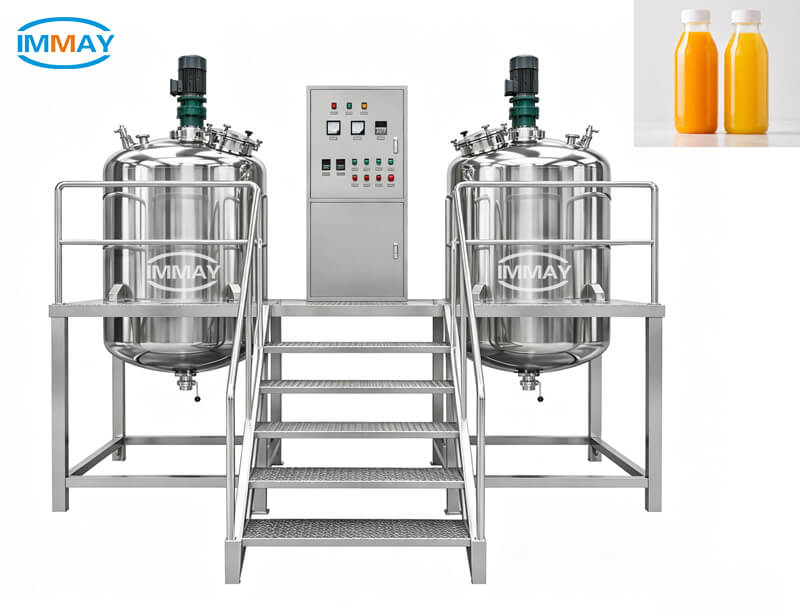
Producing FC (From Concentrate) juice involves more than simply blending concentrated juice with water. Consistent product quality depends on accurate control of formulation, Brix, acidity, and batch-to-batch consistency throughout the production process.
A stainless steel blending tank plays a central role in this process. Its design and configuration can affect blending uniformity, production efficiency, and the consistency of the final product.
When selecting a blending tank, manufacturers should evaluate more than just tank capacity. Product characteristics, production requirements, process conditions, and future expansion plans should all be considered before making a purchasing decision.
This article explains the key factors to consider when selecting a stainless steel blending tank for FC juice production, helping manufacturers choose equipment that best fits their production needs.
In FC (From Concentrate) juice production, the blending tank is the central processing vessel where concentrated juice, purified water, sugar syrup, acids, flavors, and other ingredients are combined into a uniform product before further processing. Although the formulation determines the target product characteristics, the blending process plays an important role in achieving consistent quality from batch to batch.
A properly selected stainless steel blending tank helps ingredients mix evenly, supports accurate formulation control, and prepares the product for downstream processes such as homogenization, pasteurization, and filling. Understanding where the blending tank fits within the production line is the first step toward selecting equipment that matches production requirements.
A typical FC juice production process follows these steps:
Concentrated Juice → Purified Water → Sugar Syrup → Acid & Other Ingredients → Stainless Steel Blending Tank → Homogenization (If Required) → Pasteurization → Filling
The blending tank is the stage where all formulation ingredients are combined into a homogeneous mixture before subsequent processing. During this step, manufacturers adjust product parameters such as Brix, acidity, and flavor according to the formulation while ensuring that all ingredients are evenly distributed throughout the batch.
Because every downstream process depends on a consistent blended product, stable blending conditions help reduce batch variation and improve overall production efficiency.
Uniform blending is essential because it directly influences the consistency of every production batch. Even when the same formulation is used, uneven mixing can lead to variations in product quality and make production control more difficult.
Consistent Brix
Brix is one of the most important quality parameters in FC juice production. Uniform blending helps distribute concentrate, water, and sugar syrup evenly, allowing the finished product to reach the target Brix throughout the entire batch.
Consistent Flavor
FC juice relies on accurate formulation to achieve the desired taste profile. Proper blending ensures that ingredients such as concentrate, sweeteners, acids, and flavors are evenly mixed, helping maintain a consistent flavor from one batch to the next.
Uniform Ingredient Distribution
Every ingredient should be dispersed evenly before the product enters the next processing stage. Uniform distribution reduces localized concentration differences and helps support stable downstream operations.
Stable Product Quality
Consistent blending provides a reliable foundation for homogenization, pasteurization, and filling. By producing a homogeneous mixture before further processing, manufacturers can improve batch-to-batch consistency and achieve more stable product quality over long-term production.
Before selecting a stainless steel blending tank, manufacturers should first define their product and process requirements. Different FC juice formulations may require different blending conditions, temperature control methods, and equipment configurations. Understanding these requirements before evaluating equipment helps narrow down suitable options and supports more informed purchasing decisions.
The first step is to identify the type of FC (From Concentrate) juice you plan to manufacture. Although the basic production process is similar, different products have different formulation characteristics and processing requirements.
Common examples include:
Orange juice from concentrate
Apple juice from concentrate
Mango juice from concentrate
Seabuckthorn juice from concentrate
Coconut water from concentrate
Mixed fruit juice
For example, some products contain fruit pulp, while others are clear juices. Some formulations also require stabilizers or additional ingredients. These differences can influence blending requirements and should be considered before selecting equipment.
A blending tank is designed to combine multiple ingredients into a uniform product. Before selecting equipment, manufacturers should identify all ingredients that will be introduced during the blending process.
Typical ingredients include:
Concentrated juice
Purified water
Sugar syrup
Citric acid
Flavors
Stabilizers
Vitamins
Fruit pulp (if applicable)
Different formulations can influence blending intensity, ingredient dispersion, temperature requirements, and even cleaning procedures. Understanding the complete recipe helps determine the most appropriate tank configuration for the production process.
Once your product characteristics and processing requirements have been defined, the next step is selecting a stainless steel blending tank that matches your production needs. Rather than comparing equipment based on a single specification, manufacturers should evaluate tank capacity, construction material, agitation system, and temperature control together. Selecting the right configuration helps improve production efficiency, maintain consistent product quality, and support future business expansion.
Tank capacity should be selected according to actual production requirements rather than simply matching the planned batch size. A properly sized blending tank provides sufficient working volume for efficient mixing while leaving adequate space for ingredient addition and product circulation.
When evaluating tank capacity, manufacturers should consider several factors, including daily production volume, batch size, production schedule, and available installation space. The working volume is generally more important than the total tank volume because it represents the recommended operating capacity during normal production.
Future production plans should also be taken into account. If production is expected to increase or additional FC juice products will be introduced, selecting a slightly larger tank may provide greater flexibility and help avoid premature equipment replacement.
Material selection should be based on the production process and operating environment rather than cost alone.
For most FC juice production lines, 304 stainless steel provides excellent corrosion resistance and is widely used for processing concentrated juice, purified water, sugar syrup, and other common beverage ingredients.
However, some manufacturers may prefer 316L stainless steel when processing formulations with higher acidity or when enhanced corrosion resistance is desired for long-term operation and more demanding cleaning conditions.
Instead of assuming one material is always better than the other, manufacturers should evaluate the product formulation, cleaning procedures, and expected operating environment before making a decision.
Although most FC juice products share the same objective of achieving stable and uniform blending, the agitation system should still be selected according to the formulation and production process.
For example, products containing fruit pulp require continuous circulation to help keep the pulp evenly suspended during blending, while formulations containing multiple liquid ingredients need efficient circulation to achieve uniform ingredient distribution throughout the batch.
Batch size should also be considered. As production volume increases, the agitation system must provide sufficient mixing efficiency to maintain consistent blending performance across the entire tank.
Rather than selecting an agitator based on appearance or standard configuration, manufacturers should first define the blending requirements of their product and then choose an agitation system that matches those requirements.
Whether a jacketed blending tank is required depends on the production process rather than the product itself.
Heating is commonly used when preparing sugar syrup or dissolving ingredients before they are added to the blending tank. Controlled heating helps improve ingredient dissolution and supports a more consistent blending process.
Cooling is required before downstream processing or when manufacturers need to maintain a specific product temperature during production. Stable temperature control can also improve process consistency for certain formulations.
If heating or cooling forms part of the manufacturing process, a jacketed stainless steel blending tank should be considered during equipment selection. Matching the temperature control system to the production process helps improve operational efficiency and provides greater process stability.
A blending tank is typically a long-term investment, so purchasing decisions should consider not only current production requirements but also future business development.
Before selecting equipment, manufacturers should evaluate whether production capacity is expected to increase, whether new FC juice products may be introduced, and whether larger batch sizes could become necessary in the coming years.
Planning for future expansion at the equipment selection stage can reduce the need for major upgrades later and provide greater flexibility as production requirements evolve. For many manufacturers, selecting equipment that supports both current operations and future growth is often a more practical long-term investment than choosing a tank based only on today's production needs.
Choosing a stainless steel blending tank for FC juice production involves more than comparing equipment specifications. Focusing on a single factor while overlooking production requirements can result in unnecessary costs, reduced production efficiency, and equipment that no longer meets business needs as production expands. Avoiding the following common mistakes can help manufacturers make more informed purchasing decisions.
One of the most common purchasing mistakes is choosing a blending tank based only on current production volume. While this reduces the initial investment, it can quickly become a limitation as production grows or new products are introduced.
Before selecting a tank, manufacturers should consider expected production growth, future batch sizes, and long-term business plans rather than today's requirements alone. Planning ahead can help avoid premature equipment replacement and reduce future expansion costs.
A blending tank configuration should always be matched to the production process. Factors such as temperature control, agitation performance, and product characteristics should be evaluated before selecting equipment.
For example, some FC juice production processes require heating or cooling, while others operate at ambient temperature. Products containing fruit pulp may also require different agitation performance compared with clear juice formulations. Defining process requirements first helps manufacturers select equipment that better supports their production objectives.
Price is an important purchasing consideration, but it should not be the only factor when comparing blending tanks. Differences in material quality, workmanship, agitation design, component selection, and after-sales support can all influence the long-term value of the equipment.
Instead of focusing only on the purchase price, manufacturers should compare the complete equipment configuration and evaluate which solution best matches their production requirements and long-term operating goals.
Choosing a stainless steel blending tank for FC juice production involves more than selecting the appropriate tank capacity. Product characteristics, formulation requirements, production processes, and future production plans should all be carefully evaluated before comparing equipment specifications. Defining these requirements at the beginning of the purchasing process helps manufacturers narrow down suitable equipment options and make more informed investment decisions.
A blending tank that matches the actual production process can support consistent product quality, improve production efficiency, and provide greater flexibility as manufacturing needs evolve. Taking a process-driven approach to equipment selection also helps reduce unnecessary modifications and supports more stable long-term production.