- Home
- Equipment
- Industries
- We Immay
- Resource
- Contact
Author: Site Editor Publish Time: 2025-11-20 Origin: Site
Turning a perfume formula from a small laboratory batch into a stable, repeatable industrial product is not just a matter of scaling values on a spreadsheet. It requires a controlled process, a deep understanding of how raw materials behave in large volumes, and a production environment equipped to protect the clarity, stability, and scent identity of the fragrance.
Industrial perfume manufacturing follows a structured sequence — mixing, freezing, filtration, storage, and filling. Each stage influences how the perfume develops, how clean and bright it appears, how long the scent lasts, and how consistent every bottle will be once it reaches the customer. When these stages are refined and aligned, a formulation transforms into a commercially ready fragrance that reflects the creator’s original intent.
Achieving this transformation depends on two pillars: a well-designed production workflow and equipment engineered for fragrance processing. From high-precision perfume mixing tanks to freezing and filtration systems that polish the scent, industrial equipment offers more than capacity — it shapes the quality of the final perfume. With the right setup, the production line becomes an extension of the perfumer’s craft, enabling smooth scale-up, reliable batch-to-batch uniformity, and an elegant manufacturing experience that inspires confidence.
When the process is thoughtfully designed, stepping into a perfume production line evokes a sense of purpose — materials flowing through stainless-steel tanks, fragrances freezing into clarity, and each bottle filled with precision. It becomes more than manufacturing; it becomes the art of perfume, translated into industrial form.
Before any formula enters industrial-scale production, manufacturers must fully understand how the raw materials behave, interact, and evolve throughout the process. This stage lays the technical foundation for smooth scale-up and prevents unexpected issues once production reaches hundreds or thousands of liters.
A perfume is a blend of fragrance concentrates, alcohol, and purified water, but each formula has its own unique structure.
Industrial production begins by identifying:
The ratio of top, middle, and base notes
Volatile components that may evaporate or shift during mixing
Heavy or resinous ingredients that require extended dissolution
Sensitive aroma chemicals that may react to heat or oxygen
Understanding these characteristics ensures that the process conditions — from mixing temperature to agitation intensity — are matched to the formula’s needs rather than applied universally.
Not all fragrance ingredients dissolve at the same rate or under the same conditions. In large-volume production, solubility challenges become more noticeable, especially for:
Essential oils prone to separation
Resins and absolutes that dissolve slowly
Ingredients that cloud at low temperatures
Components that interact poorly with alcohol–water ratios
Identifying compatibility early helps determine whether the formula needs controlled temperature mixing, specific dilution sequences, or additional clarification steps during production.
A perfume that is stable in a small lab bottle may behave differently in a 500 L, 1000 L, or 2000 L mixing tank. Stability considerations include:
Oxidation tendencies of certain aroma materials
Color changes triggered by light or heat
Interactions between alcohol and delicate natural extracts
Long-term scent integrity during storage
These factors influence decisions such as whether mixing should be done under closed conditions, whether nitrogen blanketing is beneficial, and how long the perfume must rest before filtration.
Industrial perfume production aims for clean, bright transparency, free from haze, sediment, or micro-precipitates. To ensure this level of clarity, manufacturers assess:
The formula’s natural clarity behavior
Temperature at which clouding occurs
Whether freezing is required to remove insoluble particles
The filtration grade needed to achieve the desired polish
This evaluation guides the selection of freezing temperature, filtration stages, and the storage conditions that keep the perfume visually flawless.
Understanding these characteristics transforms a perfume formula from a creative concept into a technically ready product — one that can be reproduced confidently and consistently at an industrial scale.
Scaling a perfume formula from a small laboratory batch to industrial production is not a matter of simply multiplying ingredient quantities. The transition introduces complexities that affect solubility, stability, clarity, and fragrance integrity. Understanding these technical considerations ensures that the perfume retains its original profile while performing consistently at scale.
As batch size increases, the volatility of certain fragrance components becomes more pronounced. Top notes may evaporate faster, middle notes may require longer blending times to harmonize, and base notes can behave differently in large volumes. Maintaining the original scent profile requires careful control over:
Mixing intensity and duration
Temperature management during blending
Timing of ingredient addition
Proper planning ensures that the aroma perceived in the final industrial batch matches the small-scale laboratory version.
While small-scale formulas often dissolve quickly in a lab, industrial-scale production introduces challenges:
Ingredients may form clumps
Slow-dissolving components can cause uneven fragrance distribution
Large liquid masses require staged addition or gradual mixing to avoid separation
Selecting the right mixing system and optimizing agitation speed ensures uniform solubilization across the entire batch.
Temperature affects solubility, clarity, and chemical stability:
Excessive heat can degrade delicate aromatic compounds
Too low a temperature can affect solubility and mixing efficiency
Maintaining a controlled temperature range throughout mixing, freezing, and filtration ensures consistency
Industrial-scale perfume mixing equipment incorporates temperature-controlled freezing systems to maintain optimal conditions for fragrance stability.
Scaling up can introduce sedimentation issues not seen in laboratory samples:
Particles that remain suspended in small volumes may settle in large tanks
Resins and natural extracts may precipitate if not properly dissolved or cooled
Freezing and filtration steps are essential to remove these sediments, preserving visual clarity and batch consistency
Consistency is the hallmark of professional industrial production. Variations in mixing, temperature, or solubilization can lead to differences in clarity, aroma, or color between batches. To mitigate this risk:
Standardize mixing speeds, times, and sequences
Monitor temperature throughout the process
Incorporate quality checkpoints before and after each stage
Scaling a perfume formula requires a careful balance of mixing, solubilization, temperature control, and sediment management. Addressing these technical considerations ensures that the industrial batch faithfully reproduces the laboratory fragrance while meeting the high expectations of consumers and retailers.
Industrial-scale perfume production follows a structured process designed to ensure the fragrance maintains its clarity, stability, and aroma integrity. This process is composed of five core stages: mixing, freezing, filtration, storage, and filling. Each step is carefully controlled to preserve the characteristics of the original formula while enabling large-volume manufacturing.
High speed mixing is the first critical stage in scaling up a perfume formula. Unlike laboratory stirring, industrial mixing involves large volumes where ingredient distribution must be uniform across hundreds or thousands of liters.
Key technical points:
High speed mixing ensures all fragrance components dissolve evenly in the alcohol base.
High speed mixing in industrial perfume stainless steel tanks allows the formula to achieve uniformity efficiently while preserving the intended scent profile.
After mixing, the perfume undergoes a controlled freezing stage. This step is designed to:
Precipitate insoluble particles or naturally occurring impurities
Improve visual clarity and stability of the final product
Technical considerations:
Freezing temperature is carefully maintained within a specified range to allow effective precipitation without compromising solubility.
This stage is essential for preparing the product for subsequent filtration while maintaining fragrance integrity.
Filtration follows freezing to remove precipitated particles and ensure a clear, stable perfume. Industrial filtration systems are designed for high volume and precision.
Key points:
Filtration grade is selected based on particle size expected from the freezing stage.
Multiple filtration passes may be applied for formulas with higher resin or oil content.
Proper filtration ensures the perfume meets visual quality standards before storage.
Once filtered, the perfume is stored in stainless steel storage tanks to allow aging and stabilization.
Technical aspects:
Tanks are made of high qulaity stainless steel materials to reduce reactions with alcohol or aromatic compounds.
Maturation duration is adjusted based on formula complexity to achieve a balanced scent and consistent batch quality.
Storage is not merely holding the perfume—it is a controlled stage for chemical and sensory stabilization.
The final stage is filling and sealing, which should maintain precision and consistency at high volume.
Industrial considerations:
Perfume filling systems are tailored to each packaging container.
Accurate volume control ensures each bottle contains the intended amount without waste.
Precise filling and sealing completes the production line, delivering a product a product that meets market requirements.
Successful industrial-scale perfume production relies on specialized equipment designed to handle large volumes while maintaining product quality. The following machines form the backbone of an efficient perfume production line: mixing/freezing/filtration, storage, and filling/sealing systems.
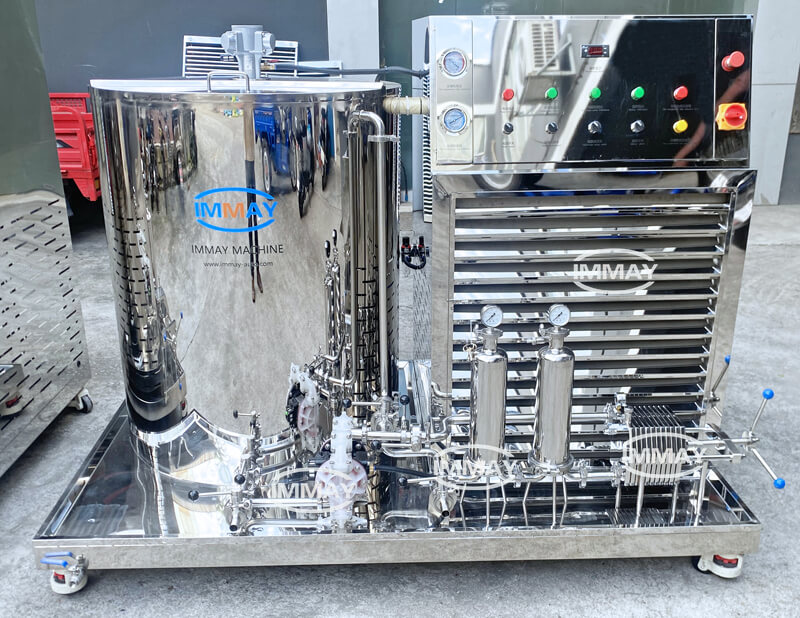
This integrated system combines high-speed mixing, controlled freezing, and precise filtration in a single unit. Its advantages include:
High Speed Mixing: Ensures uniform dispersion of aroma components across large batches.
Controlled Freezing: Maintains the appropriate temperature to precipitate insoluble particles without compromising solubility or batch consistency.
Filtration: Removes precipitated particles to achieve clear, stable perfume ready for storage.
By integrating these three functions, this machine reduces handling steps, minimizes contamination risk, and streamlines production.
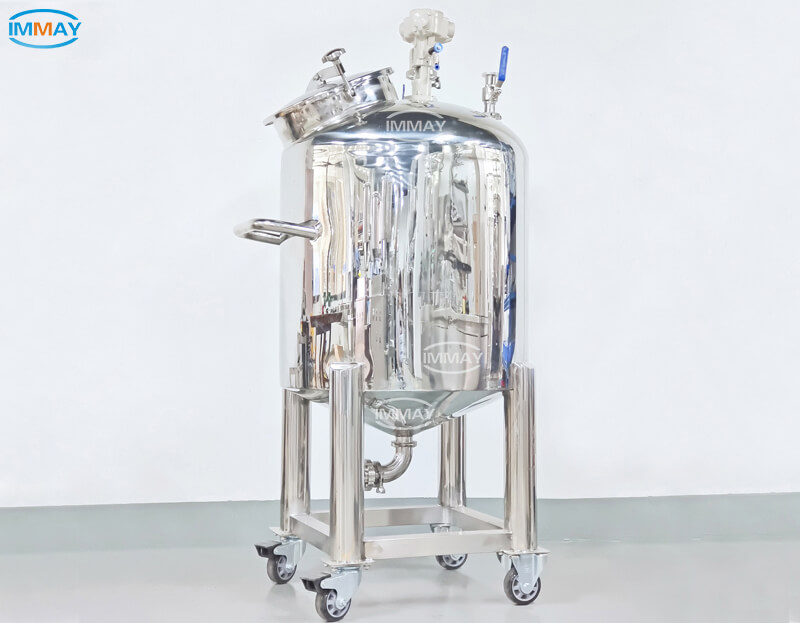
Proper storage is essential for fragrance stabilization and maturation. premium perfume stainless steel storage tanks feature the following characteristics:
Material Compatibility: Constructed from stainless steel to resist alcohol and aromatic compounds.
Pneumatic agitation: ensures uniform maturation of the perfume.
These perfume maturation tanks provide a controlled environment where the perfume can mature and remain stable before packaging.
The final stage of production is accurate filling and secure sealing. Industrial perfume bottle filling machines are designed to handle your unique perfume container while ensuring precision:
Customization: Filling systems are configured one-to-one according to bottle size and spray mechanism.
Precision Filling: Accurate volume control minimizes product waste and ensures consistency.
Sealing Integrity: Ensures bottles are properly closed, preserving fragrance quality and shelf-life.
Together, these machines form a complete production line capable of converting laboratory perfume formulas into industrial-scale products with consistent quality.
Working with IMMAY provides access to specialized expertise and equipment designed for industrial-scale perfume production. IMMAY offers:
Integrated Production Solutions: From high-speed mixing to freezing, filtration, storage, and filling, IMMAY’s equipment supports every stage of the perfume manufacturing process.
Customizable Equipment: Machines are tailored to your batch size, formula characteristics, and packaging requirements, ensuring efficient and consistent production.
Technical Support: IMMAY’s experts assist in process planning, equipment configuration, and workflow optimization, helping to translate laboratory formulas into reliable industrial batches.
Proven Industrial Reliability: Designed for continuous operation, IMMAY equipment ensures stable performance, uniform mixing, and high-quality final products across every batch.
Partnering with IMMAY allows manufacturers to scale up perfume production with confidence, combining technical precision with flexible industrial solutions.
Industrial-scale perfume production is a meticulous process that transforms laboratory formulas into commercially viable fragrances. From high speed mixing to controlled freezing, precise filtration, stainless steel storage, and tailored filling/sealing, each stage plays a crucial role in maintaining clarity, stability, and the intended scent profile.
Achieving consistent, high quality results requires a deep understanding of the formula, careful control of solubility and temperature, and equipment designed specifically for large-volume operations. Properly managed, these factors ensure that every batch meets both technical standards and market expectations.
Partnering with IMMAY integrates expertise, customizable equipment, and technical support across the production workflow. This collaboration allows manufacturers to confidently scale up, maintain uniformity across batches, and optimize production efficiency, ensuring that the final perfume reflects the creator’s vision at industrial scale.
Contact IMMAY today to discuss how your perfume formula can be efficiently translated into a stable, high quality industrial product.