- Home
- Equipment
- Industries
- We Immay
- Resource
- Contact
Author: Site Editor Publish Time: 2025-10-21 Origin: Site
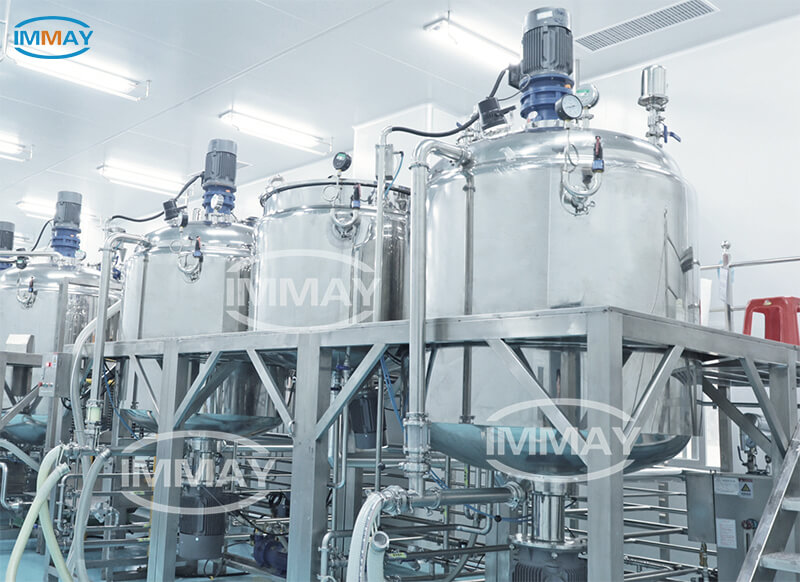
Producing high-quality cosmetic lotion at an industrial scale is more than simply mixing oil and water. The process requires careful control of emulsification, shear, temperature, and circulation to ensure a smooth texture, stable emulsion, and consistent performance across batches.
Each stage of production plays a specific role, from blending the water and oil phases to dispersing active ingredients and controlling temperature. Understanding how these steps work together is essential for achieving the desired lotion quality.
A clear grasp of the production process also provides the foundation for selecting the right cosmetic lotion mixer. By looking at what needs to happen during each stage, it becomes easier to determine which mixer features and configurations are necessary to meet production goals efficiently and reliably.
Producing high-quality cosmetic lotion on an industrial scale requires precision, control, and a deep understanding of the process. Each stage contributes to the final texture, stability, and performance of the product. The following workflow outlines the key stages of industrial lotion production and the objectives to be achieved at each point.
The foundation of any lotion is its raw materials. Industrial production separates the water and oil phases for precise control:
Water Phase: Water, humectants, and water-soluble ingredients are blended in a temperature-controlled vessel. Heating ensures powders and solutes fully dissolve for a smooth base.
Oil Phase: Oils, emulsifiers, and oil-soluble actives are combined in a separate vessel. Heating melts emulsifiers and reduces viscosity, preparing the phase for seamless integration with the water phase.
Objective: Ensure all components are fully dissolved or melted and reach the optimal temperature for emulsification.
After preparation, the water and oil phases are introduced into the main mixing vessel. Pre-mixing integrates the two phases gently:
Low to moderate shear prevents unnecessary air incorporation.
Heat- or shear-sensitive ingredients are avoided at this stage to preserve integrity.
Objective: Achieve an even preliminary blend without destabilizing sensitive components or creating air pockets.
The heart of lotion production lies in emulsification. Industrial mixers apply controlled shear and circulation to produce a uniform and stable emulsion:
High Shear Homogenization: Reduces oil droplets to micro-size for a smooth, luxurious texture.
Effective Circulation: Ensures every portion of the batch passes through the homogenization zone, maintaining uniformity.
Temperature Control: Maintains ideal conditions to protect sensitive ingredients and support stable emulsification.
Objective: Create a consistent droplet distribution and a resilient emulsion structure that resists separation.
After emulsification, the lotion is cooled to a safe handling temperature:
Jacketed vessels allow precise, uniform cooling.
Maintaining even temperature protects the emulsion and prepares for the addition of heat-sensitive active ingredients.
Objective: Bring the lotion to a temperature that preserves sensitive actives while maintaining consistency and viscosity.
Once the lotion has cooled to the appropriate temperature, functional ingredients such as powders, extracts, or heat-sensitive actives are added:
Frame agitators ensure complete dispersion.
Controlled shear prevents degradation of sensitive compounds.
Objective: Disperse all active ingredients evenly, ensuring consistent performance across the batch without damaging delicate compounds.
High shear mixing can introduce air into the lotion, affecting texture and appearance. Vacuum systems are applied after active ingredient incorporation to remove entrapped air:
Vacuum eliminates air pockets, improving density and texture.
This step ensures the lotion is visually smooth, dense, and stable.
Objective: Produce a refined, bubble-free lotion ready for packaging.
Before packaging, the lotion is held in a tank for final checks:
Visual inspection confirms uniformity and absence of separation.
Optional sampling tests viscosity, pH, and active ingredient concentration.
Objective: Ensure each batch meets stringent production standards and is ready for packaging.
In industrial lotion production, each stage of the workflow is designed to achieve specific performance outcomes. Understanding these objectives is essential for selecting and configuring the right cosmetic lotion mixer. The following section breaks down the process goals and the key indicators that define high-quality lotion production.
Key Goal: Ensure that oil and water phases are thoroughly integrated into a stable emulsion with consistent microdroplet size.
Why it matters: Uniform emulsification determines the lotion’s texture, stability, and shelf life. Large or uneven droplets can lead to phase separation, gritty texture, or uneven application.
Key Indicators:
Microdroplet size distribution
Emulsion viscosity and consistency
Resistance to phase separation during storage
Implications for Mixer Selection:
High shear homogenization and efficient circulation are essential to maintain uniform droplet size. Mixer designs should allow adjustable shear rates and thorough batch circulation to achieve consistent emulsification.
Key Goal: Disperse heat-sensitive or particulate ingredients uniformly throughout the lotion after cooling.
Why it matters: Active ingredients must be evenly distributed to ensure consistent product efficacy and appearance. Uneven dispersion can cause clumping, sedimentation, or inconsistent performance in the final product.
Key Indicators:
Homogeneity of functional ingredient distribution
Absence of localized clumping or sedimentation
Preservation of ingredient activity
Implications for Mixer Selection:
Mixers with bottom-entry or side-entry agitators and controlled shear are preferred to fully incorporate active ingredients without degradation. Temperature control is critical to protect heat-sensitive compounds.
Key Goal: Remove entrapped air introduced during high-shear emulsification to improve texture and density.
Why it matters: Air bubbles reduce lotion density, can create visual defects, and affect stability. Proper deaeration ensures a smooth, luxurious feel and improves product stability.
Key Indicators:
Absence of visible bubbles or foam
Consistent density throughout the batch
Improved shelf stability
Implications for Mixer Selection:
A vacuum system integrated with the mixer is essential for effective air removal. The system should allow adjustable vacuum levels to optimize deaeration without causing foaming or ingredient degradation.
Key Goal: Ensure that the entire batch experiences consistent shear, temperature, and flow throughout the vessel.
Why it matters: Uneven circulation or temperature gradients can lead to localized over-shearing, incomplete emulsification, or degradation of sensitive actives. Consistent temperature also affects viscosity and overall product stability.
Key Indicators:
Uniform temperature throughout the mixing vessel
Even shear exposure for all material
Consistent batch viscosity
Implications for Mixer Selection:
Mixers should provide controlled circulation and precise temperature regulation, typically through jacketed vessels or inline heating/cooling systems. Adjustable flow patterns and shear settings ensure that all parts of the batch meet quality targets.
Each stage of lotion production is designed to achieve measurable outcomes that collectively define product quality. By linking workflow steps to these key indicators—uniform emulsification, active ingredient distribution, effective deaeration, and consistent circulation/temperature—manufacturers can make informed decisions about mixer configuration. This approach ensures that the selected cosmetic lotion mixer not only handles the batch but actively contributes to producing stable, high-quality lotion.
In industrial lotion production, achieving consistent quality is not only about following the workflow—it is about ensuring that each process goal is met through the right mixer functionality. By linking the desired outcomes to mixer features, manufacturers can select and configure equipment that delivers consistent, high-quality results. Below, we break down the primary process goals and how they guide mixer selection.
Effect Goal: Create a smooth, stable emulsion with consistent microdroplet size.
Required Mixer Function: Bottom-entry high-shear homogenization allows the material to pass through the shear zone repeatedly, reducing oil droplet size and ensuring uniform distribution.
IMMAY Configuration: IMMAY cosmetic lotion mixers can be equipped with adjustable-speed bottom high-shear homogenizers, providing precise control over droplet size and emulsion stability.
By focusing shear where it is most effective, these mixers prevent uneven emulsification and produce a consistently smooth texture across the batch.
Effect Goal: Disperse functional or heat-sensitive ingredients uniformly without clumping.
Required Mixer Function: Frame-style scraper agitators gently move the material along the vessel walls and bottom, ensuring that all solids and powders are fully incorporated.
IMMAY Configuration: IMMAY mixers feature integrated frame scraper systems that provide continuous wall scraping and controlled shear, ensuring active ingredients are evenly distributed while protecting delicate compounds.
This design allows sensitive actives to maintain efficacy and prevents uneven dispersion.
Effect Goal: Remove entrapped air to improve lotion density, texture, and visual quality.
Required Mixer Function: Vacuum-assisted deaeration draws out air introduced during high-shear emulsification, eliminating bubbles and foam.
IMMAY Configuration: IMMAY cosmetic lotion mixers offer integrated vacuum systems that can be adjusted for optimal deaeration.
This step ensures the lotion feels dense, smooth, and luxurious while remaining stable during storage.
Effect Goal: Preserve sensitive ingredients, maintain consistent viscosity, and support stable emulsification.
Required Mixer Function: Jacketed vessels with heating and cooling capabilities allow precise control of the batch temperature throughout the process.
IMMAY Configuration: IMMAY mixers feature full jacketed systems for controlled heating and cooling, enabling safe incorporation of temperature-sensitive actives and maintaining product consistency.
Temperature control ensures the final lotion has the desired texture, stability, and performance.
Selecting the right cosmetic lotion mixer begins with understanding the production goals: uniform emulsification, active ingredient dispersion, effective deaeration, and precise temperature control. By mapping each objective to specific mixer functions—high-shear homogenization, frame scraper agitation, vacuum systems, and jacketed heating/cooling—manufacturers can configure IMMAY cosmetic lotion mixers to meet the precise needs of their formulation.
This approach ensures that every batch is consistent, stable, and high-quality, aligning industrial production practice with equipment selection.
Industrial lotion production is more than combining ingredients—it is a delicate interplay of pre-mixing, emulsification, temperature control, and deaeration. Understanding each step and the effects it must achieve is the foundation of consistently producing smooth, stable, and luxurious lotions.
By aligning production goals with mixer functionality—bottom-entry high-shear homogenizers for uniform emulsification, frame scraper agitators for even active dispersion, vacuum systems for flawless deaeration, and jacketed vessels for precise temperature control—manufacturers can transform process insight into tangible product excellence.
Investing in the right cosmetic lotion mixer is an investment in quality, efficiency, and market competitiveness. IMMAY offers expertly engineered mixers tailored to industrial lotion production, allowing every batch to meet professional standards.
Choose IMMAY to ensure your lotion production not only meets expectations but sets a new benchmark for smoothness, stability, and consumer satisfaction.