- Home
- Equipment
- Industries
- We Immay
- Resource
- Contact
Author: Site Editor Publish Time: 2025-11-12 Origin: Site
The cosmetic industry is experiencing rapid growth, with increasing demand for a wide variety of products, from luxurious creams and serums to innovative gels and lotions. For manufacturers, whether running a small boutique operation or a large-scale production line, the choice of a cosmetic mixing machine is critical. The right machine ensures consistent texture, stable emulsions, and reliable product quality across every batch, directly impacting consumer satisfaction and brand reputation.
Choosing between a small batch and a large-scale cosmetic mixing machine is not just about capacity; it involves understanding production needs, product types, viscosity, and mixing complexity. Small batch machines offer flexibility for developing new formulations or producing niche products, while large-scale machines provide efficiency and consistency for mass production.
This guide explores the differences between small batch and large-scale cosmetic mixing machines and provides a detailed framework for selecting the right machine for your production requirements. By the end, manufacturers will have a clear understanding of which type of machine aligns with their operational goals and product portfolio.
Selecting the right cosmetic mixing machine begins with understanding the specific requirements of each product type. Different formulations—such as creams, lotions, serums, gels, or balms—have unique viscosity, emulsification, and temperature characteristics that influence the choice of mixing machine. The correct machine ensures consistent texture, stable emulsions, and uniform product quality across every batch.
Viscosity is a critical factor. High-viscosity formulations like thick creams or balms require machines capable of strong shear mixing and thorough wall scraping to achieve a uniform texture and effective emulsification. Low-viscosity products, such as serums or liquid lotions, require machines that can mix efficiently while preserving the integrity of delicate active ingredients.
Temperature control is another essential consideration. Certain formulations require precise heating or cooling to maintain emulsion stability, activate functional ingredients, or prevent degradation. Machines with integrated heating/cooling jackets allow manufacturers to maintain consistent temperatures throughout the batch, ensuring uniform product performance.
Emulsification and homogenization capabilities are also key. High-shear mixing machines disperse and stabilize oil-water mixtures, producing smooth, consistent emulsions suitable for skincare and cosmetic products. Selecting a machine with the appropriate mixing mechanism ensures proper incorporation of all ingredients and a stable final product.
Production goals, including batch size and frequency, further influence machine selection. Small-batch machines offer flexibility for testing new formulations or producing specialty products, while large-scale machines provide efficiency and consistency for high-volume production.
By understanding these mixing requirements—viscosity, temperature control, emulsification needs, and production scale—manufacturers can make informed decisions and select the cosmetic mixing machine best suited for their current and future production needs.

Small-batch cosmetic production typically refers to operations designed to produce limited quantities of products per batch. These machines are ideal for research and development, pilot production, and specialty or boutique product lines. The focus is on flexibility, precise control, and the ability to handle frequent formula changes without compromising quality.
Small-batch machines usually handle volumes ranging from 50 liters to 300 liters, depending on the model and manufacturer. This size range allows cosmetic brands to produce new formulations, test small runs, or meet niche market demand efficiently.
Small-batch cosmetic mixing machines are designed to balance functionality with compact size:
Stainless steel mixing tank: Durable, easy to clean, and suitable for cosmetic formulations.
Integrated high shear mixing: Ensures emulsions are uniform and stable, producing smooth textures for creams, lotions, or serums.
Wall-scraping mechanism: Prevents material from sticking to the tank walls and promotes consistent mixing.
Touchscreen or button controls: Operators can adjust speed, duration, and mixing sequence easily, ensuring repeatable results.
Heating or cooling jackets (if needed): Some formulas benefit from precise temperature control during mixing to maintain stability or optimize texture.
Small-batch cosmetic mixer machines are particularly useful in scenarios such as:
New formula development: Quickly test and refine cosmetic formulations.
Niche or boutique brands: Produce small quantities efficiently without committing to large-scale machinery.
Frequent recipe changes: Easily adapt the machine to different products with minimal downtime.
Pilot or R&D production: Evaluate scalability and performance before moving to larger production.
By offering precise control, high shear mixing, and flexibility in batch size, small-batch cosmetic mixing machines allow manufacturers to experiment and innovate while maintaining consistent product quality.
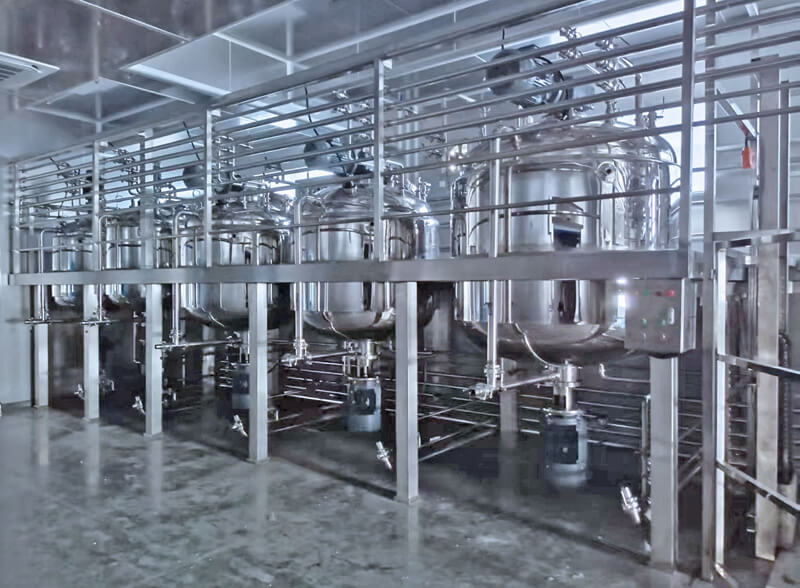
Large-scale cosmetic production refers to machines designed for high-volume, continuous or batch production. These machines are used by manufacturers producing mass-market skincare products, contract manufacturers, or brands scaling up successful formulations. The focus is on throughput, consistency, and efficiency, ensuring each batch meets quality standards while minimizing production time.
Large-scale cosmetic mixing machines typically handle volumes from 500 liters up to 5000 liters or more, depending on the production requirements. This capacity allows manufacturers to produce significant quantities daily, supporting commercial operations and large order fulfillment.
Large-scale cosmetic mixing machines are engineered to handle heavy workloads while maintaining precise control over product quality:
Heavy-duty stainless steel mixing tank: Robust construction suitable for continuous industrial use.
High-shear homogenization: Ensures uniform emulsions even in high-volume batches, producing consistent texture and stability.
Wall-scraping agitator: Prevents material from sticking to the tank walls and ensures complete mixing of all ingredients.
Touchscreen PLC controls: Operators can program mixing sequences, speed, and duration for repeatable results across batches.
Integrated heating and cooling jackets: Maintain precise temperature control to optimize product quality and consistency.
Large-scale cosmetic mixing machines are particularly suitable for:
Mass-market skincare and cosmetic brands: High-volume daily production while maintaining consistent product quality.
Contract manufacturers: Efficient production of multiple product lines with minimal downtime.
Scaling up pilot formulations: Transitioning successful small-batch formulas to industrial volumes.
Continuous production operations: Ensuring efficiency, batch-to-batch consistency, and optimized labor use.
By providing high throughput, precise mixing, and robust design, large-scale cosmetic mixing machines help manufacturers achieve industrial-level efficiency while ensuring every batch meets the desired quality standards.
When choosing a cosmetic mixing machine, understanding the differences between small-batch and large-scale machines is essential. Each type offers distinct advantages depending on production goals, product types, and operational requirements.
Small-batch machines: Designed for 50–300 liters per batch, suitable for R&D, pilot runs, and niche products. They allow manufacturers to produce limited quantities efficiently and adjust formulas frequently.
Large-scale machines: Designed for 500–5,000 liters per batch, ideal for mass production. They support high-volume daily output while maintaining consistent quality across batches.
Small-batch machines: Equipped with high shear mixing and wall-scraping mechanisms, they provide uniform emulsification for smaller quantities, enabling precise texture control.
Large-scale machines: Utilize robust high shear homogenizers and larger wall-scraping agitators to handle larger volumes without compromising consistency, ensuring stable emulsions across industrial batches.
Small-batch machines: Some models offer heating or cooling jackets to maintain formula stability for sensitive ingredients, suitable for experimental or specialty formulations.
Large-scale machines: Integrated heating and cooling systems provide precise control for large volumes, ensuring consistent product quality in industrial production.
Small-batch machines: Highly flexible, allowing quick recipe changes and product testing, making them ideal for R&D and boutique brands.
Large-scale machines: Designed for continuous production and high output; changeovers require more planning but support efficient large-scale manufacturing.
Small-batch machines: Lower initial investment, compact footprint, suitable for small facilities or pilot labs.
Large-scale machines: Higher capital cost and larger footprint, justified by efficiency and volume for commercial production.
By evaluating these differences—volume, mixing capability, temperature control, flexibility, and cost—manufacturers can make informed decisions on which machine type best fits their production needs. Understanding these distinctions ensures optimal efficiency, consistent product quality, and long-term operational success.
Choosing the right cosmetic mixing machine goes beyond understanding differences between small-batch and large-scale machines. It requires a structured approach to ensure the selected machine aligns with your production goals and product requirements. Here’s a step-by-step guide
Clarify what you aim to achieve with the machine. Are you focusing on formula development, niche product runs, or high-volume commercial production? Knowing your objectives helps narrow down the machine type and required features.
Determine the typical batch size and how often you plan to produce each formulation. This ensures the machine’s capacity matches your operational needs without underutilization or bottlenecks.
Consider the type of products you plan to produce and their processing requirements:
Viscosity level
Sensitivity to temperature
Need for emulsification and homogenization
These factors influence the choice of mixing speed, shear level, and additional functions your machine should have.
Decide on essential machine features for your process, such as:
High shear mixing capabilities
Wall-scraping or lifting mechanisms
Heating or cooling jackets
Touchscreen or button controls for ease of operation
Consider potential expansion or new product lines. Selecting a machine that allows for scalability or integration into future production setups helps prevent early obsolescence.
Consulting with experienced specialists can optimize your selection process. IMMAY’s experts provide advice on machine configuration, capacity, and functional options tailored to your production needs, helping you make an informed choice efficiently.
By following these steps, manufacturers can confidently select a cosmetic mixing machine that meets their current production requirements while accommodating future growth, ensuring smooth operations and consistent product quality.
Choosing the right manufacturer is as important as selecting the right machine. IMMAY has extensive experience in designing and producing cosmetic mixing machines that meet the needs of both small-batch and large-scale production.
IMMAY provides machines ranging from 50 liters for small-batch production to 5,000 liters for large-scale manufacturing, ensuring that every customer receives a machine suited to their production goals. Each machine is designed according to client requirements, guaranteeing optimal performance and efficiency.
As a manufacturer focused on cosmetic production, IMMAY understands the unique challenges of mixing creams, lotions, serums, and gels. Our machines are engineered to deliver precise high shear mixing, stable emulsions, and consistent product texture across every batch.
IMMAY machines are constructed from high quality stainless steel, providing durability, hygiene, and long-term reliability. The robust design ensures safe operation and reduces maintenance requirements, even in continuous production environments.
IMMAY cosmetic mixing machines incorporate essential features for cosmetic production
High shear homogenizer, which ensures thorough mixing and produces finer, smoother cosmetic cream and lotion products
Wall-scraping agitators for consistent blending
Heating and cooling jackets for temperature-sensitive formulations
Touchscreen or button controls for intuitive operation
Beyond the machine itself, IMMAY offers full technical guidance throughout the production process. From selecting the right machine to installation and operational support, our specialists help ensure your production runs smoothly and efficiently.
IMMAY cosmetic mixing machines can be configured to meet both boutique and mass-market needs. Whether you require a small-batch machine for R&D or a large-scale machine for high-volume production, IMMAY provides solutions that balance performance, reliability, and cost-effectiveness.
By choosing IMMAY cosmetic mixing machines, manufacturers gain access to reliable, efficient, and tailored solutions that support consistent product quality and optimized production workflows.
Selecting the right cosmetic mixing machine is a critical step in ensuring consistent product quality, efficient production, and long-term operational success. By understanding the differences between small-batch (50L–300L) and large-scale (500L–5000L) machines, manufacturers can align their machine choice with production goals, product types, and operational requirements.
Small-batch machines provide flexibility, precision, and ease of use for R&D, pilot runs, and specialty products. Large-scale machines deliver efficiency, consistency, and high throughput for commercial production. By evaluating batch size, viscosity, temperature requirements, homogenization needs, and potential future growth, manufacturers can make informed decisions that optimize their production processes.
IMMAY cosmetic mixer machines can be customized according to production needs, making them suitable for a wide range of cosmetic formulations, including creams, lotions, gels, and serums. They support both small-batch and large-scale production while ensuring uniformity and stability for every batch.
Contact IMMAY today to discover how our advanced cosmetic mixing machines can help you achieve efficient, consistent, and high quality production tailored to your unique manufacturing needs.