- Home
- Equipment
- Industries
- We Immay
- Resource
- Contact
Author: Site Editor Publish Time: 2026-07-17 Origin: Site
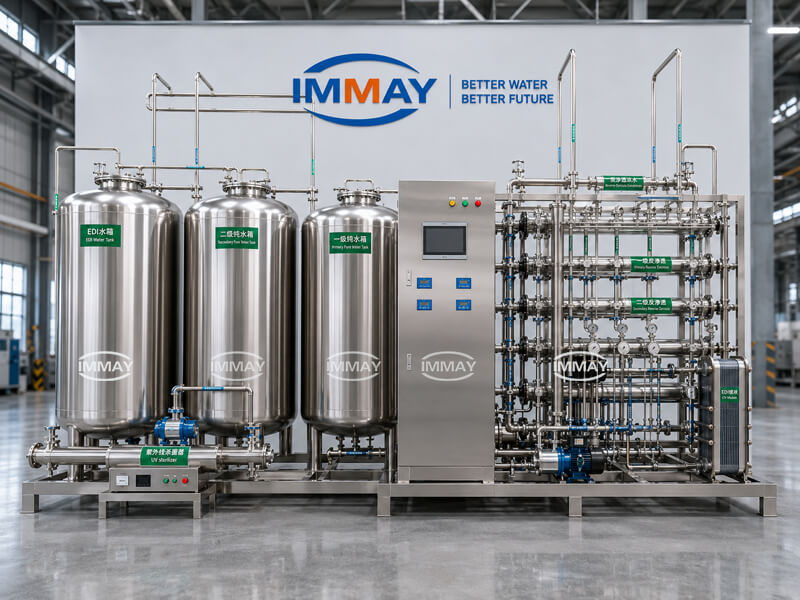
Reverse osmosis (RO) membranes are designed to remove dissolved salts and produce high-quality purified water. However, they are not designed to handle large amounts of suspended solids, hardness minerals, residual chlorine, or organic contaminants directly. When feed water enters an RO system without proper pretreatment, these impurities can foul or damage the membranes, reducing water production, increasing operating pressure, and shortening membrane service life.
Proper pretreatment acts as the first line of protection for an industrial RO system. By removing contaminants before they reach the membranes, it helps maintain stable system performance, extend membrane life, and reduce long-term operating costs. This article explains what can happen when pretreatment is omitted and why selecting the right pretreatment is essential for reliable RO operation.
Pretreatment is the process of conditioning feed water before it enters a reverse osmosis (RO) system. Its primary purpose is to remove contaminants that can reduce membrane performance or cause irreversible damage. By reducing suspended solids, chlorine, hardness, and other impurities, pretreatment helps maintain stable water production, improve membrane efficiency, and extend the service life of the RO system.
The pretreatment configuration depends on the quality of the incoming water. While every industrial RO system is different, the following components are commonly used.
A multimedia filter removes suspended solids, sediment, rust, and other larger particles from the feed water. Reducing these particles helps prevent fouling of downstream filters and RO membranes, improving overall system reliability.
An activated carbon filter removes residual chlorine, organic compounds, and unpleasant odors from the feed water. For polyamide RO membranes, chlorine removal is particularly important because prolonged exposure to chlorine can permanently damage the membrane surface.
When the feed water contains high levels of hardness minerals such as calcium and magnesium, a water softener is installed before the RO system. Softening the water helps reduce scale formation on the membrane surface, maintaining stable water production and operating pressure.
A cartridge filter is typically the final pretreatment stage before water enters the RO system. It captures fine particles that pass through previous filtration stages, providing an additional level of protection for the RO membranes.
There is no universal pretreatment configuration for every industrial RO system. The appropriate combination of filters depends on the characteristics of the feed water. Municipal water, well water, surface water, and other water sources contain different contaminants, so pretreatment should always be selected based on a water quality analysis rather than using the same configuration for every application.
Without proper pretreatment, contaminants in the feed water enter the RO system directly instead of being removed beforehand. Over time, this can reduce membrane performance, increase operating costs, and affect the overall reliability of the system. The severity of these problems depends on the feed water quality and operating conditions, but the following issues are among the most common.
Suspended solids, colloidal particles, and organic matter that are not removed during pretreatment can accumulate on the membrane surface. As fouling develops, water flow through the membrane becomes more restricted, resulting in lower permeate production and reduced system efficiency. Severe fouling may also shorten membrane service life if not addressed promptly.
Hardness minerals such as calcium and magnesium can precipitate on the membrane surface when pretreatment is inadequate. This scale layer restricts water flow, causing permeate production to decrease while operating pressure gradually increases. If scaling continues, membrane cleaning becomes more difficult and replacement may be required earlier than expected.
Most industrial RO systems use polyamide membranes, which are sensitive to chlorine. Without an activated carbon filter or another effective dechlorination method, residual chlorine can attack the membrane surface, reducing salt rejection performance and permanently damaging the membrane. Unlike fouling or scaling, chlorine damage cannot typically be reversed through cleaning.
Poor pretreatment often leads to higher operating expenses throughout the RO system. Membranes may require more frequent replacement, operating pressure may increase as fouling and scaling develop, filter elements may need to be changed more often, and maintenance requirements generally become more frequent. These factors increase the overall cost of producing purified water.
As membrane performance declines, the RO system may require more frequent cleaning, maintenance, or component replacement. Unexpected shutdowns can interrupt the supply of purified water needed for industrial processes, reducing production efficiency and increasing maintenance workload.
Not every industrial RO system requires the same pretreatment configuration. The appropriate combination of filtration equipment depends on the quality of the feed water and the contaminants it contains. A pretreatment system designed for municipal water may not provide adequate protection for well water or surface water. Selecting pretreatment based on a water analysis helps protect RO membranes and maintain stable long-term performance.
Water Source | Typical Pretreatment | Main Purpose |
Municipal Water | Activated carbon filter + cartridge filter | Removes residual chlorine and fine particles before RO |
Well Water | Multimedia (sand) filter + water softener (if required) + activated carbon filter + cartridge filter | Removes sediment, hardness, chlorine (if present), and fine particles |
Surface Water | Multimedia (sand) filter + activated carbon filter + cartridge filter (additional pretreatment may be required depending on water quality) | Reduces suspended solids, organic matter, and other contaminants before RO |
High Hardness Water | Water softener before RO | Reduces calcium and magnesium to minimize membrane scaling |
Note: The pretreatment configuration should always be selected according to the feed water analysis. Water quality can vary significantly even between sites using the same water source, so the final pretreatment design may differ from one application to another.
Selecting the right pretreatment is one of the most important steps in building a reliable industrial reverse osmosis water purification system. Instead of using the same filtration configuration for every application, pretreatment should be selected according to the characteristics of the feed water and the operating requirements of the RO system.
The first step is to understand the quality of the incoming water. Parameters such as suspended solids, hardness, residual chlorine, iron, manganese, organic matter, and turbidity all influence pretreatment selection. A water analysis provides the information needed to identify potential contaminants before they reach the RO membranes.
Different water sources require different pretreatment solutions. Municipal water, well water, and surface water contain different types and concentrations of contaminants, so the filtration stages should be selected based on actual water quality rather than using a standard configuration for every project.
The primary purpose of pretreatment is to reduce contaminants that can foul, scale, or damage RO membranes. Proper pretreatment helps maintain stable water production, consistent permeate quality, and a longer membrane service life while reducing unnecessary maintenance.
Even a well-designed pretreatment system requires routine maintenance. Filters should be inspected and replaced according to their operating condition, and pretreatment equipment should be monitored to maintain consistent performance. Keeping pretreatment in good condition helps protect the RO system and supports stable long-term operation.
Proper pretreatment is one of the most important factors affecting the performance and service life of an industrial reverse osmosis water treatment system. Without adequate pretreatment, suspended solids, hardness minerals, chlorine, and other contaminants can reduce membrane efficiency, increase operating pressure, and lead to more frequent maintenance and membrane replacement.
Selecting pretreatment based on the feed water quality helps maintain stable water production, protect RO membranes from fouling and scaling, and reduce long-term operating costs. Whether the water source is municipal water, well water, or surface water, a properly designed pretreatment system provides the foundation for reliable and efficient industrial RO operation.