- Home
- Equipment
- Industries
- We Immay
- Resource
- Contact
Author: Site Editor Publish Time: 2025-11-06 Origin: Site
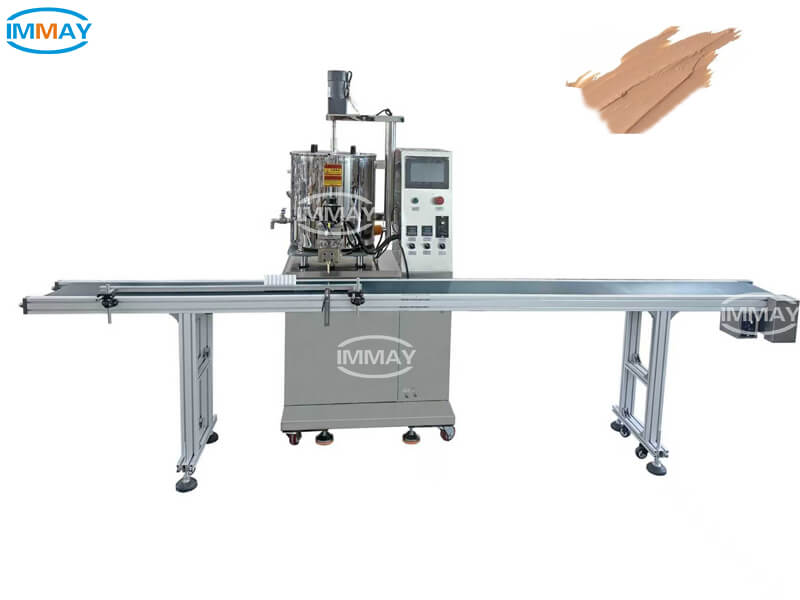
High viscosity concealers, as wax-based or oil-wax cream products, exist in a semi-solid or highly viscous state in industrial production, directly affecting filling accuracy and product appearance. Manual or room-temperature filling struggles to maintain fluidity and dosage stability, potentially causing localized pigment clustering or uneven fills. Cosmetic heating filling machines maintain cream fluidity through precise temperature control, enabling accurate filling of each unit, making them the professional choice for industrial production of high viscosity concealers.
High-viscosity concealers are typically formulated with a combination of waxes, oils, and pigments, creating a dense, semi-solid cream. At lower temperatures, the wax-based matrix becomes rigid and difficult to flow, making it challenging to pump or extrude the product into its packaging. This can directly affect filling accuracy and production efficiency.
In addition, pigments and fillers used to provide color and opacity may sometimes form localized clusters or distribute unevenly within the viscous matrix. If the material is not properly mixed or maintained at a controlled temperature, these inconsistencies can result in visible streaks or color variation in the final product.
Understanding the formulation’s physical properties and temperature sensitivity is essential for industrial production. Selecting appropriate cosmetic heating filling machine, ensures that the concealer maintains sufficient flow for smooth and precise filling while keeping pigments and fillers evenly dispersed, ultimately guaranteeing consistent product quality.
High-viscosity concealers, which are typically formulated with waxes, oils, and pigments, can become very stiff at room temperature. This limited flowability makes it difficult for the product to move smoothly through the filling system, especially in volumetric or piston-type machines. As a result, the filling process can be slowed down, and in some cases, the machine may struggle to dispense the concealer at all. This not only reduces overall production efficiency but also increases the risk of inconsistent fill volumes, putting pressure on dosage precision and batch uniformity.
By contrast, heating the concealer to an appropriate temperature before filling ensures that the product softens sufficiently, maintaining smooth flow and accurate dosing. For industrial-scale production of high viscosity concealers, relying on room-temperature filling machines alone can therefore limit capacity and compromise consistency.
Cosmetic heating filling machines allow the concealer to be maintained at a controlled temperature during the entire filling process. For high-viscosity formulations, this ensures that the wax-based cream softens sufficiently, providing smooth flow through pistons or pumps and filling valves. Consistent flowability helps avoid blockages and allows the machine to fill each container efficiently.
With cosmetic heating filling machines, precise metering systems can reliably dispense uniform amounts of concealer into each container. This ensures that every unit meets the intended weight or volume specification, reducing product waste and maintaining batch consistency—critical factors for industrial-scale production.
Specially designed heated pipelines prevent the concealer from cooling in specific areas of the filling system. This eliminates the risk of localized stiffening that could impede flow. By keeping the entire product path at a consistent temperature, the machine ensures smooth, continuous filling and maintains uniform appearance and texture.
Cosmetic heating filling machines significantly improve the efficiency of industrial-scale cosmetic production, especially for high-viscosity products like concealers. By maintaining optimal flowability, these machines allow for continuous, smooth filling at higher speeds than room-temperature equipment. This reduces production bottlenecks and minimizes downtime, resulting in more consistent output per shift.
Precise temperature control and accurate dosing ensure that each container receives the exact intended volume. This minimizes overfills, underfills, and inconsistencies in appearance, lowering the rate of defective units. Fewer defects translate directly into cost savings on raw materials and packaging.
Although heating filling machines require initial investment, the combination of higher throughput, reduced waste, and improved batch consistency enhances overall cost-effectiveness. For high-viscosity concealers, the machine’s ability to maintain product quality while accelerating production makes it a financially advantageous solution for large-scale cosmetic manufacturing.
Investing in a cosmetic heating filling machine allows manufacturers to optimize labor, reduce manual intervention, and maintain consistent quality, ultimately generating higher ROI over time. For businesses producing high-viscosity concealers, the economic benefits often outweigh the initial equipment costs, making it a strategic choice for sustainable, efficient production.
When selecting a cosmetic heating filling machine for high viscosity concealers, the required heating temperature is a key consideration. Different formulations may require different temperatures to reach optimal flowability. The machine must be capable of reaching and maintaining the target temperature reliably. Ensuring that the equipment’s heating range matches the product’s specific requirements is essential for smooth and efficient filling during industrial production.
The intended filling volume for high-viscosity concealers is a key factor when selecting a heating filling machine. Machines are designed to handle specific volume ranges efficiently, and the choice of piston size, pump capacity, or filling mechanism must match the target container fill. Selecting a machine with an inappropriate volume range can lead to slower production, repeated adjustments, or reduced accuracy. Understanding the required filling volume in advance ensures that the machine configuration supports efficient, precise, and consistent production for the intended container size.
When selecting a heating filling machine for high-viscosity concealers, the type and size of the packaging containers play a crucial role. The machine must be compatible with the container dimensions, opening size, and material to ensure smooth filling without spillage or damage. For example, tubes, jars, or pots may require different filling nozzle designs, stroke lengths, or pump pressures. Understanding the packaging specifications in advance allows manufacturers to choose the appropriate machine configuration, ensuring both efficiency and precision during production.
Cosmetic heating filling machines are essential equipment for the industrial production of high viscosity concealers, ensuring proper flowability, accurate filling, and consistent product quality. Makeup manufacturers should select the right makeup heating filling machine based on production capacity, formulation characteristics, and container specifications.
Contact IMMAY today to optimize your production process and achieve consistent, high quality results with our professional cosmetic heating filling machine.