- Home
- Equipment
- Industries
- We Immay
- Resource
- Contact
Author: Site Editor Publish Time: 2025-11-23 Origin: Site
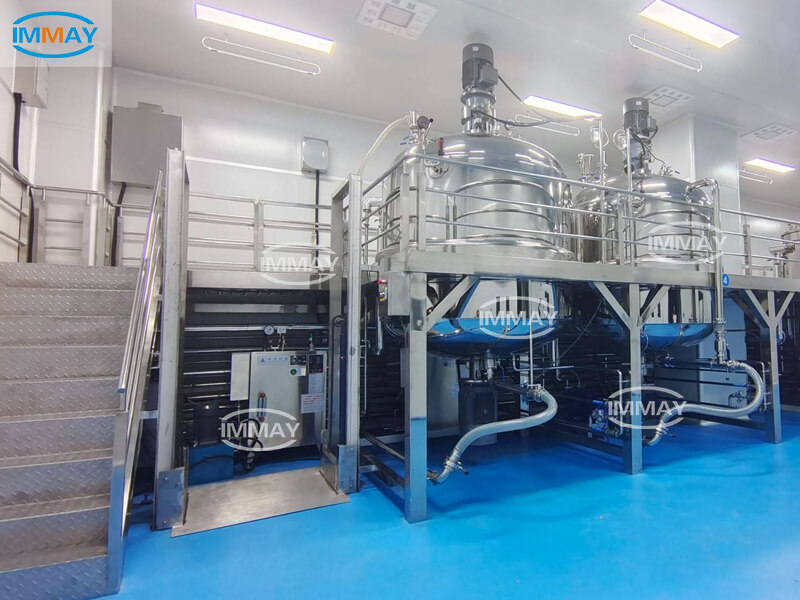
Ointments occupy an important place in personal care, pharmaceutical, and dermatological product lines. Their rich texture, occlusive effect, and ability to deliver active ingredients rely on a formulation structure that is very different from lotions or gels. In industrial production, maintaining this structure consistently across every batch becomes a defining challenge.
At a technical level, ointments feature high viscosity, multi-phase compositions, and precise oil–water balance requirements. These characteristics make them sensitive to shear distribution, heating uniformity, and ingredient dispersion. Any inconsistency during mixing can lead to graininess, phase separation, or variations in texture that affect both product performance and user perception.
As manufacturers scale up from pilot batches to full-scale production, traditional mixing approaches often struggle to deliver the uniformity and stability these formulations require. This brings the spotlight to vacuum emulsifying mixers — equipment designed to manage high-viscosity materials, improve phase fusion, and enhance the quality of every batch. Understanding why these machines matter begins with recognizing the real challenges behind ointment manufacturing.
Ointments are inherently dense and viscous, which makes uniform mixing more difficult than with lotions or serums. High-viscosity formulations resist flow, creating areas within the mixing vessel where ingredients may remain under-processed. Without sufficient shear or properly designed agitators, these “dead zones” can lead to uneven dispersion, inconsistent texture, and longer processing times.
Most ointments consist of oil and water phases that must form a stable emulsion. Achieving consistent droplet size and uniform distribution is critical to product performance. If the phases are not properly emulsified, the ointment can separate during storage, affecting both its appearance and functional properties. Maintaining this stability becomes increasingly difficult at industrial scale without specialized ointment mixing equipment.
Many ointment formulations include powders, thickeners, or active ingredients that must be fully dispersed into the base. Improper incorporation can lead to lumps, uneven concentration, or inconsistent potency. Traditional mixers often struggle with these high-viscosity powders, making it challenging to achieve homogeneous batches without advanced ointment mixing systems.
During industrial mixing, air can become trapped within thick ointment formulations. Entrapped air may affect texture, density, and the final appearance of the product. Standard open-environment mixing equipment has limited ability to remove air, which can lead to inconsistencies and affect downstream packaging efficiency.
A key feature of vacuum emulsifying mixers is the integrated vacuum system, which allows air to be removed from the ointment after mixing. High-viscosity formulations tend to trap air during the homogenization process, which can affect texture, density, and appearance. By applying vacuum once the ingredients are fully blended, the machine draws out trapped air, resulting in a smoother, more uniform product. This also ensures that powders and active ingredients are fully incorporated without compromising consistency, supporting reliable batch-to-batch quality.
The homogenizing system generates high shear forces that break down oil and water droplets into smaller, uniformly sized particles. This process creates a stable emulsion, ensuring the final ointment maintains its desired consistency and functional properties. High shear mixing also accelerates emulsification, reducing overall production time while maintaining quality.
Scraper-type frame agitators move along the vessel walls to prevent material from sticking, ensuring full circulation of the ointment. This design is particularly important for thick formulations, which tend to form dead zones in traditional mixers. Continuous scraping and mixing allow heat and shear to be evenly distributed, supporting uniform texture and stable emulsification.
Many ointment formulations require precise temperature control during mixing. A heating jacket melts solids and improves flow, while a cooling system helps set the final structure. Integrated temperature control ensures that both the oil and water phases reach the optimal conditions for emulsification, while preventing degradation of sensitive ingredients.
By integrating vacuum, high shear, and scraper agitation with precise temperature control, vacuum emulsifying mixers create a controlled environment for ointment production. These combined features address the challenges outlined in the previous section, enabling industrial-scale manufacturing with consistent texture, stability, and batch-to-batch reliability.
Ointments require a uniform texture to ensure quality, usability, and functional performance. Vacuum emulsifying mixers maintain consistent shear, circulation, and temperature, producing a stable emulsion across the entire batch. This reduces variability between batches, ensuring that every production run delivers the same smooth, homogenous product.
High-viscosity formulations are difficult to handle with traditional mixers. The combination of high shear homogenization and scraper-type frame agitators in vacuum emulsifying mixers allows dense ointments to mixing fully within the vessel. This design prevents dead zones, ensures thorough ingredient incorporation, and significantly improves mixing efficiency, making industrial-scale production feasible without compromising quality.
By applying high shear forces, vacuum emulsifying mixers rapidly reduce droplet size and disperse powders evenly. This accelerates the emulsification process, ensuring active ingredients are fully integrated and effective throughout the formulation. Improved dispersion also minimizes material waste and enhances overall production efficiency.
After mixing, trapped air in the ointment can create uneven texture or affect appearance. The vacuum system removes these air pockets, resulting in a denser, smoother final product. This step is critical for industrial production, as it helps maintain consistency in both aesthetic and functional properties.
Vacuum emulsifying mixers are designed to handle a wide range of batch sizes, from small pilot tests to large-scale manufacturing. Because the machine applies the same mixing principles at all scales, formulations developed at the laboratory stage can be scaled up with minimal adjustment, ensuring consistent results and reducing the risk of quality issues during production expansion.
The vessel size determines the batch volume and production efficiency. Small pilot batches may require 50–300 L tanks, while large-scale industrial production often needs 500–5000 L or larger. Selecting the right capacity ensures the ointment mixer can handle your intended output without compromising consistency or process efficiency.
Vacuum emulsifying mixers can be operated via a programmable PLC system or a manual button interface. PLC systems offer precise control over speed, temperature, and mixing cycles, which is valuable for complex or repeatable formulations. Button-operated models are simpler and may suit smaller or less frequent production runs. Choosing the control type depends on your production complexity and desired level of automation.
Some mixers feature a liftable (elevating) design for easy maintenance, sampling, or batch handling, while others are fixed for more stable industrial-scale operation. Liftable vacuum ointment mixers are often preferred for flexible production needs, whereas fixed ointment vacuum mixers are more suitable for consistent, high-volume manufacturing.
The physical footprint of the high shear mixer for ointment is an important consideration. Ensure your production area can accommodate the tank size, lifting mechanism (if applicable), and surrounding clearance for operation and maintenance. Adequate floor space also allows efficient handling of raw materials and finished products.
Vacuum emulsifying mixers address the key challenges of ointment manufacturing, including high viscosity, oil–water phase stability, and uniform ingredient dispersion. By combining high shear homogenization, scraper-type frame agitation, and post-mixing vacuum, these industrial ointment manufacturing machines ensure consistent texture, smoothness, and batch-to-batch reliability across industrial production scales.
Choosing the right capacity, control system, and mixer structure helps optimize efficiency and adapt the process to specific production needs. Properly configured vacuum emulsifying mixers enable ointment manufacturers to produce high quality ointments with improved productivity and reliable performance.
Contact IMMAY today to discuss your ointment manufacturing requirements and explore solutions tailored to your formulations and production scale.