- Home
- Equipment
- Industries
- We Immay
- Resource
- Contact
Author: Site Editor Publish Time: 2026-04-08 Origin: Site
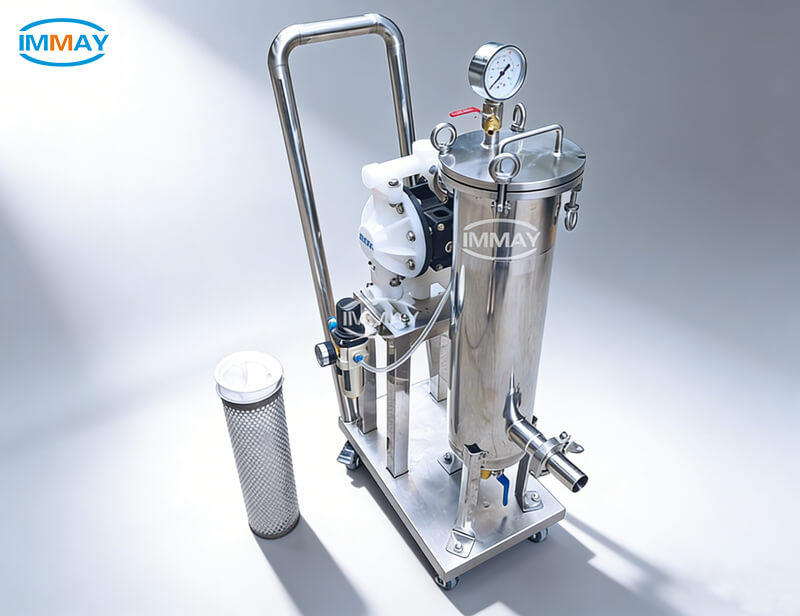
Industrial liquid filtration plays a critical role in maintaining product consistency and process stability across industries such as cosmetics, food processing, and chemical manufacturing.
In real production environments, two of the most commonly used filtration solutions are bag filters and cartridge filters. While both are designed to remove unwanted particles from liquids, they differ significantly in filtration precision, flow capacity, and operating approach.
There is no universally “better” option between the two—only the one that best fits your specific process conditions and filtration goals. Choosing the wrong system can lead to inefficient filtration, unnecessary costs, or inconsistent product quality.
This article provides a clear, practical comparison of bag filters and cartridge filters, examining their structure, performance, and typical applications to help you determine which solution is right for your industrial liquid filtration needs.
A bag filter is a type of industrial liquid filtration system that uses a replaceable filter bag enclosed within a pressure vessel (filter housing) to remove solid particles from liquids. The liquid typically flows through the filter bag—either from the inside to the outside or vice versa—allowing contaminants to be captured while clean fluid passes through.
Bag filters are generally designed for coarse to medium filtration, with typical micron ratings ranging from approximately 25 to 200 microns. This makes them suitable for applications where large volumes of liquid need to be processed and ultra-fine filtration is not required.
Key advantages include high flow capacity, low operating cost, and quick, simple bag replacement, making them a practical choice for pre-filtration and bulk particle removal in industrial processes.
A cartridge filter is an industrial liquid filtration system that uses replaceable filter cartridges installed inside a sealed housing to remove fine particles from liquids. The liquid flows through the cartridge media, where contaminants are retained either on the surface (surface filtration) or within the internal structure of the media (depth filtration), depending on the cartridge design.
Cartridge filters are typically used for fine filtration, with micron ratings commonly ranging from 0.2 to 50 microns. This higher level of precision makes them suitable for processes where tighter particle control and cleaner output are required.
They are widely applied in industries with higher purity standards, such as cosmetics, water treatment, and food processing, particularly in final filtration stages where consistent and reliable filtration performance is essential.
Bag filters are typically designed for coarse to medium filtration, usually in the range of 25–200 microns, making them suitable for removing larger particles. In contrast, cartridge filters can achieve much finer filtration, often between 0.2–50 microns, with common applications in the 1–10 micron range.
If your process requires fine particle removal or higher clarity, a cartridge filter is generally the better choice.
Bag filters are built to handle high flow rates and large liquid volumes, which makes them ideal for bulk processing and upstream filtration. Cartridge filters, while more precise, are usually limited to lower flow rates per unit and are better suited for controlled or smaller-volume applications.
For high-volume processing, bag filters are more efficient, while cartridge filters are better for precision-focused stages.
Bag filters typically have lower upfront and replacement costs, especially in applications where filtration precision is not critical. Cartridge filters tend to have higher replacement costs due to finer media and more complex construction, but they offer more consistent filtration performance.
If cost control is a priority, bag filters are more economical; if consistent fine filtration is required, cartridge filters justify the higher cost.
Bag filters are designed for quick and simple replacement, reducing downtime during maintenance. Cartridge filters may require more frequent replacement depending on the application, especially in high-load conditions, and can involve slightly more handling.
For easier maintenance and faster changeovers, bag filters have an advantage, while cartridge filters require more careful management.
Bag filter systems generally require larger housings, especially in multi-bag configurations for higher flow rates. Cartridge filter systems are typically more compact and easier to integrate into space-limited production lines.
If installation space is limited, cartridge filters are usually the more practical option, while bag filters suit larger-scale setups.
A bag filter is a practical choice when your process prioritizes high throughput, cost efficiency, and removal of larger particles. It is commonly used in the following scenarios:
For applications involving large volumes of liquid—such as juices, syrups, or base chemical liquids—bag filters provide high flow capacity with minimal pressure drop. Their design allows continuous processing without significantly restricting flow, making them well-suited for bulk filtration stages.
Bag filters are often used as a first filtration step before finer systems. By removing larger particles upfront, they help protect downstream equipment, reduce fouling, and extend the service life of more precise filtration components.
When the liquid contains a relatively high load of suspended particles, bag filters offer higher dirt-holding capacity compared to finer filters. This reduces the frequency of replacement and helps maintain stable operation under heavier contamination conditions.
In general, if your goal is to handle large volumes, reduce operating costs, or perform initial particle removal, a bag filter is usually the more suitable option.
A cartridge filter is the preferred option when your process requires higher filtration precision, consistent performance, and tighter control over particle removal. It is commonly used in the following scenarios:
For liquids that have already undergone processes such as industrial reverse osmosis (RO) treatment, cartridge filters are used to maintain and protect the achieved purity level. Their fine micron ratings allow them to remove residual particles that could affect product quality.
When the goal is to eliminate very small suspended solids, cartridge filters provide reliable and consistent filtration performance. Their media structure—whether surface or depth type—ensures effective capture of fine contaminants that bag filters may not retain.
Cartridge filters are often installed as the final filtration step in a production line, especially in industries such as cosmetics, food, and high-purity liquid processing. At this stage, filtration stability and precision are critical to ensure uniform product quality before filling or packaging.
In general, if your process demands fine filtration, stable performance, and high output clarity, a cartridge filter is the more suitable choice.
Yes, bag filters and cartridge filters are often used together in industrial liquid filtration systems to achieve both efficiency and precision. Combining the two allows manufacturers to optimize their process while protecting downstream equipment.
In a combined setup, bag filters are typically used as the first stage to remove larger particles and bulk solids. This reduces the load on finer filtration stages and helps prevent clogging or premature wear in more delicate components.
After the bag filter stage, cartridge filters are installed to perform precise filtration. This second stage captures fine particles that the bag filter may have missed, ensuring high purity and consistent quality of the final product.
Using both together not only improves filtration efficiency but also extends the service life of cartridges and protects critical downstream equipment, making it a practical approach for many industrial processes.
There is no absolute “better” option between bag filters and cartridge filters. Each type of filtration system has its strengths and is best suited for specific applications. Bag filters excel in high-flow, bulk particle removal and pre-filtration scenarios, while cartridge filters provide finer precision and stability for final filtration or high-purity liquids.
The key to effective industrial liquid filtration is matching the filtration solution to your process requirements. Selecting the right filter type ensures optimal performance, cost efficiency, and product quality.
If you are unsure which system is best for your production needs, consulting with an equipment expert can help optimize your selection. At IMMAY, our specialists can provide guidance on designing and implementing the ideal filtration solution for your process.