- Home
- Equipment
- Industries
- We Immay
- Resource
- Contact
Author: Site Editor Publish Time: 2026-07-26 Origin: Site
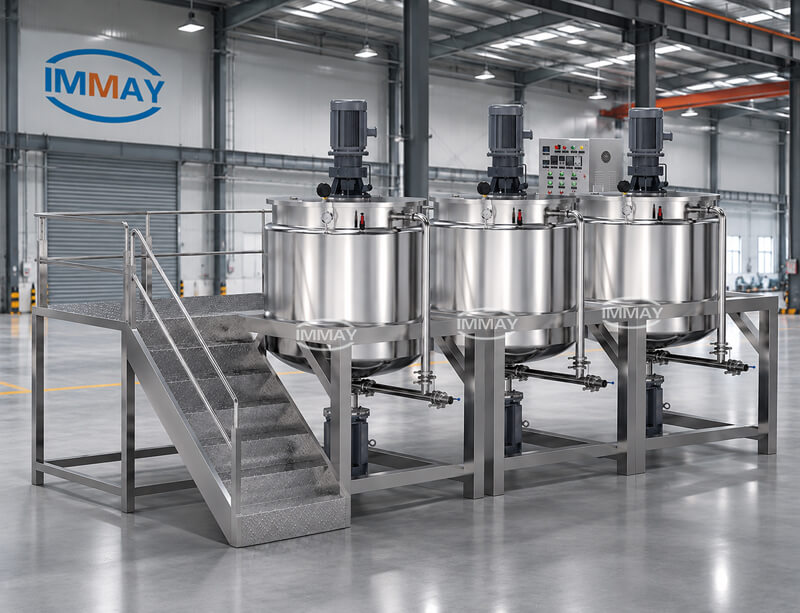
Many small and medium-sized manufacturers plan to produce more than one product using a single stainless steel mixing tank. For example, a factory may manufacture liquid soap today and shampoo tomorrow, or produce different cosmetic lotions in separate batches.
Using one tank for multiple products can reduce equipment investment and save production space. However, whether this approach is practical depends on several factors, including product properties, tank configuration, cleaning requirements, and production planning.
This article explains when one mixing tank can successfully handle multiple products and when separate equipment is the better choice.
For many small and medium-sized manufacturers, investing in production equipment requires balancing current production needs with future business growth. Instead of purchasing separate mixing tanks for every product, many companies look for a solution that can support multiple formulations while keeping initial investment under control.
This is especially common for start-up factories, OEM/ODM manufacturers, and businesses expanding their product range. A single stainless steel mixing tank may be expected to produce products such as liquid soap, shampoo, body wash, lotions, or other compatible liquid formulations. If the equipment can be shared across multiple products, manufacturers can improve production flexibility without purchasing additional tanks for each new product.
Before making that decision, however, it is important to understand why many manufacturers choose this approach and what factors determine whether one mixing tank is suitable for multiple products.
For small and medium-sized manufacturers, purchasing one versatile mixing tank is often more practical than investing in several dedicated tanks at the beginning of production. This allows production to start with a lower equipment budget while leaving room for future expansion as demand increases.
Many growing factories have limited production space. Using one mixing tank for compatible products reduces the number of machines required, making it easier to organize the production area and reserve space for future equipment.
Instead of remaining idle between production runs, a mixing tank that can process different compatible products is used more frequently. Higher equipment utilization helps manufacturers make better use of their investment and supports more flexible production scheduling.
As market demand changes, manufacturers often introduce new formulations without immediately expanding their production facilities. A multi-purpose mixing tank allows compatible products to be produced on existing equipment, making it easier to test new products before investing in additional production lines.
Production plans often evolve over time. A factory may initially manufacture only one product but later expand into related liquid formulations with similar processing requirements. Choosing a mixing tank that can accommodate multiple compatible products provides greater flexibility as the business grows.
A stainless steel mixing tank can often be used to manufacture multiple products, but compatibility is determined by the production process rather than the product name alone. Factors such as viscosity, mixing method, heating requirements, cleaning procedures, and ingredient compatibility all influence whether different products can be produced using the same equipment.
The following table provides general guidance for common applications.
Product Type | Typical Suitability | Main Considerations |
Shampoo | Generally suitable | Similar liquid formulation and cleaning process |
Liquid Soap | Generally suitable | Comparable viscosity and mixing requirements |
Hand Wash | Generally suitable | Usually compatible with other water-based liquid products |
Body Wash | Often suitable | Verify viscosity and ingredient compatibility |
Cosmetic Lotion | Often suitable | Thorough cleaning is recommended between batches |
Cosmetic Cream | Depends on the process | Higher viscosity requires different mixing or homogenizing conditions |
Food Sauces | Depends on the formulation | Flavor residue and cleaning requirements should be evaluated |
Chemicals | Depends on the formulation | Confirm material compatibility and process requirements |
However, this table should be considered only as a general reference. Two products within the same category may have completely different processing requirements. For example, some cosmetic creams require vacuum homogenization, while others can be produced using conventional agitation. Likewise, liquid products with similar appearances may have significantly different viscosities or heating requirements.
Instead of deciding based solely on the product type, manufacturers should evaluate whether the products share similar production conditions before planning to use one mixing tank for multiple applications.
Whether a stainless steel mixing tank can be used for multiple products depends on more than the product name. The key consideration is whether the different formulations require similar processing conditions throughout production.
Before deciding to use one mixing tank for multiple products, manufacturers should evaluate the following factors.
Product viscosity is one of the first factors to consider. Products with similar viscosity generally require comparable mixing conditions, making them more suitable for production in the same mixing tank.
However, if one product is a low-viscosity liquid while another is a high-viscosity cream or paste, different agitator designs, motor power, or mixing speeds may be required. In these cases, one standard configuration may not provide the best performance for every product.
Rather than comparing product categories, manufacturers should compare the viscosity range of all products planned for production.
Different formulations often require different mixing processes.
Some products only need gentle agitation to blend liquids, while others require high-shear mixing to disperse powders, emulsify oil and water, or achieve a uniform texture. If all planned products follow a similar mixing process, one mixing tank is generally more suitable for multiple applications.
When production processes differ significantly, selecting a tank with a more versatile mixing configuration may provide greater flexibility.
Temperature control is another important consideration.
Some formulations are mixed at ambient temperature, while others require heating to dissolve ingredients or cooling before filling. If products have similar temperature requirements, one jacketed mixing tank can often support multiple production processes.
When temperature requirements vary widely, manufacturers should confirm that the tank configuration can accommodate the full operating range.
Even if products appear similar, their ingredients may interact differently with processing equipment.
Manufacturers should evaluate whether different formulations contain ingredients that require specific material grades, special surface finishes, or dedicated processing conditions. Products with significantly different chemical properties may require additional consideration before sharing the same mixing tank.
Evaluating ingredient compatibility helps reduce the risk of production issues and simplifies long-term equipment planning.
Cleaning requirements often determine whether one mixing tank can be used efficiently for different products.
Products containing strong fragrances, pigments, sticky ingredients, or heavy oils may require more thorough cleaning before the next production batch. If cleaning takes too long or leaves noticeable residue, frequent product changeovers can reduce overall production efficiency.
A mixing tank designed for easy cleaning can make multi-product production more practical, especially when product changeovers occur regularly.
Production planning is just as important as equipment configuration.
If products are manufactured in occasional batches, one mixing tank may provide sufficient production capacity. However, when several products need to be produced every day or within the same shift, sharing one tank may create scheduling conflicts and reduce production efficiency.
In these situations, manufacturers should evaluate both current production requirements and future capacity expansion before deciding whether a single mixing tank is the most suitable solution.
No single factor determines whether one stainless steel mixing tank can produce multiple products. In most cases, the decision is based on a combination of product characteristics, processing requirements, cleaning efficiency, and production planning. Evaluating these factors before purchasing equipment helps manufacturers choose a mixing tank that supports both current production and future product expansion.
A single stainless steel mixing tank is not the right solution for every production facility. However, for many manufacturers, it can provide an effective balance between production flexibility and equipment investment.
The following situations are generally well suited to using one mixing tank for multiple compatible products.
For small and medium-sized manufacturers, purchasing one versatile mixing tank is often more practical than investing in multiple dedicated systems. It allows production to begin with lower equipment costs while maintaining the flexibility to expand production capacity as the business grows.
A single mixing tank is generally a good choice when different products have similar viscosities, mixing methods, and temperature requirements. For example, products that use comparable processing conditions can often be produced efficiently on the same equipment after appropriate cleaning between batches.
Manufacturers introducing new products or expanding their product range may not initially know which formulations will become long-term production items. Using one mixing tank for pilot production and small-batch manufacturing allows different formulations to be evaluated before investing in additional equipment.
When production space is limited, installing multiple dedicated mixing tanks may not be practical. A multi-purpose mixing tank helps maximize the use of available floor space while providing flexibility for different production tasks.
For businesses launching a new production line or entering a new market, controlling initial equipment investment is often a priority. Choosing a properly configured mixing tank that can support multiple compatible products allows manufacturers to start production without purchasing separate tanks for every formulation.
Although a single stainless steel mixing tank can be an efficient solution for many manufacturers, it is not always the most practical choice. As production requirements become more complex, using separate mixing tanks may improve operational efficiency, reduce production interruptions, and better support long-term business growth.
The following situations are commonly considered when evaluating whether dedicated mixing tanks are more suitable.
When products have a wide viscosity range, one mixing tank configuration may not provide optimal performance for every formulation.
For example, producing a low-viscosity liquid in one batch and a highly viscous cream in the next may require different agitator designs, mixing speeds, or motor power. In these situations, separate mixing tanks can be configured specifically for each production process, helping achieve more consistent mixing performance.
Some formulations contain fragrances, pigments, essential oils, or other ingredients that are more difficult to remove during cleaning.
Although proper cleaning procedures can reduce residue, manufacturers producing products with strong odors or colors may prefer dedicated mixing tanks to simplify changeovers and reduce the possibility of residual materials affecting subsequent production.
When a factory manufactures products for different industries, production planning becomes more complex.
For example, producing food products and industrial chemicals within the same facility often requires separate production equipment to simplify production management and avoid unnecessary changeovers. In these situations, dedicated mixing tanks are generally a more practical production arrangement.
As production volume increases, a single mixing tank may become a bottleneck.
If multiple products need to be manufactured simultaneously or within tight delivery schedules, separate mixing tanks allow parallel production, reducing waiting time between batches and improving overall production efficiency.
Using one mixing tank for many different products usually means more frequent cleaning and production changeovers.
If the production schedule requires switching between products several times each day, the time spent cleaning and preparing the equipment may eventually exceed the savings achieved by using a single tank. In these situations, dedicated mixing tanks can improve workflow and increase effective production time.
Choosing one stainless steel mixing tank for multiple products requires more planning than purchasing equipment for a single application. Before requesting a quotation, manufacturers should clearly define their production requirements to help suppliers recommend a suitable tank configuration.
The following checklist can help prepare the necessary information before discussing a project with a mixing tank manufacturer.
Multi-Purpose Mixing Tank Procurement Checklist
Which products will be manufactured?
List all current products as well as any products that may be added in the future. This helps determine whether one tank can support all planned applications.
What is the viscosity range of the products?
Understanding the lowest and highest product viscosity helps determine the appropriate agitator type, motor power, and mixing speed.
Will heating or cooling be required?
Some formulations require temperature control during mixing, while others can be processed at ambient temperature. Defining these requirements helps determine whether a jacketed tank is needed.
How frequently will production switch between products?
Frequent product changeovers may increase cleaning time and influence whether one mixing tank remains the most efficient solution.
What batch size is expected?
The required working volume should match both current production capacity and anticipated future demand.
Is future product expansion planned?
If additional formulations are expected in the coming years, selecting a more versatile tank configuration may reduce the need for equipment replacement later.
Which stainless steel material is appropriate?
Selecting the correct material, such as 304 or 316L stainless steel, depends on the characteristics of the products being manufactured.
Using one stainless steel mixing tank for multiple products can be a practical solution when the formulations share similar processing requirements and production conditions. For many small and medium-sized manufacturers, this approach offers greater flexibility while reducing initial equipment investment.
However, the decision should be based on the complete production plan rather than the products alone. Factors such as viscosity, mixing method, cleaning requirements, production capacity, and future expansion all influence whether one mixing tank or multiple dedicated tanks will provide the best long-term value.
Defining your production requirements before requesting quotations allows equipment suppliers to recommend a mixing tank configuration that matches both your current manufacturing needs and future business growth.