- Home
- Equipment
- Industries
- We Immay
- Resource
- Contact
Author: Site Editor Publish Time: 2026-10-28 Origin: Site
Stainless steel storage tanks are widely used to store liquids in manufacturing facilities. During storage and material transfer, operators may need to know the liquid level inside the tank to manage daily operations.
A level gauge provides a direct way to monitor this information. Understanding its role in storage tank operation is the first step in deciding whether it is necessary for a particular application.
A level gauge is used to monitor the liquid level inside a stainless steel storage tank, helping operators understand how much material is currently stored. This information is useful for managing stored liquids and planning material replenishment and discharge.
By checking the liquid level, operators can determine when additional material needs to be added and whether sufficient material remains for subsequent operations. It also helps them monitor changes in the stored volume during filling and discharge, making it easier to coordinate material handling.
When a storage tank is connected to an automated control system, a level sensor can provide signals for high-level or low-level alarms. Depending on the system configuration, these signals can also control pumps or valves to start or stop material transfer at preset levels. This is particularly useful when operators need to monitor multiple storage tanks or automate material transfer.
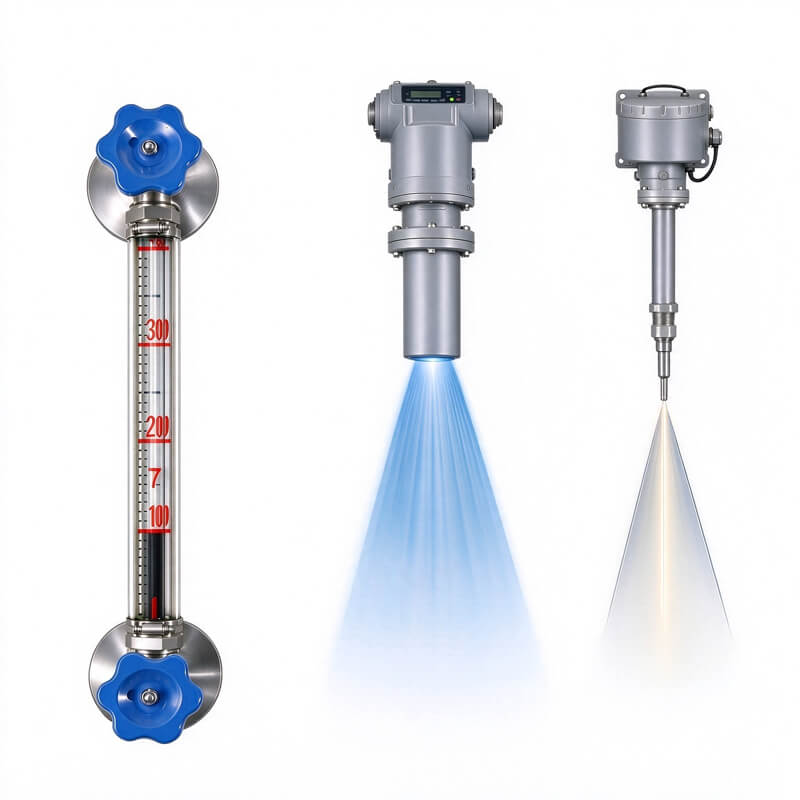
Several types of level gauges can be used on stainless steel storage tanks, depending on how the liquid level needs to be monitored, the properties of the stored material, and the tank's operating conditions. Common options include sight glass level gauges, mechanical float level gauges, and electronic level sensors.
A sight glass level gauge allows operators to observe the liquid level directly through a transparent viewing section or a level-indicating tube connected to the tank. It provides a straightforward way to monitor the stored liquid without requiring an electronic measurement system.
This type is suitable for storage tanks where operators can check the liquid level locally and do not need remote monitoring or automatic control. The sight glass material, pressure rating, and connection structure should be suitable for the stored liquid and the tank's operating conditions.
A mechanical float level gauge uses a float that rises and falls with the liquid surface. Its movement is transferred to a mechanical indicator, allowing operators to read the liquid level without relying on electronic signals for the indication.
This type can be used when a tank requires a visible level reading and a simple mechanical arrangement is sufficient. However, the float must be compatible with the stored liquid, and its movement can be affected by high viscosity, material buildup, or other conditions that restrict the float's movement.
An electronic level sensor detects or measures the liquid level and converts the measurement into an electrical signal. Depending on the sensor type, it can provide continuous level readings or detect whether the liquid has reached a preset point. When connected to a suitable control system, it can support remote monitoring, level alarms, and automated pump or valve control.
Common electronic level measurement technologies include:
Ultrasonic level sensors: Measure the distance to the liquid surface using sound waves. Foam, vapor, and obstructions inside the tank can affect measurement.
Radar level sensors: Use electromagnetic waves to measure the distance to the liquid surface. Their suitability depends on the tank structure, liquid properties, and instrument specifications.
Hydrostatic level sensors: Determine liquid level from the pressure generated by the liquid column. The calculation depends on the liquid's density and the sensor's installation position.
Electronic float level sensors: Use a float that moves with the liquid level and converts its movement into an electrical signal. Their suitability depends on the liquid properties, float design, and required control functions.
The appropriate sensor depends on the required measurement range, accuracy, liquid characteristics, and operating conditions. For tanks that require automatic control, the sensor's output must also be compatible with the control system.
A level gauge is useful when operators need to monitor the liquid level regularly as part of daily storage operations. Whether a stainless steel storage tank needs one depends on how frequently material moves in and out of the tank, how easily the liquid level can be observed, and whether the tank is connected to an automated system.
When a storage tank receives material from upstream equipment and supplies liquid to downstream processes, the liquid level can change frequently. A level gauge helps operators track these changes, determine when replenishment is needed, and avoid interrupting material supply because the tank has run low.
For tall or large-capacity storage tanks, checking the liquid level directly can be inconvenient. The same applies when a tank is installed in a restricted space or at a position where the liquid surface is difficult to see. A level gauge provides a more convenient way to monitor the stored liquid without relying on direct visual inspection.
When a storage tank operates with transfer pumps, valves, or an automated control system, a level sensor can provide signals for controlling material movement. For example, the system can trigger a low-level alarm when the liquid drops below a preset point or stop incoming material when the tank approaches its designated filling level. These functions require a compatible sensor and control arrangement.
In facilities where operators need to track the amount of liquid available for production, a level gauge provides a convenient reference for estimating the remaining volume. This is particularly relevant when several storage tanks hold different materials or when material availability affects production scheduling. For tanks with irregular dimensions or internal structures, the relationship between liquid level and actual volume should also be established if accurate inventory estimates are required.
A level gauge is not essential for every stainless steel storage tank. If operators can manage the stored material effectively through existing procedures or measurement methods, an additional level monitoring device may not be necessary.
When a storage tank holds a relatively small volume of liquid, operators may be able to keep track of the remaining material based on the amount added and discharged. If the stored volume is easy to manage and precise, real-time level monitoring is not required, a separate level gauge may offer limited practical value.
Tanks that are filled or emptied only occasionally may not require continuous level monitoring. If operators can check the liquid level during routine operations and schedule material transfers accordingly, the tank may operate effectively without a dedicated level gauge.
If the tank is equipped with a sight glass or another suitable arrangement for directly observing the liquid level, an additional level gauge may be unnecessary. However, the opaque walls of a standard stainless steel tank do not allow operators to see the liquid inside, so direct observation requires an appropriate viewing feature.
Some storage tanks use load cells or weighing systems to monitor the amount of stored material. If the weight data provides sufficient information for inventory management and daily operations, a separate level gauge may not be needed. The choice depends on whether the application requires the actual liquid height, the quantity of material stored, or both.
Before installing a level gauge on a stainless steel storage tank, the tank structure, stored liquid properties, and monitoring requirements should all be taken into account. These factors help determine which measurement method is suitable and where the device should be installed.
The tank's height, diameter, top and side openings, and available installation space can affect the placement of a level gauge. The connection point should allow the device to measure the liquid level across the required operating range. For tanks with internal components or limited access, the installation arrangement also needs to accommodate the tank's existing structure.
Liquid viscosity, foaming, suspended solids, and material buildup can affect the performance of certain level measurement devices. For example, foam may interfere with some measurement methods, while viscous liquids or deposits can affect devices that rely on contact with the material. The selected instrument should suit the actual liquid properties and operating conditions.
Some applications only require a local display that operators can read at the tank. Others need remote level monitoring, high- or low-level alarms, or signals for automated pump and valve control. Defining these requirements in advance helps determine whether a visual gauge, a level switch, or a continuous electronic level sensor is appropriate.
Different level gauges use different measurement principles, and their suitability depends on factors such as tank geometry, liquid properties, operating temperature, and pressure. The required measurement range and accuracy should also be established before selection. For tanks that require both level indication and automatic control, the measuring device and control system must be compatible with each other.
A level gauge is an optional component of a stainless steel storage tank, and its value depends on how the tank is used and how the stored material is managed. Some applications require frequent level monitoring to coordinate material transfer or support automated operation, while others can rely on simpler procedures or alternative measurement methods.
Ultimately, selecting the right configuration means understanding the role the storage tank plays in the overall manufacturing process. By assessing actual operating requirements before choosing the tank's accessories, manufacturers can determine whether a level gauge is necessary and select a suitable measurement method for long-term operation.