- Home
- Equipment
- Industries
- We Immay
- Resource
- Contact
Author: Site Editor Publish Time: 2026-08-03 Origin: Site
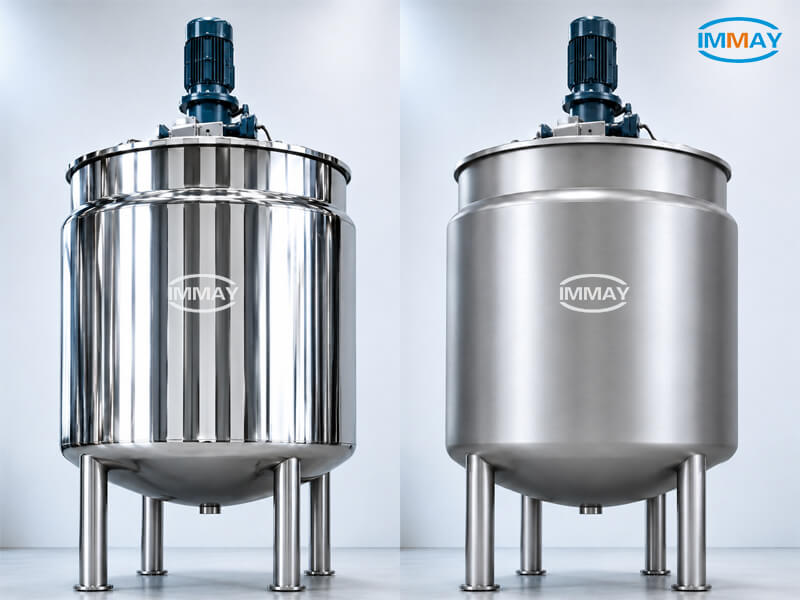
Mirror polishing is a common surface finish for stainless steel mixing tanks, especially in industries where product cleanliness and frequent cleaning are important. However, not every mixing tank requires a mirror-polished interior, and selecting the highest polishing level is not always the most practical or cost-effective option.
The right surface finish depends on several factors, including the type of product being mixed, cleaning procedures, production frequency, and overall process requirements. In many industrial applications, a standard finish can provide satisfactory performance without the additional manufacturing cost of mirror polishing.
Understanding the differences between mirror polishing and standard finishes helps buyers evaluate equipment more effectively. By matching the surface finish to actual production needs rather than choosing it by default, manufacturers can select a stainless steel mixing tank that balances performance, maintenance, and investment.
Mirror polishing is a mechanical surface finishing process that gradually removes microscopic imperfections from stainless steel, creating a smooth and highly reflective surface. In stainless steel mixing tanks, mirror polishing is primarily applied to product-contact surfaces to improve cleanability and surface quality rather than simply to create a shiny appearance. The process can achieve different surface roughness levels depending on production requirements, making it suitable for applications where surface cleanliness is an important consideration.
The main difference between mirror polishing and a standard stainless steel finish is surface smoothness. A mirror-polished surface has fewer microscopic irregularities, making it easier to remove product residue during cleaning. Standard finishes are suitable for many industrial applications, but they may retain slightly more material on the surface after production. It is important to note that mirror polishing improves surface quality rather than the mixing performance of the tank, which depends on factors such as agitator design, tank configuration, and operating conditions.
Mirror polishing is most commonly applied to the interior surfaces that come into direct contact with the product. These areas typically include the tank wall, bottom, top cover, and other wetted components when required. Exterior mirror polishing is also available for some stainless steel mixing tanks, although it is generally selected to improve appearance instead of influencing the production process.
Mirror polishing is widely used in industries where equipment is cleaned frequently and product cleanliness is a priority. A smoother surface can help reduce product retention, simplify cleaning between production batches, and support more consistent production conditions. For this reason, mirror-polished stainless steel mixing tanks are commonly selected for cosmetic, food, beverage, and pharmaceutical manufacturing. However, the appropriate surface finish should always be determined by the specific production process rather than applied as a standard configuration for every mixing tank.
Mirror polishing is selected because it can provide practical advantages during daily production and equipment maintenance. While it is not required for every manufacturing process, a smoother interior surface can improve cleaning efficiency and support applications where product quality and cleanliness are important. The following are some of the main reasons why manufacturers choose mirror-polished stainless steel mixing tanks.
A smoother interior surface makes it easier to remove product residue during routine cleaning. This can shorten cleaning time and reduce the effort required between production batches, particularly when processing products with higher viscosity or ingredients that tend to adhere to the tank wall. Easier cleaning also helps improve production efficiency when tanks are cleaned frequently.
Some products, such as cosmetic creams, lotions, sauces, gels, and syrups, can remain on the tank surface after discharge. Mirror polishing reduces microscopic surface irregularities where these materials are more likely to collect, allowing more product to be removed during emptying and cleaning. This can help minimize material waste and simplify batch-to-batch cleaning.
A smoother stainless steel surface is generally easier to keep clean throughout long-term operation. For applications that place greater emphasis on product cleanliness, mirror polishing can help maintain a cleaner product-contact surface and reduce the possibility of residue remaining after cleaning. This is one reason why it is commonly specified for cosmetic, food, beverage, and pharmaceutical mixing equipment.
Manufacturers that produce multiple products on the same mixing tank often need to clean the equipment between batches. Mirror polishing can simplify this cleaning process by making residue easier to remove, helping reduce cleaning time before switching to the next formulation. For facilities with frequent product changeovers, this can improve production flexibility and reduce equipment downtime.
Although mirror polishing offers practical advantages, it is not the best choice for every stainless steel mixing tank. Many industrial processes do not require an extremely smooth product-contact surface, and selecting a standard interior finish can provide reliable performance while reducing manufacturing costs. The appropriate surface finish should be based on actual production requirements rather than applying mirror polishing as a default specification.
Many industrial chemicals do not require the high level of surface smoothness used in sanitary production. If the product is easy to discharge and routine cleaning is sufficient, a standard interior finish can meet the processing requirements while reducing equipment cost.
Paints, coatings, and similar products often contain pigments, fillers, or other solid materials. In many cases, production performance depends more on the mixing system than on the surface finish of the tank. Unless specific cleaning or product requirements exist, mirror polishing is not always necessary.
Liquid fertilizers and other agricultural formulations generally place greater emphasis on mixing efficiency, corrosion resistance, and production capacity than on achieving a highly polished interior surface. A standard stainless steel finish is often suitable for these applications.
Mixing tanks used to prepare water treatment chemicals, such as flocculants, coagulants, or cleaning solutions, typically do not require mirror-polished product-contact surfaces. As long as the tank material and design are appropriate for the process, a standard finish is often sufficient for daily operation.
For products that are not highly sensitive to surface cleanliness or are produced in dedicated mixing tanks, investing in mirror polishing may provide limited practical benefit. When cleaning requirements are less demanding and cross-product contamination is not a major concern, a standard interior finish can offer a cost-effective solution while meeting production needs.
A standard interior finish does not mean lower equipment quality. Instead, it represents a practical choice for applications where the additional manufacturing cost of mirror polishing does not provide significant operational benefits. Selecting the surface finish according to the production process allows buyers to balance equipment performance, maintenance requirements, and overall investment more effectively.
Both mirror polish and standard finish are widely used for stainless steel mixing tanks. Neither is universally better than the other. The right choice depends on the product being processed, cleaning requirements, production frequency, and budget. Understanding the differences between these two surface finishes helps buyers select a tank configuration that matches their manufacturing needs.
Feature | Mirror Polish | Standard Finish |
Surface Appearance | Smooth, highly reflective surface | Smooth surface with a matte or satin appearance |
Cleaning Difficulty | Easier to clean due to a smoother surface | Suitable for routine cleaning but may require slightly more effort |
Product Residue | Lower product retention after discharge and cleaning | May retain slightly more residue, depending on the product |
Typical Applications | Cosmetics, food, beverage, pharmaceutical production | Industrial chemicals, paints, fertilizers, water treatment chemicals, and general industrial mixing |
Relative Cost | Higher due to additional polishing processes | Lower manufacturing cost |
Yes, mirror polishing generally increases the manufacturing cost of a stainless steel mixing tank. However, the additional cost depends on several factors rather than the polishing process alone. Understanding these factors helps buyers compare quotations more accurately and determine whether mirror polishing provides sufficient value for their production requirements.
Larger mixing tanks require a greater polishing area, increasing both labor time and manufacturing effort. As tank capacity increases, the cost difference between a standard finish and a mirror-polished finish generally becomes more noticeable because more interior surface area must be processed.
Not every mixing tank requires both interior and exterior mirror polishing. In many applications, only the product-contact surfaces inside the tank are mirror polished, while the exterior receives a standard finish. Selecting mirror polishing only where it provides practical benefits can help reduce manufacturing costs without affecting production performance.
The required surface roughness also influences polishing cost. Achieving a lower Ra value requires additional polishing steps and tighter quality control, increasing manufacturing time. Buyers should specify the surface roughness that matches their production process rather than requesting the lowest possible Ra value by default.
Mirror polishing is a labor-intensive manufacturing process. Complex tank designs, internal structures, welded areas, and additional product-contact components require more polishing work, increasing production time and overall manufacturing complexity. These factors can all affect the final equipment cost.
Mirror polishing can provide practical benefits for applications requiring easier cleaning and higher surface cleanliness, but it also increases manufacturing cost. Instead of selecting mirror polishing as a standard specification, buyers should evaluate whether the additional investment aligns with their product characteristics, cleaning procedures, and production requirements. Choosing the appropriate surface finish is often more cost-effective than selecting the highest polishing level for every stainless steel mixing tank.
There is no single surface finish that is suitable for every stainless steel mixing tank. The best choice depends on how the equipment will be used, the products being processed, and the overall production environment. Evaluating the following factors before purchasing helps buyers select a surface finish that provides the right balance between performance, maintenance, and investment.
The type of product being mixed is one of the most important considerations. High-viscosity materials, products that easily adhere to the tank wall, or formulations requiring frequent cleaning may benefit from a smoother mirror-polished surface. In contrast, many industrial chemicals and general-purpose liquids can be processed effectively with a standard interior finish.
Production facilities that clean mixing tanks after every batch often benefit from mirror polishing because the smoother surface allows product residue to be removed more easily. If the equipment is dedicated to a single product and cleaned less frequently, a standard finish may already provide satisfactory performance.
Different industries have different expectations for surface cleanliness. Cosmetic, food, beverage, and pharmaceutical manufacturers often select smoother product-contact surfaces to simplify cleaning and maintain consistent production conditions. For applications with lower hygiene requirements, a standard finish is often a practical and economical choice.
If one mixing tank will be used for multiple products, faster and more effective cleaning between production batches becomes increasingly important. Mirror polishing can help reduce cleaning time and product carryover, making it a suitable option for manufacturers with frequent product changeovers. Dedicated production lines, however, may not require the same level of surface finish.
Mirror polishing increases manufacturing cost, so it should be selected only when it provides measurable value for the production process. Rather than specifying the highest polishing level by default, buyers should consider whether the expected improvements in cleaning efficiency and surface cleanliness justify the additional investment.
Selecting the right surface finish is ultimately a matter of matching the mixing tank to the production process. By considering product characteristics, cleaning practices, hygiene requirements, production flexibility, and budget together, buyers can choose a stainless steel mixing tank that meets both operational needs and long-term investment goals.
Mirror polishing is not the default choice for every stainless steel mixing tank. The most suitable surface finish depends on the product being processed, cleaning procedures, hygiene expectations, production frequency, and overall manufacturing requirements. Evaluating these factors before purchasing allows buyers to compare different tank configurations based on practical production needs rather than selecting the highest polishing level by default.
Choosing a surface finish that matches the intended application can improve long-term equipment value while avoiding unnecessary manufacturing costs. Discussing product characteristics, cleaning methods, and operating conditions with the equipment supplier before production helps buyers select a stainless steel mixing tank that supports reliable performance, efficient maintenance, and future production requirements.