- Home
- Equipment
- Industries
- We Immay
- Resource
- Contact
Author: Site Editor Publish Time: 2026-07-24 Origin: Site
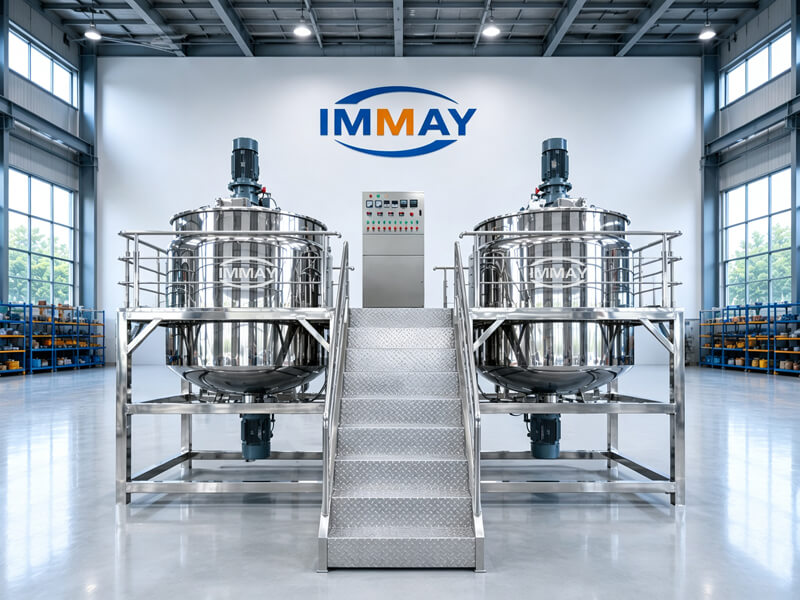
Industrial stainless steel mixing tanks with agitators play an important role in manufacturing processes involving liquid and cream products. They are used across a wide range of industries, with equipment specifications varying according to production scale and process requirements.
When planning an equipment investment, manufacturers need to determine the cost of the mixing tank and how it fits within their production budget. So, how much does an industrial stainless steel mixing tank cost?
The price of a stainless steel mixing tank varies depending on its capacity, construction materials, agitator configuration, and optional features. While every project has unique requirements, the following table provides a general price reference for standard industrial mixing tanks equipped with agitators.
Tank Capacity | Common Price Range (USD) | Common Applications |
100L | $2,000–$4,000 | Laboratory batches, pilot production, small-scale mixing |
300L | $4,000–$6,000 | Cosmetics, food ingredients, specialty chemicals |
500L | $6,000–$8,000 | Daily production of creams, lotions, detergents, liquid products |
1000L | $8,500–$13,000 | Medium-scale industrial manufacturing |
2000L | $13,000–$25,000 | Continuous production in cosmetics, food, and chemical plants |
5000L | $25,000–$40,000+ | High-volume industrial processing and large production lines |
The prices above are intended as a general reference for standard stainless steel mixing tanks with agitators. Actual quotations vary according to project specifications and optional configurations.
Although tank capacity is often the first specification buyers consider, it is rarely the only factor that determines the final quotation. Two stainless steel mixing tanks with the same volume can differ significantly in price because they are designed for different production processes and operating requirements.
The following factors have the greatest influence on the cost of an industrial mixing tank and should be carefully evaluated before comparing quotations.
Tank capacity forms the foundation of the equipment cost. Larger tanks require more stainless steel, heavier structural reinforcement, larger agitators, more powerful motors, and longer fabrication time.
However, price does not always increase in direct proportion to capacity. A standard 1000L stainless steel mixing tank may cost less than a highly customized 500L tank equipped with heating, cooling, precision controls, and special process features.
For this reason, selecting a tank based on actual batch size rather than purchasing excess capacity can help optimize both the initial investment and long-term operating efficiency.
Material selection affects both manufacturing cost and long-term equipment durability.
For most food, cosmetic, and general chemical applications, 304 stainless steel provides excellent corrosion resistance and is often the most economical choice.
316L stainless steel offers improved resistance to chlorides, acidic ingredients, and aggressive cleaning chemicals. It is commonly selected for products containing salts, corrosive raw materials, or formulations requiring higher corrosion resistance.
Choosing 316L where it is genuinely needed can extend equipment life, while selecting it for every project may unnecessarily increase the investment.
The mixing system is one of the most significant contributors to equipment cost because it directly affects mixing performance.
Different products require different agitator designs.
Common configurations include:
Anchor agitators for medium- to high-viscosity products requiring gentle, uniform mixing.
Paddle agitators for low-viscosity liquids and general blending applications.
High speed dispersers for rapid powder dispersion and pigment incorporation.
High shear homogenizers for emulsification, particle size reduction, and stable product consistency.
More advanced mixing systems generally require larger motors, stronger drive components, and additional engineering, resulting in higher equipment costs.
Temperature control requirements have a major influence on both manufacturing complexity and price.
Depending on the production process, a stainless steel mixing tank includes:
Steam heating system
Electric heating system
Hot water heating systems
Water cooling systems
These systems add fabrication steps, additional piping, instrumentation, and insulation materials, increasing both manufacturing cost and installation complexity.
For products requiring controlled heating or cooling throughout the mixing process, these options often provide greater process stability and production efficiency.
The motor is one of the core components of the mixing system, and its specification affects both performance and reliability.
Higher-viscosity products typically require greater torque and more powerful motors. In addition, motors from different manufacturers may vary in efficiency, durability, service life, and available certifications.
As a result, two mixing tanks equipped with motors of the same rated power may still have noticeably different prices depending on component quality and application requirements.
Surface finish requirements vary considerably between industries and directly influence fabrication time.
General industrial applications usually require standard mechanical polishing, while cosmetic, food, and pharmaceutical production often specify smoother internal surfaces to facilitate cleaning and reduce product residue.
Achieving finer surface finishes requires additional polishing processes and quality inspection, which increases manufacturing cost.
Selecting a surface finish appropriate for the intended application helps balance equipment performance with budget.
The level of automation selected can significantly affect equipment cost.
Common control options include:
Button control panels
PLC-based control systems
More advanced control systems offer improved process control, recipe management, and operating convenience, but also require additional electrical components, programming, and commissioning.
The appropriate control level should be selected according to production scale and operational requirements.
Most industrial mixing tanks are manufactured according to specific process requirements rather than standard configurations.
Common custom options include:
Additional manholes
Sight glasses
Load cells
Extra inlet or outlet connections
Bottom outlets
Special nozzle arrangements
Sampling valves
Customized support structures
Although each individual modification may appear minor, multiple custom features can substantially increase engineering time, fabrication complexity, and overall equipment cost.
Providing complete process information during the quotation stage helps suppliers recommend suitable configurations while avoiding unnecessary customization.
Getting an accurate quotation for a stainless steel mixing tank starts with clear communication between the buyer and the supplier. Buyers usually have a basic understanding of their products, formulations, and production requirements, along with some confirmed equipment specifications. Other technical details can be discussed with the supplier to determine a suitable equipment configuration.
Start by providing the supplier with basic information about your products and production process. This gives the supplier a better understanding of the intended application and the equipment requirements.
Useful information includes:
Product name and type
Basic formulation and ingredient characteristics
Product viscosity
Batch size and expected production volume
Main production procedures
Any confirmed equipment specifications
The more clearly these requirements are communicated, the easier it is for the supplier to understand the intended application and assess the equipment needed.
Buyers do not always need to have every technical detail finalized before requesting a quotation. If you are unsure about the agitator type, tank structure, stainless steel grade, heating or cooling configuration, or control system, discuss these points with the supplier.
Based on the product characteristics and production process you provide, the supplier can offer equipment recommendations and explain the available configuration options. This communication helps clarify technical requirements before the equipment specifications are finalized.
After discussing the technical requirements, review the proposed equipment configuration with the supplier. Confirm that the tank capacity, material, agitator system, auxiliary components, and other specifications meet your production needs.
Once the configuration is confirmed, the supplier can prepare a more accurate quotation based on the agreed equipment specifications. Make sure the quotation also identifies the included components, services, and delivery terms so you have a clear understanding of the proposed purchase.
Purchasing a stainless steel mixing tank is an important investment in a manufacturing operation. The equipment should be selected according to the products being processed, production requirements, and the functions needed for daily operation. Understanding how these requirements influence equipment cost helps manufacturers make informed investment decisions.
A suitable mixing tank provides the foundation for consistent production and supports the development of manufacturing operations. By defining equipment requirements and planning the investment carefully, manufacturers can select equipment that serves their production needs and delivers long-term value.