- Home
- Equipment
- Industries
- We Immay
- Resource
- Contact
Author: Site Editor Publish Time: 2026-08-06 Origin: Site
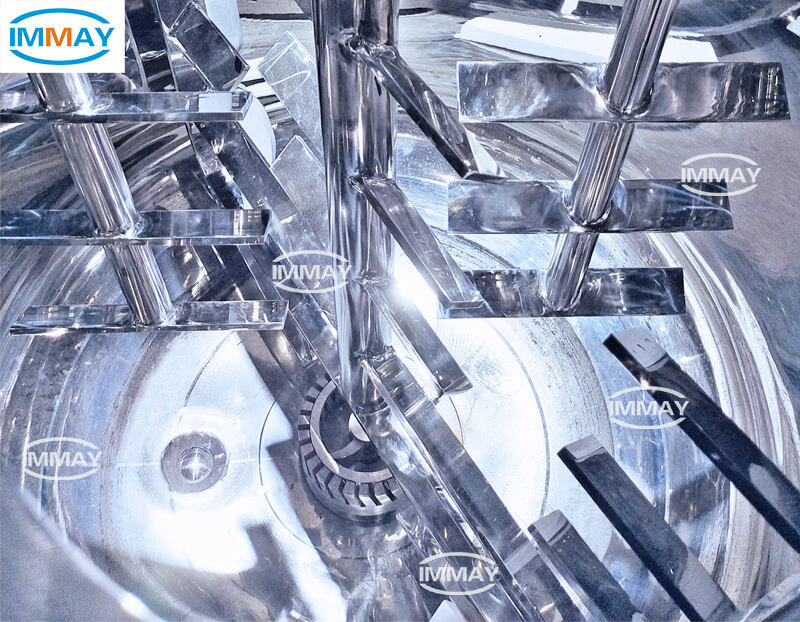
Selecting the right agitator speed is one of the most important decisions when purchasing a stainless steel mixing tank. However, it is also one of the most misunderstood specifications. Many buyers assume that a higher RPM always delivers faster mixing and better product quality.
In reality, the ideal agitator speed depends on several factors, including product viscosity, agitator type, tank dimensions, and the mixing objective. An unsuitable speed can lead to excessive foaming, poor circulation, longer mixing times, unnecessary energy consumption, or increased wear on mechanical components.
Instead of choosing an RPM based only on previous experience or comparing numbers between suppliers, buyers should understand how agitator speed is matched to the product and process. This guide explains the key factors that influence agitator speed selection and what to consider before purchasing a stainless steel mixing tank.
Agitator speed directly affects mixing efficiency, product quality, and equipment performance. While many buyers focus on motor power or tank capacity, selecting an appropriate agitator speed is equally important. A speed that is too low may not provide sufficient circulation, while excessive speed can create operational problems that increase production costs and reduce product quality.
Rather than aiming for the highest possible RPM, the goal is to achieve effective mixing while matching the characteristics of the product and the production process.
Agitator Speed Too Low | Agitator Speed Too High |
Slow blending and longer batch times | Excessive foaming |
Poor liquid circulation | Vortex formation |
Ingredients may settle or separate | Product damage from excessive shear |
Inconsistent mixing results | Higher energy consumption |
Reduced process efficiency | Faster wear of seals, bearings, and other rotating components |
Choosing the right agitator speed helps maintain consistent product quality while reducing unnecessary energy use and mechanical wear. Instead of selecting a speed based on experience alone, buyers should evaluate the mixing application, product properties, and equipment configuration before determining the most suitable operating range.
There is no single agitator speed that works for every stainless steel mixing tank. The appropriate RPM depends on the product being processed, the agitator design, the tank dimensions, and the production objective. Selecting the right combination helps achieve efficient mixing while minimizing energy consumption and unnecessary equipment wear.
Product viscosity is usually the first factor considered when selecting agitator speed. Low-viscosity liquids flow easily and generally require higher rotational speeds to create sufficient circulation. In contrast, high-viscosity products resist movement and are typically mixed more effectively at lower speeds with higher torque.
For example, cosmetic serum can usually be mixed at higher speeds, while products such as shampoo, cream, ointment, or paste often require slower agitator speeds to avoid excessive shear, air entrainment, or unnecessary mechanical stress.
Product Type | Typical Viscosity | Typical Agitator Speed |
Water | Low | High |
Serum | Low | High |
Liquid detergent | Medium | Medium |
Shampoo | Medium to High | Low to Medium |
Cream | High | Low |
Paste | Very High | Low |
General guideline: As product viscosity increases, the recommended agitator speed generally decreases while the required mixing torque increases.
Different agitator designs move liquids in different ways. As a result, two mixing tanks with the same capacity may operate at completely different RPMs while achieving similar mixing performance.
For example, an anchor agitator is designed to move high-viscosity products close to the tank wall and typically operates at relatively low speeds. A propeller agitator creates strong axial flow and is better suited to low-viscosity liquids, allowing it to operate at much higher speeds.
Agitator Type | Typical Speed | Best For |
Anchor | Low | High-viscosity products |
Paddle | Medium | General liquid mixing |
Propeller | High | Low-viscosity liquids |
High Shear Homogenizer | Very High | Emulsification and particle size reduction |
This is one of the main reasons different stainless steel mixing tank anufacturers recommend different RPMs for similar mixing tanks. The agitator design, rather than the tank itself, often determines the most suitable operating speed.
Tank size also affects the appropriate agitator speed. Although two mixing tanks may operate at the same RPM, a larger tank usually has a larger agitator diameter. This means the agitator blade travels a greater distance during each rotation, resulting in a much higher blade tip speed.
As tank diameter increases, manufacturers often reduce the operating RPM to maintain efficient mixing while avoiding excessive shear forces, vibration, or unnecessary power consumption.
For this reason, agitator speed should never be selected based on tank capacity alone. Tank geometry, agitator diameter, and the desired flow pattern should all be considered together during equipment design.
The purpose of the mixing process also influences the ideal agitator speed. Different production tasks require different flow patterns and energy input.
For example, dissolving powders often requires stronger circulation to prevent agglomeration, while maintaining product uniformity during storage may only require gentle agitation. Heating and cooling processes may also benefit from different mixing intensities to improve heat transfer without introducing excessive air.
Common mixing objectives include:
Dissolving powders
Blending multiple liquids
Suspending solid particles
Improving heating efficiency
Enhancing cooling performance
Maintaining product uniformity during production or storage
Because each application has different process requirements, the optimal agitator speed should be selected according to the specific production objective rather than using a fixed RPM for every product.
No. A higher agitator speed does not always mean faster or better mixing. While increasing RPM can improve circulation and shorten mixing time in some applications, excessive speed may create new problems that negatively affect product quality and equipment performance.
The purpose of agitator speed selection is not to achieve the highest possible RPM, but to find the operating range that provides sufficient mixing force without causing unnecessary side effects.
Issue | How It Affects the Mixing Process |
Excessive foaming | High-speed agitation can introduce more air into the product, which may affect appearance, filling accuracy, and product stability. |
Vortex formation | Strong rotational flow may create a vortex, reducing effective mixing and causing uneven circulation in some applications. |
Excessive shear force | High shear levels may damage sensitive ingredients or change the desired product texture. |
Increased temperature | Higher mechanical energy input can generate additional heat, which may affect temperature-sensitive products. |
Faster component wear | Continuous operation at unsuitable speeds can increase stress on seals, bearings, and other rotating components. |
For example, a high speed agitator is suitable for low-viscosity liquids that require rapid circulation, but the same speed is not appropriate for products such as cream or paste, where excessive shear and air entrainment can reduce product quality.
A properly designed stainless steel mixing tank should balance agitator speed, torque, and product characteristics. The recommended RPM should be determined based on the application rather than simply selecting the highest available speed.
Yes, agitator speed can often be adjusted depending on the mixing tank configuration and production requirements. Many stainless steel mixing tanks use a Variable Frequency Drive (VFD) to control motor speed, allowing operators to adjust the agitator RPM based on different products, batch stages, or process requirements.
However, adjustable speed is not always necessary for every application. The decision depends on the product characteristics, production flexibility, and mixing objectives.
A VFD allows the motor speed to be increased or reduced during operation. This provides greater flexibility when one mixing tank is used for multiple products or when the product properties change during processing.
Common situations where variable speed control is beneficial include:
Different product viscosities: A tank used for both low-viscosity liquids and thicker products require different mixing speeds.
Multiple production stages: Some processes may need a slower speed during ingredient addition and a higher speed during blending or dispersion.
A fixed-speed agitator can be a practical choice when the production process is stable and the same product is manufactured repeatedly.
Examples include:
A single product with consistent viscosity
A well-established production process
Applications where the required mixing speed does not change significantly
Projects where a simpler and more cost-effective configuration is preferred
A VFD is not automatically required for every stainless steel mixing tank. For manufacturers producing multiple products or working with different formulations, adjustable speed can provide greater process flexibility. However, for dedicated production lines with stable operating conditions, a fixed-speed design may already meet the mixing requirements.
Before selecting a speed control system, buyers should consider the expected product range, future production plans, and whether different mixing conditions will be required throughout the equipment's service life.
When comparing stainless steel mixing tanks from different suppliers, buyers often notice that manufacturers often recommend different agitator speeds for similar tank capacities or applications. This does not necessarily mean that one design is better than another. The recommended RPM is determined by the overall mixing system design rather than a single specification.
One of the main reasons is the agitator design. Different impeller types create different flow patterns and mixing forces. For example, an anchor agitator designed for high-viscosity products usually operates at a lower speed, while a propeller agitator for low-viscosity liquids can run at a much higher speed.
The agitator diameter also affects the actual mixing effect. Two tanks operating at the same RPM may have very different tip speeds if their agitator sizes are different. A larger agitator travels a greater distance during each rotation, creating higher blade tip speed and stronger fluid movement even at the same RPM.
Other factors that influence the recommended agitator speed include:
Motor power and gearbox ratio: The drive system determines how much torque is available at a specific speed.
Product viscosity: Higher-viscosity products usually require lower speeds with higher torque, while low-viscosity liquids may need higher speeds for sufficient circulation.
Tank geometry: Tank diameter, liquid height, and agitator position affect the flow pattern inside the vessel.
Mixing objective: Blending liquids, dissolving powders, suspending particles, or maintaining uniformity may require different mixing intensities.
For this reason, buyers should avoid comparing mixing tanks based only on RPM numbers. A higher or lower speed does not automatically indicate better performance. The correct agitator speed should be evaluated together with the agitator type, motor configuration, product characteristics, and the intended mixing process.
Understanding the complete mixing system allows buyers to make more accurate comparisons between suppliers and select a stainless steel mixing tank configuration that matches their actual production requirements.
Selecting the right agitator speed involves more than choosing a higher or lower RPM. Product viscosity, agitator design, tank geometry, and production objectives should all be evaluated together to determine the most suitable mixing configuration.
Discussing these process requirements with the equipment supplier before manufacturing helps buyers compare different stainless steel mixing tank options more effectively. A well-matched agitator system can provide stable mixing performance while supporting current production requirements and future product development