- Home
- Equipment
- Industries
- We Immay
- Resource
- Contact
Author: Site Editor Publish Time: 2026-08-12 Origin: Site
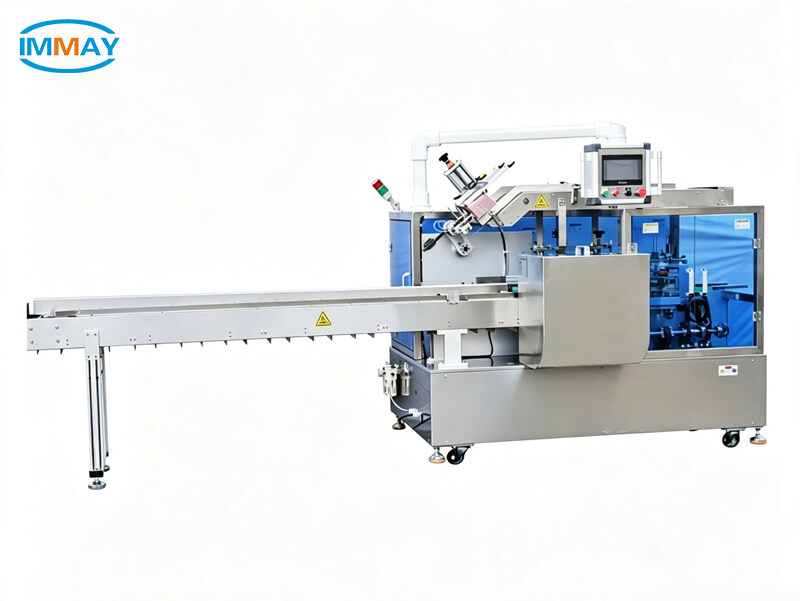
Purchasing an automatic cartoning machine involves much more than selecting the right speed or carton size. To achieve stable production, the machine must be compatible with upstream and downstream equipment, product characteristics, carton specifications, and the overall production process. A mismatch can lead to production bottlenecks, frequent stoppages, unnecessary labor, and reduced line efficiency.
Before making a purchasing decision, buyers should evaluate how the cartoning machine will integrate with the entire production line rather than considering it as a standalone piece of equipment. Understanding the key integration factors helps compare different cartoning solutions more effectively and select a system that supports both current production requirements and future business growth.
An automatic cartoning machine is only one part of a complete production line. While it plays an important role in secondary packaging, its overall performance depends on how well it integrates with upstream and downstream equipment. Even a high-speed cartoning machine may not improve productivity if the rest of the production line cannot supply or receive products at the same rate.
Before selecting a machine, buyers should map their entire production process and identify how products move from manufacturing to final packaging. Understanding the complete workflow helps determine whether the cartoning machine's speed, feeding method, and layout are compatible with the rest of the production line.
A typical automated production line includes:
Product Manufacturing → Primary Packaging → Product Inspection → Automatic Cartoning → Case Packing → Palletizing
The production stages before cartoning vary depending on the product being manufactured. For example, cosmetic products may go through filling and capping, pharmaceutical products may require blister packaging, while food products may be flow wrapped before entering the cartoning machine. Regardless of the product type, the cartoning machine should be evaluated as part of the complete production line rather than as a standalone piece of equipment.
When selecting an automatic cartoning machine, buyers should evaluate the production capacity of the entire packaging line, rather than comparing the cartoning machine's speed with a single upstream machine. Depending on the product and packaging process, the equipment before cartoning may include filling machines, blister packaging machines, pouch packaging machines, flow wrapping machines, or other primary packaging equipment.
Instead of focusing only on the machine's maximum speed, buyers should determine its recommended continuous operating speed under the actual product, carton, and feeding conditions. The objective is to maintain a consistent product flow through the complete line without creating unnecessary accumulation, idle time, or downstream bottlenecks.
Production Line Condition | Possible Result |
Upstream equipment operates faster than the cartoning machine | Product accumulation before cartoning |
Cartoning machine operates faster than the available product supply | Frequent idle running |
Downstream equipment cannot handle the cartoning output | Finished carton accumulation |
Different stages have significantly different cycle times | Production bottlenecks |
Equipment operates within compatible production ranges | More stable and balanced production flow |
For example, a blister packaging machine may continuously supply products to the cartoning machine in a pharmaceutical application, while a pouch packaging machine or flow wrapper may perform the primary packaging in a food or consumer goods application. The specific equipment can vary significantly, but the principle remains the same: the cartoning machine should be selected according to the production capacity and operating conditions of the complete line, rather than its advertised maximum speed alone.
Factor | Why It Matters |
Normal production rate | Reflects actual continuous output |
Peak production rate | Helps evaluate short-term capacity |
Product supply stability | Affects cartoning machine utilization |
Carton loading cycle | Influences achievable cartoning speed |
Downstream capacity | Helps prevent finished carton accumulation |
Buffer capacity | Helps absorb temporary speed differences |
Future production increase | Provides room for capacity growth |
The objective is not to choose the fastest cartoning machine, but to select a machine whose practical operating capacity fits the complete production line. A properly balanced line can reduce bottlenecks, unnecessary idle time, and interruptions while providing sufficient capacity for future production needs.
An automatic cartoning machine may be used for many different products, including bottles, tubes, jars, sachets, pouches, blister packs, and other packaged products. However, product compatibility depends on more than the product category itself. The product's dimensions, shape, weight, surface condition, orientation, and stability can all affect how it is transported, positioned, and loaded into the carton.
Before selecting a cartoning machine, buyers should provide detailed product information and samples rather than simply stating the product type. This allows the supplier to evaluate how the product will move through the machine and determine whether additional feeding, positioning, or handling components are required.
Product Type
Common products handled by automatic cartoning machines include:
Bottles
Tubes
Jars
Sachets
Pouches
Blister packs
Vials
Small consumer products
Other individually packaged products

Different products require different handling methods. For example, a rigid bottle may be transported by a conveyor and positioned before cartoning, while flexible sachets or pouches may require a different feeding and orientation method. Blister packs may also require dedicated loading mechanisms to maintain consistent positioning.
Product Characteristic | Why It Matters |
Product dimensions | Determines whether the product fits the feeding and cartoning range |
Shape | Affects product orientation and positioning |
Weight | Influences conveying and transfer requirements |
Surface condition | Affects gripping, pushing, and conveying stability |
Product rigidity | Determines how the product can be handled |
Orientation | Affects how the product enters the carton |
Product stability | Helps determine whether additional positioning is needed |
Packaging condition | Affects feeding and handling during cartoning |
The key point is that product compatibility should be evaluated based on the actual product and its handling characteristics, not simply its product category. Providing product dimensions, weight, packaging condition, and representative samples before purchasing helps the supplier determine the appropriate feeding and cartoning configuration more accurately.
The carton specifications are one of the key factors when selecting an automatic cartoning machine. Different carton dimensions and styles require the machine to operate within a specific working range. A cartoning machine can usually handle multiple carton sizes within its designed range, but this does not mean that one machine can accommodate cartons of any size.
Before purchasing, buyers should provide the actual carton dimensions and confirm the machine's applicable carton range. Important specifications include:
Carton Specification | Why It Matters |
Length | Determines whether the carton falls within the machine's size range |
Width | Affects carton feeding, opening, and product insertion |
Height | Influences carton forming and closing |
Paperboard thickness | Can affect carton feeding and opening stability |
Tuck end style | Determines the applicable carton closing method |
Leaflet insertion | May require an additional leaflet feeding system |
Carton quality and consistency | Affects reliable feeding and opening |
For multiple SKUs, the key question is not whether one cartoning machine can handle every carton size, but whether the different cartons fall within a practical and compatible size range for the same machine. Cartons with relatively small dimensional differences can often be handled through machine adjustments or change parts, depending on the machine configuration.
However, if the carton dimensions or product specifications vary significantly, trying to cover all products with one machine may not be the most practical solution. A large difference in carton size can require substantially different feeding, forming, or loading configurations, and in some cases a separate cartoning machine may be more suitable.
Tip: When planning for multiple SKUs, provide the supplier with the smallest and largest carton sizes you expect to produce, along with the dimensions of the main products. This allows the applicable working range to be evaluated before purchasing and helps determine whether one machine is sufficient or whether different product groups should be assigned to separate machines.
The way a product enters the carton is an important part of automatic cartoning machine selection. Different products may require different feeding and transfer methods depending on their shape, packaging format, rigidity, orientation, and production speed. Therefore, buyers should evaluate the product flow and loading process before selecting the machine configuration.
Product Format | Typical Feeding Method |
Bottle | Conveyor Feed |
Tube | Pusher or Conveyor Feed |
Sachet | Flight Chain or Conveyor Feed |
Pouch | Conveyor or Pick-and-Place |
Blister Pack | Automatic Blister Feeder |
Jar | Conveyor or Pusher Feed |
These are general examples rather than fixed configurations. The appropriate feeding method depends on the actual product and production requirements. For products that are flexible, unstable, unusually shaped, or difficult to orient, additional guiding, positioning, or transfer mechanisms may be required.
The feeding method should therefore be considered together with the product dimensions, carton specifications, and required production speed. Rather than choosing a cartoning machine first and then trying to adapt the product to it, buyers should first determine how the product needs to be fed, oriented, and transferred into the carton. This provides a better basis for selecting a suitable automatic cartoning machine configuration.
The physical space available in the factory should be evaluated before purchasing an automatic cartoning machine. The machine must not only fit within the available floor area, but also leave sufficient space for product flow, operator access, maintenance, and connection with other equipment in the production line.
Key factors to evaluate include:
Installation footprint — Confirm the machine's overall length, width, and height, including conveyors and auxiliary equipment.
Maintenance clearance — Leave sufficient space around service areas for inspection, adjustment, component replacement, and routine maintenance.
Conveyor direction — Check whether the machine's product and carton flow direction matches the existing production line layout.
Door size — Confirm that the machine and its major components can pass through factory doors during delivery and installation.
Ceiling height — Check clearance for the machine itself, electrical components, overhead conveyors, or lifting equipment if required.
Operator access — Allow enough room for operators to load materials, monitor production, perform adjustments, and access the machine safely.
Space requirements can also change when the cartoning machine is integrated with upstream and downstream equipment. A machine that fits on its own may require additional space once conveyors, inspection systems, carton handling equipment, or other line components are included.
Procurement Tip: Ask the supplier to provide a layout drawing before confirming the order. The drawing should show the machine dimensions, product flow direction, conveyor connections, operator access areas, and required maintenance clearance. Comparing this layout with the actual factory space can help identify installation problems before the equipment is manufactured and delivered.
An automatic cartoning machine should be selected based not only on current production requirements, but also on reasonably foreseeable changes in products and packaging. Buyers may need to consider future SKUs, carton sizes, product dimensions, production capacity, and additional packaging functions when evaluating a machine.
Potential future changes may include:
New SKUs
Different carton sizes
Different product dimensions
Higher production volumes
Leaflet insertion
Code inspection
Date or batch coding
Vision inspection
However, planning for future production does not necessarily mean choosing the most expandable or highly configured machine available. Adding functions that may never be used can increase the initial investment, machine complexity, and maintenance requirements. The more practical approach is to identify reasonably foreseeable changes and determine which ones should be considered in the initial machine configuration.
For example, if a manufacturer expects to introduce several products with carton dimensions within a similar range, selecting a machine that can accommodate this range may be worthwhile. However, if a future product will have a significantly different size, packaging format, or loading method, purchasing a second machine later may be more practical than trying to make one machine handle both applications.
Procurement Tip: Plan for the future, but do not over-configure the machine based on uncertain requirements. Discuss your expected product changes, carton ranges, and production growth with the supplier, then determine which requirements should be included in the initial purchase and which can be addressed separately if they become necessary.
Before discussing an automatic cartoning machine with a supplier, buyers should prepare as much information about the product, carton, existing equipment, and production requirements as possible. Complete information allows the supplier to evaluate the production flow more accurately and recommend a suitable machine configuration.
Information | Why It Matters |
Product dimensions | Helps determine the appropriate feeding and handling method |
Product weight | Affects product transfer and handling stability |
Product orientation | Determines how the product should be transferred into the carton |
Carton dimensions | Confirms whether the carton falls within the machine's working range |
Carton style | Helps determine the carton opening and closing configuration |
Production speed | Used to evaluate production capacity and line balance |
Existing equipment layout | Helps determine how the cartoning machine can be integrated |
Factory space | Confirms whether installation and maintenance space are sufficient |
Future product plans | Helps evaluate foreseeable changes in products and cartons |
For an existing production line, it is also useful to provide layout drawings, equipment specifications, conveyor dimensions, and product flow information where available. Product and carton samples can provide additional information that may not be apparent from specifications alone.
The more complete the information provided before the project begins, the more accurately the supplier can evaluate compatibility, identify potential integration issues, and propose a suitable automatic cartoning machine configuration.
Many manufacturers do not build a completely new production line when they decide to automate cartoning. Instead, they may already have equipment for product manufacturing, primary packaging, labeling, inspection, or other processes and want to replace manual carton packing with an automatic cartoning machine.
In some cases, the cartoning machine can be added directly to the existing line if the product flow, production speed, conveyor layout, and available space are compatible. However, existing equipment may need to be adjusted or additional equipment added to create a stable connection between the existing process and the new cartoning machine.
Direct integration may be practical when:
Product output is consistent
Product dimensions are suitable for the cartoning machine
The existing conveyor can provide a compatible product flow
Production speeds are reasonably matched
There is sufficient installation space
The existing line has suitable connection points
In these situations, the new cartoning machine may be connected with relatively limited modifications.
Some production lines may require additional components to achieve stable product flow, such as:
Buffer Conveyor — Helps absorb temporary differences in production speed between connected machines.
Product Orientation System — Positions products consistently before they enter the cartoning machine.
Reject Station — Removes defective or incorrectly positioned products before cartoning.
Additional Conveyor Sections — Adjusts the distance, height, or direction between existing equipment and the cartoning machine.
The required changes depend on the existing production line and the product being packaged. A line designed for manual carton packing may not have the product spacing, orientation, or continuous flow required for automatic cartoning.
Before adding an automatic cartoning machine to an existing line, buyers should evaluate:
Factor | What to Check |
Product flow | Can products reach the cartoning machine continuously? |
Production speed | Are the connected machines operating within compatible ranges? |
Product orientation | Does the product arrive in the required orientation? |
Conveyor layout | Can the existing conveyors connect with the new machine? |
Available space | Is there enough room for the machine and additional components? |
Product quality | Can defective products be removed before cartoning? |
Electrical and control integration | Can the equipment operate together as one production process? |
An existing production line can often be upgraded with an automatic cartoning machine, but the feasibility depends on the actual equipment, product, and factory layout. Before purchasing, buyers should provide the supplier with the existing line layout, equipment information, product specifications, and production requirements so that the integration approach can be evaluated in advance.
Choosing an automatic cartoning machine based only on its basic specifications can create problems when the machine is connected to a complete production line. The following mistakes are worth considering before making a purchase.
A higher rated speed does not necessarily mean better production performance. If the rest of the line cannot provide products or handle finished cartons at a compatible rate, the cartoning machine may experience frequent idle periods or create bottlenecks. Buyers should compare the practical operating capacity of the complete line rather than focusing only on maximum speed.
A machine may handle several carton sizes, but only within its designed working range. Assuming that one machine can accommodate any future carton can lead to problems when a new SKU has significantly different dimensions. Buyers should identify reasonably foreseeable carton sizes and confirm the applicable range before ordering.
Different products may require different feeding, orientation, and transfer methods. Bottles, tubes, pouches, sachets, and blister packs can behave very differently during product handling. Selecting the cartoning machine before evaluating how the actual product will enter the carton can result in an unsuitable feeding configuration.
The machine footprint is only part of the required space. Conveyors, operator access, maintenance areas, electrical components, and connections to other equipment also need to be considered. A machine that fits within the available floor area may still be difficult to operate or maintain if the surrounding space is insufficient.
Buying a machine based solely on today's requirements can create limitations when production changes. At the same time, over-configuring a machine for uncertain future needs can unnecessarily increase the initial investment. Buyers should consider reasonably foreseeable changes in products, cartons, and production volume while avoiding functions or capacity that may never be needed.
The key is to match the cartoning machine to the actual production requirements and foreseeable changes, rather than simply selecting the largest, fastest, or most highly configured machine available.
Selecting an automatic cartoning machine should be approached as a production line planning decision rather than simply a machine purchase. Product characteristics, production capacity, carton specifications, equipment compatibility, available factory space, and reasonably foreseeable production changes should all be evaluated together before placing an order.
Providing complete product and carton information, sharing the existing production line layout, and discussing integration requirements with the supplier at an early stage can help buyers identify potential limitations before manufacturing begins. This makes it easier to compare different cartoning solutions, determine the appropriate configuration, and choose an option that fits the current production process without unnecessarily over-investing in uncertain future requirements.
Yes, an automatic cartoning machine can handle multiple products when their dimensions, packaging formats, and handling requirements fall within the machine's applicable working range. However, products with substantially different sizes or feeding requirements may require different configurations or a separate machine.
Not necessarily. The machines do not need to operate at exactly the same speed, but their practical operating capacities should be compatible. Buffering or controlled product flow can also help manage temporary differences between production stages. The goal is a stable overall production flow rather than identical machine speeds.
In many cases, yes. The feasibility depends on factors such as product flow, production speed, conveyor layout, product orientation, available space, and the connection between existing equipment and the cartoning machine. A layout and equipment assessment should be completed before purchasing.
The required space depends on the machine model and the complete production line. Buyers should consider the machine footprint, conveyor connections, operator access, maintenance clearance, and the space required for upstream and downstream equipment. Asking the supplier for a layout drawing before installation planning is recommended.
Ideally, provide representative product samples and the actual cartons used in production. Product dimensions, weight, packaging condition, carton dimensions, paperboard thickness, and carton style should also be provided. If multiple SKUs will be processed, samples covering the expected product and carton range can help the supplier evaluate compatibility more accurately.