- Home
- Equipment
- Industries
- We Immay
- Resource
- Contact
Author: Site Editor Publish Time: 2026-08-27 Origin: Site

Choosing mixing equipment for a cosmetic formula starts with understanding the process behind the formula. When planning cosmetic production, buyers need to carefully consider both a vacuum emulsifying mixer and a stainless steel mixing tank before making a purchase. Both are used for mixing cosmetic formulations, but their configurations and available functions are not exactly the same.
The key is to determine which equipment is better suited to the requirements of the formula and the production process.
So, which one is the better choice for your cosmetic formula? Understanding the differences between these two types of equipment can help buyers make a more informed decision.
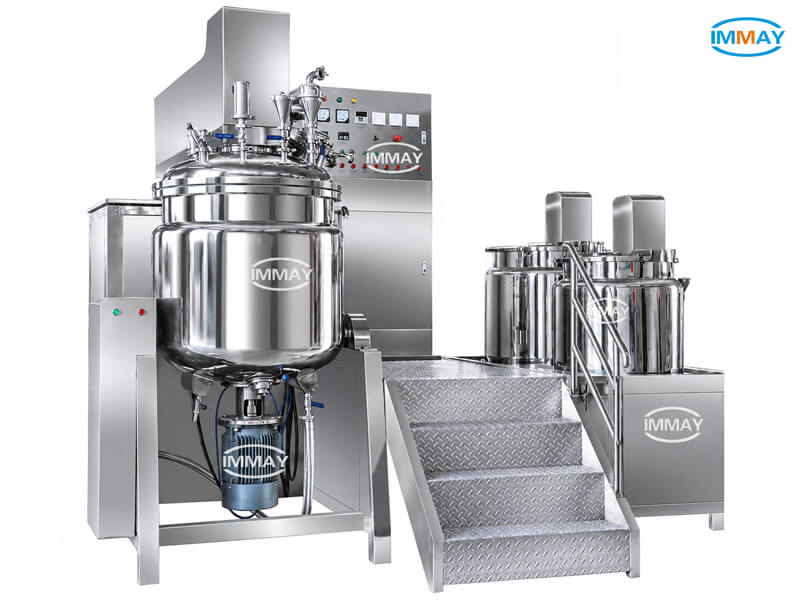
A vacuum emulsifying mixer consists of a main emulsifying mixing tank with an integrated high shear homogenizer, together with an oil phase tank, a water phase tank, a vacuum system, and heating and cooling systems.
The main components include:
Oil phase tank – used to prepare and heat the oil phase before it is transferred to the main mixing tank.
Water phase tank – used to prepare and heat the water phase before it is transferred to the main mixing tank.
Main emulsifying mixing tank with high shear homogenizer – the main vessel where the oil and water phases are combined, mixed, and emulsified.
Vacuum system – used for vacuum deaeration after mixing process.
Heating and cooling systems – used to control the temperature of the oil and water phases and the product during processing.
A stainless steel mixing tank is a main processing vessel equipped with an agitator for mixing and blending the ingredients. It can also be configured with heating and cooling functions and different agitators when required by the formulation.
The main components include:
Mixing tank with agitator – the main vessel used to hold and mix the ingredients.
Heating and cooling jacket – used to control the product temperature during processing.
A vacuum emulsifying mixer is suited to cosmetic formulas that contain oil and water phases and require an emulsification process. In this type of formulation, the two phases are prepared separately and then combined in the main emulsifying mixing tank.
When the Formula Contains Oil and Water Phases
The formula contains an oil phase and a water phase.
The oil phase and water phase are prepared separately before being combined.
The oil and water phases are heated during phase preparation.
The two phases are transferred to the main emulsifying mixing tank.
High shear homogenization is used to achieve emulsification.
The emulsified product is cooled after emulsification.
Vacuum processing is used to remove entrained air from the product after mixing and emulsification.
The typical process can be described as:
Oil Phase Preparation → Water Phase Preparation → Heating → Phase Combination → High-Shear Homogenization → Emulsification → Cooling → Vacuum Deaeration
Face Cream
Face creams commonly contain both oil-soluble and water-soluble ingredients and are formulated as oil-water emulsions. During production, the oil and water phases are prepared and heated before being combined. High-shear homogenization is then used to form a uniform emulsion, followed by cooling and vacuum deaeration.
Moisturizing Cream
Moisturizing creams often contain oils, emollients, water, humectants, and other functional ingredients. When these ingredients form an oil-water emulsion, a vacuum emulsifying mixer provides the separate phase preparation, heating, high-shear homogenization, cooling, and vacuum deaeration required by the process.
Hand Cream
Hand creams are commonly formulated as emulsion-based products containing an aqueous phase and an oil phase. The two phases are prepared separately and combined during the emulsification process. High-shear homogenization helps form the required emulsion structure, while the subsequent cooling and vacuum deaeration stages complete the processing.
Body Cream
Body creams generally have a cream-like consistency and commonly use an oil-water emulsion structure. When the formulation requires separate oil and water phase preparation, heating, emulsification through high-shear homogenization, cooling, and vacuum deaeration, a vacuum emulsifying mixer is suitable for the process.
Lotion
Many cosmetic lotions are formulated as oil-water emulsions, although their viscosity and formulation can vary considerably. When the lotion requires separate oil and water phase preparation followed by high-shear emulsification, a vacuum emulsifying mixer can provide the integrated processing functions required by the formula.
Sunscreen
Sunscreen formulations can contain oil-soluble and water-soluble ingredients that need to be processed into a uniform emulsion. When the formulation uses separate oil and water phases and requires heating, high-shear homogenization, cooling, and vacuum deaeration, a vacuum emulsifying mixer can be used for the manufacturing process.
Other Oil-Water Emulsion-Based Cosmetic Products
Other cream and lotion products can also use a vacuum emulsifying mixer when their formulas contain oil and water phases that need to be emulsified. The specific equipment configuration should be determined according to the formulation, batch size, viscosity, temperature requirements, and processing sequence.
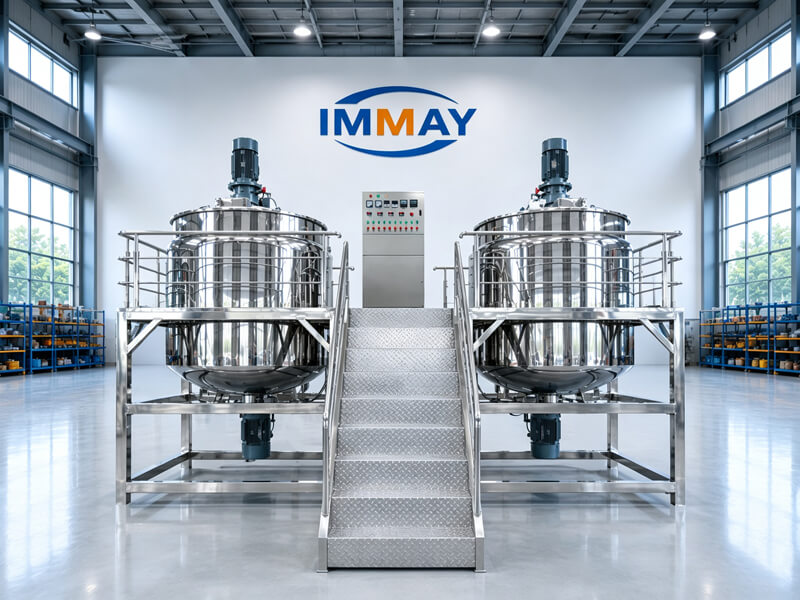
A stainless steel mixing tank is commonly used when the cosmetic formula primarily requires powder-liquid mixing or liquid-liquid mixing and does not require the complete oil and water phase preparation and vacuum processing configuration of a vacuum emulsifying mixer.
The tank can also be equipped with a high-shear homogenizer when the formula requires high-shear mixing or emulsification. Therefore, the presence of a homogenizer alone does not determine whether a vacuum emulsifying mixer is required.
Powder-liquid mixing involves adding one or more powder ingredients into a liquid and processing them until they are properly dissolved, dispersed, or uniformly mixed.
Typical processes include:
Powder + Liquid → Powder Addition → Dissolving / Dispersion → Mixing
A stainless steel mixing tank with a suitable agitator can be used for this type of process. The agitator keeps the ingredients moving through the tank and helps distribute the powder throughout the liquid.
The actual agitator design and mixing speed should be selected according to factors such as powder characteristics, liquid viscosity, powder addition rate, and required mixing time.
Liquid-liquid mixing involves combining two or more liquid ingredients to form a uniform product.
Typical processes include:
Liquid + Liquid → Ingredient Addition → Agitation → Uniform Mixing
A stainless steel mixing tank with an agitator is commonly suitable for this type of process. The liquids can be added according to the production sequence and mixed until the required uniformity is achieved.
Heating or cooling can also be incorporated into the tank when temperature control is part of the formulation process.
Shampoo
Shampoo is typically a liquid personal care product that involves blending water, surfactants, conditioning ingredients, thickeners, fragrances, and other ingredients. The production process mainly involves controlled addition and mixing of liquid ingredients, with powders or other solid ingredients added when required by the formula.
A stainless steel mixing tank with an agitator is commonly suitable for this type of process.
Shower Gel
Shower gel generally consists of a water-based system containing surfactants, thickeners, fragrances, and other functional ingredients. The ingredients are added according to the formulation sequence and mixed until a uniform product is obtained.
A stainless steel mixing tank can provide the required mixing and temperature control for this process.
Body Wash
Body wash is generally produced by blending water-based ingredients with surfactants, moisturizers, fragrances, and other components. The production process primarily involves liquid-liquid mixing and controlled ingredient addition.
A stainless steel mixing tank with an agitator can therefore be used for the main mixing process.
Hair Dye
Hair dye can contain water, dye precursors, surfactants, emulsifiers, fatty alcohols, conditioning agents, and other ingredients. Depending on the formulation, the production process may involve liquid-liquid mixing, powder-liquid mixing, dispersion of solid ingredients, or emulsification.
A stainless steel mixing tank can be configured with a high shear homogenizer to handle the mixing and emulsification process.
Hair Perm Products
Hair perm products can contain water, active ingredients, fatty alcohols, emulsifiers, conditioning agents, and other components. Depending on the formulation, the production process may involve liquid-liquid mixing, powder-liquid mixing, or emulsification.
A stainless steel mixing tank can be configured with a high shear homogenizer to handle the mixing and emulsification process.
Equipment Configuration | Vacuum Emulsifying Mixer | Stainless Steel Mixing Tank |
Main mixing tank | ✓ | ✓ |
Oil phase tank | ✓ | Normally not included |
Water phase tank | ✓ | Normally not included |
Agitator | ✓ | ✓ |
High-shear homogenizer | Integrated | Optional |
Heating | ✓ | ✓ |
Cooling | ✓ | ✓ |
Vacuum deaeration | ✓ | Not normally included |
A vacuum emulsifying mixer is configured with a main emulsifying mixing tank, oil phase tank, water phase tank, integrated high shear homogenizer, heating and cooling systems, and a vacuum system. These components work together for phase preparation, mixing, emulsification, temperature control, and vacuum deaeration.
A stainless steel mixing tank consists primarily of a mixing tank with agitator. It can be equipped with heating and cooling jacket, and different agitators according to the formulation and production process. It can therefore handle mixing and, when equipped with a high-shear homogenizer, emulsification.
Choosing between a vacuum emulsifying mixer and a stainless steel mixing tank should be based on the requirements of the cosmetic formula and production process rather than the product name alone. A vacuum emulsifying mixer provides an integrated configuration for oil and water phase preparation, high-shear homogenization, heating, cooling, and vacuum deaeration, while a stainless steel mixing tank offers a more flexible configuration for mixing and can also be equipped with different agitators and heating and cooling function.
Before purchasing, buyers should provide the equipment supplier with complete information about the formula, ingredients, viscosity, mixing process, temperature requirements, batch size, and required production capacity. This allows the supplier to evaluate the appropriate equipment configuration and determine whether a vacuum emulsifying mixer or a stainless steel mixing tank is better suited to the specific cosmetic production process.