- Home
- Equipment
- Industries
- We Immay
- Resource
- Contact
 |
What Is a Cosmetic Cream Mixer?
A cosmetic cream mixer is an industrial processing system used to produce semi-solid cosmetic formulations such as facial creams, moisturizing creams, and other emulsion-based personal care products. In manufacturing environments, this equipment is responsible for combining multiple ingredients into a uniform formulation while maintaining controlled processing conditions.
Unlike simple mixing devices used for low-viscosity liquids, cream mixers are designed to handle formulations that gradually become thicker during production. As ingredients are blended and emulsified, the mixture develops a structured internal network that gives the product its characteristic texture and stability. For this reason, cream manufacturing requires mixing systems capable of maintaining consistent material circulation and controlled processing conditions throughout the entire batch.
In cosmetic factories, cosmetic cream mixers forms the central unit of the production process, where prepared raw materials are combined and transformed into the finished cream base before further processing and filling.

The Structure of Cosmetic Cream Formulations
Most cosmetic creams are structured as emulsion systems, meaning they contain two liquids that do not naturally mix: an oil phase and a water phase. These phases are combined with the help of emulsifying agents to form a stable dispersion.
The quality of the final product depends heavily on how these components are integrated during processing. Factors such as droplet size distribution, phase balance, and mixing uniformity influence the appearance, viscosity, and sensory properties of the finished cream.
Because of this, the formulation structure plays a major role in determining how the mixing process must be carried out.
Oil Phase
The oil phase provides many of the sensory and protective characteristics associated with cosmetic creams. It usually consists of oils, waxes, and lipid-based ingredients that contribute to the richness, smoothness, and barrier properties of the product.
These ingredients often have relatively high viscosity or melting points. During production, they are heated to allow waxes and solid lipids to melt and form a homogeneous oil phase before being combined with the water phase. Maintaining uniform dispersion of these materials during mixing is essential for ensuring that the final cream has consistent texture and stability.
Water Phase
The water phase forms the second major component of most cosmetic cream formulations. It acts as the medium for water-soluble ingredients and helps determine the spreadability and absorption characteristics of the final product.
This phase commonly contains purified water along with humectants, stabilizers, and other hydrophilic additives. In industrial production, the water phase is often prepared separately under controlled temperature conditions before it is introduced into the main mixing vessel.
Proper integration of the water phase with the oil phase is essential for forming a stable emulsion structure.
Emulsifiers
Emulsifiers play a critical role in enabling oil and water to coexist in a stable system. These ingredients reduce the interfacial tension between the two phases and allow one liquid to disperse within the other as fine droplets.
During the mixing process, mechanical energy breaks the oil phase into small droplets within the surrounding water phase. Emulsifiers then stabilize these droplets by forming a protective layer at the interface. This process prevents rapid separation and helps maintain the long-term stability of the cream.
The effectiveness of this emulsification process has a direct influence on the appearance, viscosity, and performance of the final cosmetic product.
From Formulation Structure to Mixing Technology
Because cosmetic creams consist of multiple phases with different physical properties, their production requires carefully controlled mixing conditions. The oil phase, water phase, and emulsifiers must be combined in a way that allows a stable emulsion structure to develop during processing.
These formulation characteristics explain why cream manufacturing relies on specialized mixing systems capable of managing viscosity changes, phase integration, and controlled thermal conditions throughout the batch process.
Why Cosmetic Cream Manufacturing Requires Specialized Mixing Equipment
Cosmetic cream production involves more than simply blending ingredients together. Most cream formulations are structured as complex emulsions, where materials with very different physical and chemical properties must be combined into a stable system. During manufacturing, the interaction between oil components, water-based ingredients, and functional additives creates several processing challenges.
Because of these challenges, cosmetic manufacturers rely on dedicated mixing equipment designed specifically for emulsion production. Such systems provide controlled mixing intensity, effective circulation of viscous materials, and the ability to manage temperature-sensitive ingredients throughout the process.
The need for specialized mixing equipment becomes clearer when examining the key technical requirements involved in cream production.
Oil and Water Phase Integration
At the formulation level, most cosmetic creams are emulsion systems composed of an oil phase dispersed within a water phase or vice versa. Since oil and water are naturally immiscible, simply stirring them together does not create a stable mixture.
During manufacturing, the two phases must be combined under controlled conditions so that one phase is dispersed into the other as fine droplets. This process requires sufficient mechanical energy to break the oil phase into small particles while maintaining continuous circulation within the mixing vessel.
If the phases are not integrated properly, the emulsion will form unevenly, leading to instability or separation during storage. Specialized cosmetic cream mixers are therefore designed to generate the mixing conditions necessary to bring the oil and water phases together in a controlled and repeatable manner.
Viscosity Control During Mixing
Another challenge in cream manufacturing is the gradual increase in viscosity as the formulation develops. When the oil and water phases begin to emulsify and structuring agents start to hydrate or crystallize, the mixture can quickly become significantly thicker.
High-viscosity materials do not circulate easily in conventional mixing systems. Without adequate mixing force and tank-wide circulation, certain areas of the vessel may receive less mixing energy, resulting in uneven texture or incomplete blending.
Industrial cream mixers address this issue through agitation systems designed for viscous products. These mixing systems maintain movement throughout the vessel and help ensure that the entire batch remains uniform as viscosity changes during processing.
Uniform Distribution of Active Ingredients
Modern cosmetic creams often contain a variety of active ingredients and functional additives. These main include moisturizing agents, botanical extracts, vitamins, and other performance-enhancing components.
For the final product to perform consistently, these ingredients must be distributed evenly throughout the entire batch. If mixing is insufficient, localized concentration differences will occur, which can affect product performance and consistency.
A well-designed mixing process ensures that both major ingredients and small-dose additives are dispersed uniformly within the formulation. Achieving this level of uniformity requires mixing systems capable of generating strong circulation and controlled shear within the product.
Formation of a Stable Emulsion Structure
Beyond simply mixing ingredients, cream production must also establish a stable internal emulsion structure. The long-term stability of a cosmetic cream depends largely on the size and distribution of the dispersed droplets formed during emulsification.
Smaller and more uniformly distributed droplets generally lead to improved product stability, smoother texture, and more consistent appearance. Creating this droplet structure requires sufficient shear forces during processing so that the dispersed phase can be broken into fine particles and stabilized by emulsifiers.
If the droplet size distribution is too broad or insufficiently controlled, the product may exhibit phase separation, inconsistent viscosity, or changes in appearance over time.
For these reasons, cream production relies on mixing equipment capable of generating the mechanical conditions necessary to form and maintain a stable emulsion system.
Key Components of an Industrial Cosmetic Cream Mixer
Industrial cosmetic cream mixers are designed to process formulations that involve multiple phases, increasing viscosity, and temperature-sensitive ingredients. To handle these requirements, the equipment integrates several structural and functional components within a single processing system. Each component plays a specific role in maintaining mixing efficiency, controlling processing conditions, and supporting the formation of a stable emulsion structure.
Understanding these components helps explain how industrial cream mixers are able to process complex cosmetic formulations in a controlled and repeatable manner.

Mixing Tank Structure
The mixing tank forms the main processing vessel where all ingredients are combined and transformed into the final cream formulation. In industrial cosmetic production, the vessel is constructed from stainless steel, which provides durability, corrosion resistance, and compatibility with a wide range of cosmetic ingredients.
The interior surfaces of the tank are usually designed to be smooth and continuous, allowing viscous materials to circulate effectively during mixing. Proper tank geometry also helps prevent the accumulation of product in corners or stagnant zones.
Cosmetic cream mixers are built as jacketed vessels, meaning that the tank walls include an outer layer through which heating or cooling media can circulate. This jacketed design allows manufacturers to control the temperature of the product throughout the production process. Since cream formulations often require both heating and cooling stages, the ability to manage thermal conditions directly within the mixing vessel is essential for stable processing.

Agitation System
The agitation system provides the primary mechanical movement required to keep the product circulating inside the mixing tank. Because cosmetic creams can become highly viscous during processing, the agitator must be capable of moving thick materials while maintaining uniform mixing throughout the vessel.
Industrial cream mixers often use frame-type agitators, which rotate close to the inner wall of the tank. This design helps move the entire batch rather than simply stirring the central region of the vessel.
The agitator is also equipped with wall-scraping elements. These scrapers continuously sweep along the tank wall, preventing material from sticking to heated surfaces and helping maintain consistent heat transfer between the product and the vessel jacket. By keeping the product in motion across the entire tank surface, the agitation system supports uniform mixing and temperature distribution.
High Shear Homogenization System
While the agitation system maintains bulk circulation, the high shear homogenization system is responsible for creating the fine droplet structure required in emulsion-based products.
During emulsification, mechanical shear forces break the dispersed phase—typically oil—into small droplets within the continuous phase. The homogenization system generates localized regions of intense turbulence and shear, allowing the droplets to be reduced in size and distributed more uniformly throughout the mixture.
A narrower droplet size distribution contributes to improved product stability and a smoother texture. When combined with emulsifiers present in the formulation, the homogenization process helps establish the internal structure that defines the final cream.
Vacuum System
Cosmetic cream mixers are equipped with a vacuum system to remove entrained air from the product after the emulsification process. Once the cream has been fully mixed and homogenized, small air bubbles can remain trapped within the high-viscosity formulation. If not removed, these bubbles can affect the appearance, texture, and perceived quality of the final product.
Operating under vacuum allows these air pockets to rise and escape more easily, producing a smooth, dense, and uniform cream. This de-aeration process is particularly important for formulations where a consistent surface finish or precise dosing is required during filling.
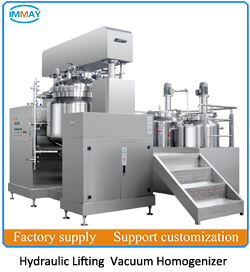
In some industrial designs, this vacuum function is integrated into what is known as a vacuum emulsifying mixer, where the vessel combines mixing, homogenization, and post-process de-aeration.
Main Applications of Cosmetic Cream Mixers
Industrial cosmetic cream mixers are versatile pieces of equipment that serve a wide range of product types across the personal care and pharmaceutical industries. By providing controlled emulsification, uniform ingredient distribution, and viscosity management, these mixers ensure consistent quality and performance in every batch. Their applications extend beyond basic creams to more complex formulations that require precise handling of multiple phases and functional additives.
Facial Creams
Facial creams represent one of the most common applications for cosmetic cream mixers. These products include:
Moisturizing creams: Formulations designed to deliver hydration and maintain skin barrier function. Oil and water phases, along with humectants and emollients, must be blended into a smooth, stable emulsion.
Anti-aging creams: Often contain active ingredients such as peptides, antioxidants, or botanical extracts. Uniform distribution of these actives is critical for product efficacy.
Cosmetic cream mixers ensure that the delicate balance between oil, water, and functional additives is maintained, producing a consistent texture and smooth skin feel. High shear and controlled mixing prevent phase separation, while temperature-controlled vessels protect heat-sensitive ingredients.
Body Lotions
Body lotions are typically lighter in viscosity compared to facial creams but require the same level of emulsion stability. They main include:
Hydrating formulations with glycerin or hyaluronic acid
Soothing lotions containing aloe vera, botanical extracts, or vitamins
Mixers for body lotions ensure that oil droplets are uniformly dispersed and emulsifiers are fully activated. Even with lower viscosity formulations, industrial mixers provide consistent blending across large production volumes, supporting batch-to-batch reproducibility.
Sunscreens
Sunscreen creams and lotions pose additional challenges due to the inclusion of UV filters, some of which are oil-soluble and others water-soluble. Cosmetic cream mixers allow:
Proper dispersion of inorganic filters (e.g., zinc oxide, titanium dioxide)
Integration of chemical UV filters into the continuous phase without agglomeration
Maintenance of emulsion stability under temperature-controlled conditions
Achieving uniform SPF distribution is critical, and mixers with high shear capability and precise temperature control are essential to ensure product efficacy and safety.
Pharmaceutical Creams
Pharmaceutical creams, commonly referred to as ointments, include formulations for topical drug delivery. They often contain active pharmaceutical ingredients (APIs) that require:
Even distribution throughout the base
Protection from degradation during processing
Consistent viscosity for accurate dosing
Industrial cream mixers allow careful incorporation of APIs into oil-in-water or water-in-oil bases while controlling shear and temperature. This ensures both product stability and therapeutic consistency across batches.
Personal Care Emulsions
Beyond creams and lotions, cosmetic cream mixers are widely used for other personal care emulsions, including:
Hair styling products such as conditioning creams and leave-in treatments
Body gels and emulsified cleansers
Specialized skin care formulations with functional additives
These products often have unique rheological properties or contain sensitive actives, making controlled mixing essential. Mixers ensure uniform droplet distribution, stable texture, and reliable performance in each production run.
How to Choose the Right Cosmetic Cream Mixer
Selecting the appropriate cosmetic cream mixer is a critical decision for industrial manufacturers. The right equipment ensures consistent product quality, efficient production, and scalability while minimizing operational issues. When evaluating mixers, several technical and practical factors should be considered.
Production Capacity
The batch size required is often the primary consideration when selecting a mixer. Industrial mixers are available in a range of capacities, from small-scale laboratory units to large production vessels designed for continuous or semi-batch operation.
Key points to consider include:
Planned daily or weekly production volume: Choosing a mixer that aligns with current and projected production ensures optimal efficiency and avoids under- or over-utilization.
Viscosity of formulations: Highly viscous creams require stronger mixing power.
Future scalability: Investing in equipment slightly larger than current needs can accommodate product line expansion without requiring a completely new system.
Selecting the right capacity ensures consistent mixing quality and reduces the risk of uneven emulsification or incomplete ingredient dispersion.
Automation Level
Modern cosmetic cream mixers offer varying levels of automation, which can impact both operational efficiency and ease of use. Options mainly include:
Button control: Basic mixers with push-button operation allow operators to start, stop, and adjust speed, suitable for smaller production or formulations requiring manual oversigh

PLC-controlled systems: Programmable logic controllers enable automated operation, allowing pre-set mixing programs for specific formulations. This can improve reproducibility, reduce operator intervention, and simplify batch tracking.

Choosing the appropriate automation level depends on production complexity, workforce expertise, and the degree of process control required. Higher automation often provides better consistency and reduces human error, which is especially valuable for complex or high-value formulations.
Facility Layout and Integration
The physical layout of the production facility plays a significant role in mixer selection. Considerations include:
Available floor space: Ensure the mixer can fit comfortably while allowing space for maintenance and safe operation.
Integration with other equipment: Mixers need to connect to upstream raw material tanks and downstream filling and packaging lines. Proper positioning can optimize workflow and reduce material transfer time.
Access for cleaning and inspection: Even though industrial mixers are designed for robust operation, easy access for routine inspection and component maintenance ensures operational reliability.
Understanding the constraints and opportunities presented by your facility helps ensure the mixer can be installed efficiently and operated safely while maintaining production flexibility.
By carefully evaluating production capacity, automation level, and facility layout, manufacturers can select a cosmetic cream mixer that balances operational efficiency, product quality, and long-term adaptability. Consulting equipment experts can further refine the choice to match specific formulation needs, production targets, and facility constraints.
Parameters of Cosmetic Cream Mixer
Model | Effective Capacity | Homogenizer | Mixing | Dimension (mm) | Heating(KW) | Limited Vacuum (Mpa) | |||||
Power | Speed | Power | Speed | Length (mm) | Width (mm) | Height (mm) | Electric heating | Steam heating | |||
IMA-CCM-30 | 30L | 1.1~2.2 | 0~3000 | 0.55~0.75 | 0~63 | 1800 | 1000 | 1750/2300 | 18 | 9 | -0.08 |
IMA-CCM-50 | 50L | 2.2~3 | 0~3000 | 0.75~1.1 | 0~63 | 2430 | 1230 | 1850/2600 | 18 | 9 | -0.08 |
IMA-CCM-100 | 100L | 3~5.5 | 0~3000 | 1.1~1.5 | 0~63 | 2800 | 1500 | 2000/2750 | 32 | 13 | -0.08 |
IMA-CCM-200 | 200L | 4~7.5 | 0~3000 | 1.5~2.2 | 0~63 | 2800 | 1850 | 2300/3300 | 45 | 15 | -0.08 |
IMA-CCM-300 | 300L | 5.5~7.5 | 0~3000 | 2.2~3 | 0~63 | 3000 | 1950 | 2400/3450 | 45 | 18 | -0.08 |
IMA-CCM-500 | 500 | 7.5~11 | 0~3000 | 3~4 | 0~63 | 3300 | 2100 | 2750/3900 | 50 | 27 | -0.08 |
IMA-CCM-1000 | 1000 | 11~15 | 0~3000 | 5.5~7.5 | 0~63 | 4200 | 3600 | 3250/4800 | 85 | 30 | -0.08 |
Working Process of a Cosmetic Cream Mixer
Understanding the working process of a cosmetic cream mixer is critical for both industrial operators and engineers seeking to optimize production. Industrial cream mixers consist of a main mixing tank, an oil phase tank, and a water phase tank. Each unit serves a specific function in the controlled preparation of stable, high-quality cosmetic creams.
Breaking down the process into clear, step-by-step stages highlights how industrial mixers manage complex formulations while maintaining consistency, texture, and emulsion stability.
Oil Phase Preparation
The production process begins with the oil phase, which includes oils, waxes, emollients, and other lipid-soluble ingredients. In its dedicated tank, the oil phase is:
Measured and pre-blended to ensure accurate proportions
Heated to melt solid lipids or waxes, reducing viscosity for easier mixing
Temporarily held under controlled agitation to maintain homogeneity
Proper oil phase preparation ensures that the lipophilic components are fully melted, uniform, and ready for subsequent emulsification.
Water Phase Preparation
Simultaneously, the water phase is prepared in its own tank. This phase mainly contains:
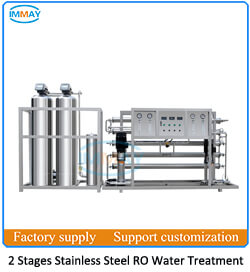
Purified water (produced through industrial reverse osmosis water treatment machine)
Humectants and hydrophilic additives
Soluble stabilizers and other functional ingredients
During preparation, water-phase ingredients are dissolved or dispersed under controlled temperature conditions, ensuring a consistent solution. Proper water phase preparation prevents clumping and uneven incorporation during later mixing stages.
Heating, Mixing, and Emulsification
Once both phases are ready, they are transferred to the main mixing tank for controlled emulsification. This stage involves:
Heating the combined mixture to maintain fluidity and support emulsifier activation
High-shear mixing to disperse the oil phase into fine droplets within the water phase (or vice versa)
Agitation and circulation to ensure uniform droplet distribution and consistent emulsion formation
The emulsification stage establishes the internal structure of the cream, affecting viscosity, texture, and stability. Precision in temperature control and mixing intensity is essential for reproducible results.
Cooling
After the emulsion has formed, the mixture is gradually cooled under continued agitation. Cooling allows:
Development of final viscosity
Solidification or crystallization of certain structural components such as waxes
Stabilization of the emulsion network
Maintaining gentle circulation during cooling prevents localized over-thickening and ensures uniform texture throughout the batch.
Addition of Heat-Sensitive Ingredients and Final Low-Speed Mixing
At this stage, temperature-sensitive ingredients—such as vitamins, peptides, or botanical extracts—are added to the cooled cream.
Low-speed mixing ensures even distribution without damaging the active components or disrupting the emulsion structure
Optional functional additives or fragrances are incorporated at this point for consistent product quality
This step ensures that the final formulation retains all intended properties, including bioactivity, texture, and sensory characteristics.
Discharge
Once the cream has reached its final composition and viscosity:
The finished product is discharged from the main stainless steel mixing tank
It is transferred to storage or filling equipment under controlled conditions to maintain stability and prevent contamination
Efficient discharge and transfer maintain batch integrity, ensuring that the final cosmetic product meets quality standards and is ready for packaging.
Recommended Products