- Home
- Equipment
- Industries
- We Immay
- Resource
- Contact
Author: Site Editor Publish Time: 2026-11-04 Origin: Site
Industrial stainless steel mixing tanks are used in different manufacturing processes, and their operating requirements vary with the products being processed and the production setup. These differences also influence how operators manage the equipment during daily production.
When selecting a mixing tank, the control system deserves attention alongside the tank's mechanical configuration. A good starting point is to understand the functions that the control system is responsible for managing.
A stainless steel mixing tank control system manages the operation of the tank's main processing components. Its functions depend on the equipment configuration, with mixing and temperature management being two important aspects of tank operation.
The control system manages the operation of the agitator and homogenizer, if the tank is equipped with one. Operators can start and stop the motors and adjust their rotational speeds according to the mixing requirements. A timer function can also be added to set the operating duration of the mixing equipment.
For tanks equipped with multiple mixing devices, such as an anchor agitator and a high-shear homogenizer, the control system can manage each device's operation separately. This allows different mixing speeds and operating times to be set according to the processing stage.
For tanks equipped with a heating or cooling jacket, the control system can monitor the product temperature through a temperature sensor installed in the tank. The measured temperature is displayed on the control panel, providing operators with information about the product's temperature during processing.
Heating and cooling use different control methods. During heating, the system can regulate the heating process according to a preset temperature. During cooling, the product temperature decreases through the circulation of cooling water in the jacket. If automatic cooling control is included, the system can close the cooling water inlet valve when the product reaches the preset cooling temperature. Otherwise, cooling water supply is controlled manually.
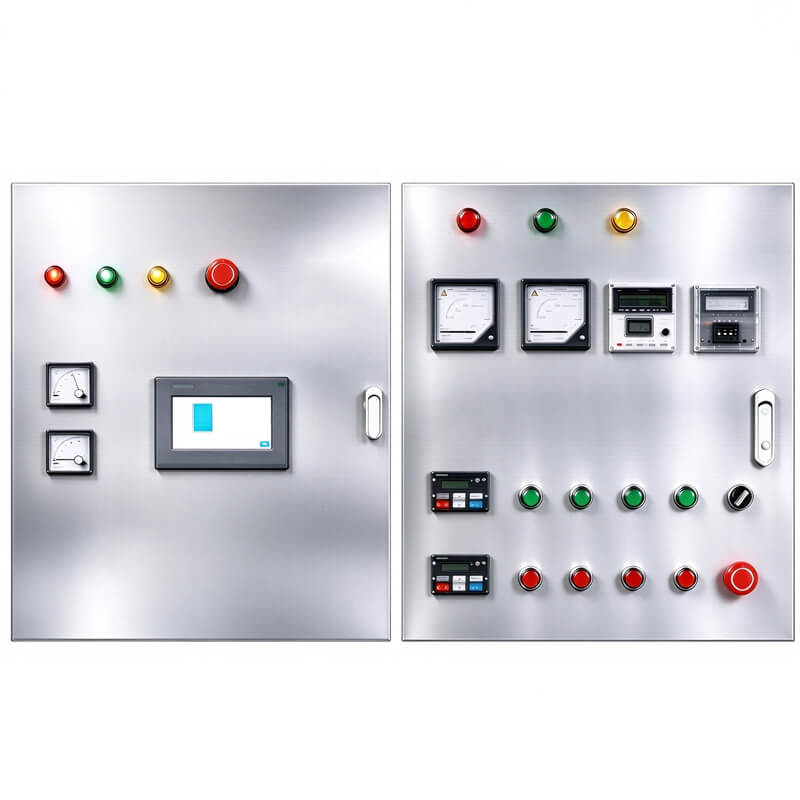
Industrial stainless steel mixing tanks commonly use manual button control or PLC-based control systems with a touchscreen interface. These configurations differ in how operators interact with the equipment and manage its operation. The choice depends on the mixing requirements and the level of process control needed.
Manual button control uses a control panel fitted with buttons, switches, and other operating components. Operators use these controls to start and stop the agitator motor and adjust its rotational speed when a speed controller is installed.
This type of control is suitable for mixing tanks with straightforward operating requirements. Its main functions focus on direct equipment operation, with each action initiated manually. Additional functions, such as timer settings and temperature display, can also be incorporated into the control panel.
A PLC and touchscreen control system uses a programmable logic controller (PLC) to execute control instructions and a touchscreen as the human-machine interface (HMI). The PLC processes input signals and controls the connected equipment, while the touchscreen allows operators to enter operating parameters, issue commands, and monitor equipment status.
This configuration supports more flexible process control. Operators can set the agitator speed and operating time, monitor product temperature, and configure automatic operating sequences. If the tank is equipped with a heating and cooling system, these functions can also be incorporated into the programmed control process. The available functions depend on the tank's equipment configuration and control requirements.
For a single stainless steel mixing tank, the choice of control system depends on the operating requirements of the mixing process and the desired level of automation. Factors such as agitator speed adjustment, operating time settings, and temperature control help determine which configuration is suitable for the production process.
Manual button control is suitable for a single mixing tank with straightforward operating requirements. The control panel allows operators to start and stop the agitator motor. If variable-speed operation is required, a frequency inverter can be incorporated to adjust the agitator speed.
Manual control can also be used for heating and cooling operations. The heating system can be switched on or off through the control panel, while cooling is controlled through the cooling water supply. Temperature display and timer functions can also be added to the panel according to production requirements.
A PLC and touchscreen control system is suitable for a single mixing tank that requires programmable operating parameters and automatic process control. Operators can enter agitator speed, mixing time, and temperature settings through the touchscreen, while the PLC executes the corresponding control instructions.
For tanks equipped with heating and cooling systems, temperature control can also be incorporated into the program. The PLC can regulate heating according to the preset temperature and control an automatic cooling water inlet valve when the product reaches the specified cooling temperature. This allows the system to execute programmed operations at different stages of the mixing process with less manual intervention.
When a factory operates multiple stainless steel mixing tanks, the control system needs to accommodate the operating requirements of each tank and the way different production tasks are arranged. Some tanks handle separate products or batches and operate independently, while others are involved in different stages of the same production process. These operating arrangements influence the choice of control system.
Manual button control is suitable when multiple mixing tanks perform separate production tasks without requiring coordinated automatic operation. Each tank can have its own control panel, allowing operators to start and stop the agitator, adjust its speed, and manage heating or cooling functions independently.
This arrangement gives operators direct control over each tank. It is practical when different batches have separate operating schedules and do not require automatic coordination between equipment. Timer functions and temperature displays can also be incorporated into individual control panels according to each tank's requirements.
PLC and touchscreen control is suitable for production facilities where multiple mixing tanks need more coordinated process management. The control system can connect the operating components of different tanks, allowing operators to monitor their operating status and manage process parameters through a touchscreen interface.
For example, when several tanks are used in successive production stages, the PLC can execute programmed operating sequences according to the production process. It can also manage functions such as agitator speed, mixing time, heating and cooling temperature, and valve control for the connected tanks, depending on the system configuration.
Control system selection is an important part of specifying industrial stainless steel mixing tanks. It influences how equipment fits into the overall manufacturing process and how production operations are managed across a facility.
Ultimately, choosing a suitable control system is about establishing the right level of operational control for the production environment. As manufacturing requirements evolve, the control system should also support the long-term development of the production process.