- Home
- Equipment
- Industries
- We Immay
- Resource
- Contact
 |
Selecting an industrial liquid detergent mixing tank begins with the formulation to be processed. In liquid detergent manufacturing, the combination of ingredients, their physical properties, and their behavior during mixing all influence the requirements placed on the equipment.
A clear understanding of the formulation provides the basis for evaluating the required mixing method, agitator configuration, and temperature control. These considerations help determine which industrial mixing tank is suited to the product and its manufacturing process.
How Does Liquid Detergent Formulation Affect Mixing Requirements?
What Are the Main Ingredients in Liquid Detergent?
Liquid detergent formulations typically contain water and surfactants, along with other ingredients selected according to the intended cleaning performance and product characteristics. These may include builders, solvents, chelating agents, thickeners, fragrances, and preservatives.
Water: Serves as the primary liquid medium and dissolves ingredients that are soluble in the aqueous phase.
Surfactants: Provide the main cleaning action by helping loosen and remove soil from fabrics.
Builders and Chelating Agents: Help manage water hardness and support cleaning performance, depending on the formulation.
Solvents and Other Additives: Serve specific functions, such as supporting ingredient solubility, adjusting viscosity, providing fragrance, or preserving product quality.
The formulation determines not only which ingredients are used, but also the mixing conditions needed to incorporate them into a consistent finished product.
How Do Ingredient Properties Affect Mixing?
Liquid detergent ingredients differ in physical form, solubility, and compatibility. Some liquid ingredients blend readily with the existing mixture, while powders and other materials may need to dissolve or disperse before they can be incorporated evenly.
The order of addition also matters. Certain ingredients need to dissolve in the liquid phase before other components are introduced, while others are added later according to their properties and the formulation procedure. The appropriate sequence depends on the ingredients involved and how they interact during mixing.
For simpler formulations, conventional agitation may be sufficient, while formulations containing ingredients that are difficult to disperse require additional high shear processing. The mixing method should reflect the requirements of the actual formulation.
How Does Viscosity Affect the Mixing Process?
Viscosity affects how easily liquid detergent moves within the mixing tank. Low-viscosity liquids generally circulate more readily, while high-viscosity liquids offer greater resistance to flow. As viscosity increases, moving the material throughout the tank becomes more demanding, making the mixing requirements an important consideration when selecting the agitator configuration.
How Does the Mixing Tank Handle These Requirements?
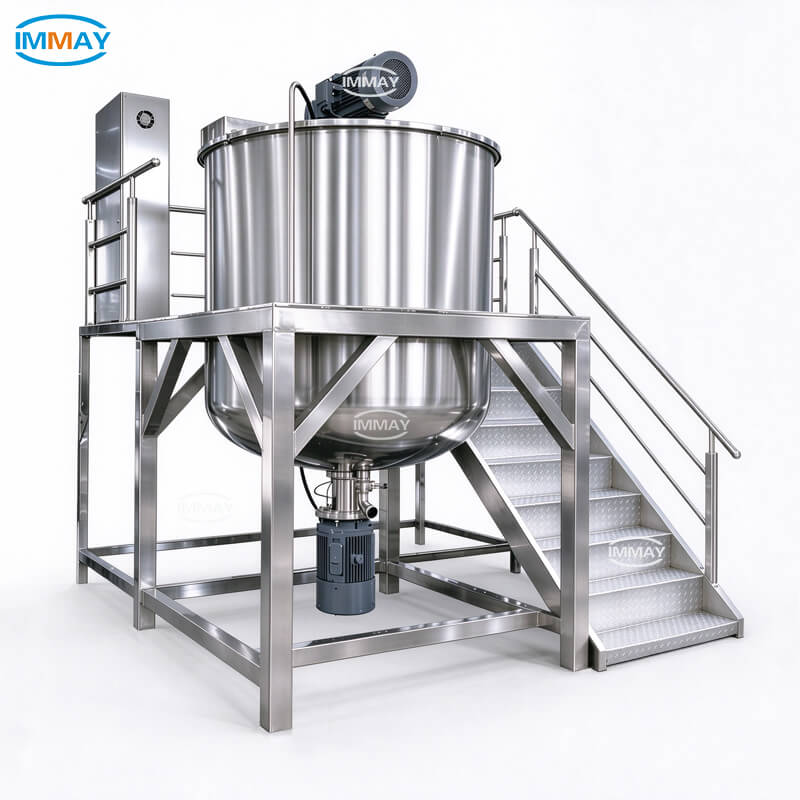
Stainless Steel Mixing Vessel
The liquid detergent mixing vessel is made of stainless steel, which offers corrosion resistance and durability for liquid detergent manufacturing. The smooth inner surface facilitates the removal of product residues during cleaning.
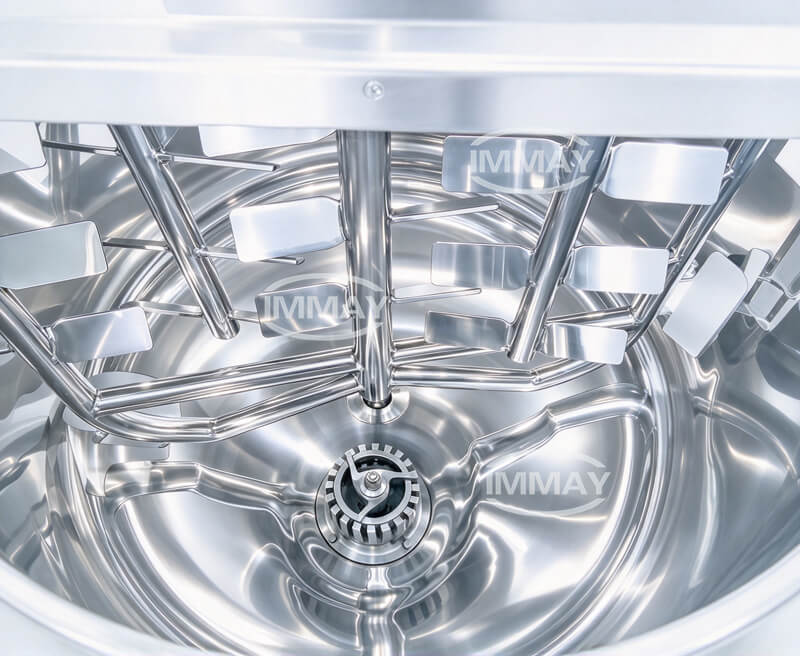
Frame Anchor Agitator for Overall Mixing
The frame anchor agitator is installed at the top of the tank. As it rotates, it moves the material throughout the vessel, promoting overall circulation and blending the ingredients into a uniform mixture.
Viscosity affects how easily the material circulates. Higher-viscosity liquids offer greater resistance to flow, making movement throughout the tank more difficult. The frame anchor agitator supports overall mixing across different liquid detergent formulations.
Bottom High Shear Homogenizer for High Shear Processing
The bottom high-shear homogenizer applies intense mechanical shear to the material near the bottom of the tank. It helps break down agglomerates and disperse ingredients that require more intensive processing.
Most liquid detergent formulations require high-shear processing. When the ingredients need additional dispersion, the bottom homogenizer works alongside the frame anchor agitator, which maintains overall material circulation within the tank.
Optional Heating and Cooling System
The tank can be equipped with a jacketed heating and cooling system when the manufacturing process requires temperature control. Heating can help dissolve certain ingredients or reduce viscosity during processing, while cooling brings the mixture to the required temperature before the next processing stage.
For formulations that can be mixed effectively at room temperature, the heating and cooling system is not necessary. Its inclusion depends on the actual temperature requirements of the detergent formulation.
How Should You Select a Stainless Steel Mixing Tank for Liquid Detergent Manufacturing?
Daily Output and Batch Size
Daily output determines how much liquid detergent needs to be processed and how large each batch should be. For example, a factory with a high daily output may use larger batches to reduce the number of mixing cycles, while smaller batches can suit lower output requirements or a wider range of product varieties. The working volume of the stainless steel mixing tank should match the intended batch size, allowing sufficient space for ingredients to be added and mixed within the vessel.
Formulation and Mixing Requirements
The formulation determines the mixing requirements of the liquid detergent. Ingredient properties and the viscosity of the finished product affect how materials move and blend within the tank. Most liquid detergent formulations require high shear processing, making a bottom high shear homogenizer useful alongside the frame anchor agitator for overall mixing. The need for heating or cooling depends on whether the ingredients must be dissolved or processed at a specific temperature.
Factory Layout and Equipment Dimensions
Factory layout affects the dimensions of the stainless steel mixing tank that can be installed and operated in the available space. Ceiling height, floor space, access for ingredient loading, and room for equipment maintenance all influence the tank's design. The tank also needs to fit into the material flow between ingredient preparation, mixing, storage, and filling. A suitable arrangement allows the equipment to connect with the surrounding process.
Technical Parameters of The Industrial Liquid Detergent Stainless Steel Mixing Tank
Parameter | Specification |
Working Volume | 50L-5000L |
Tank Material | Stainless Steel |
Main Agitator | Frame Anchor Agitator |
Main Agitator Speed | 0-63 rpm |
Homogenizer Type | High Shear Homogenizer |
Homogenizer Speed | 0-3000 rpm |
Heating and Cooling System | Optional |
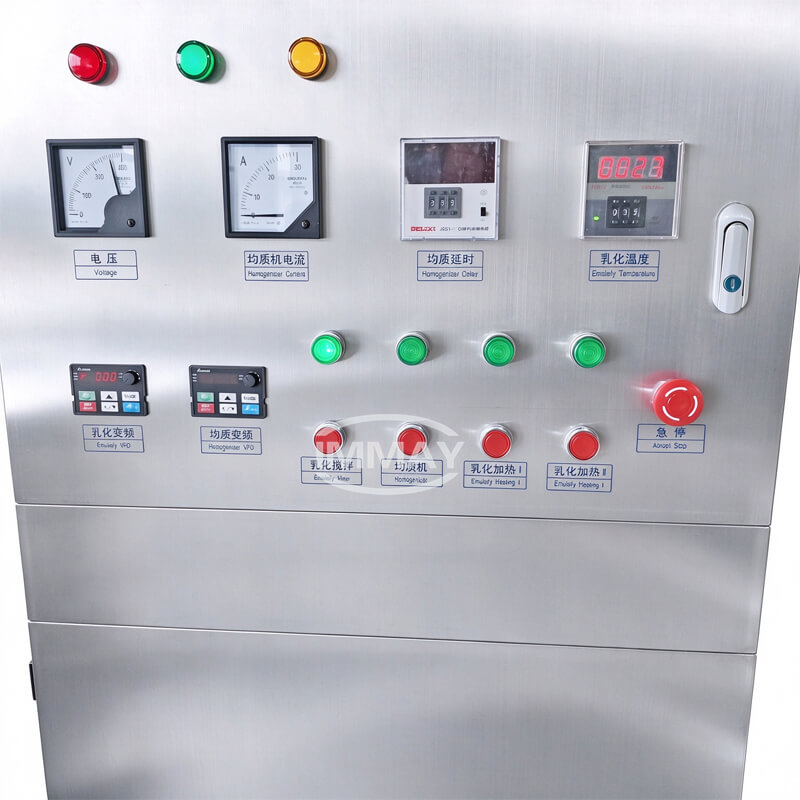
Control System | PLC or Button Control |
Power Supply | Customized |
Main Details of The Industrial Liquid Detergent Stainless Steel Mixing Tank
Recommended Products