- Home
- Equipment
- Industries
- We Immay
- Resource
- Contact
|


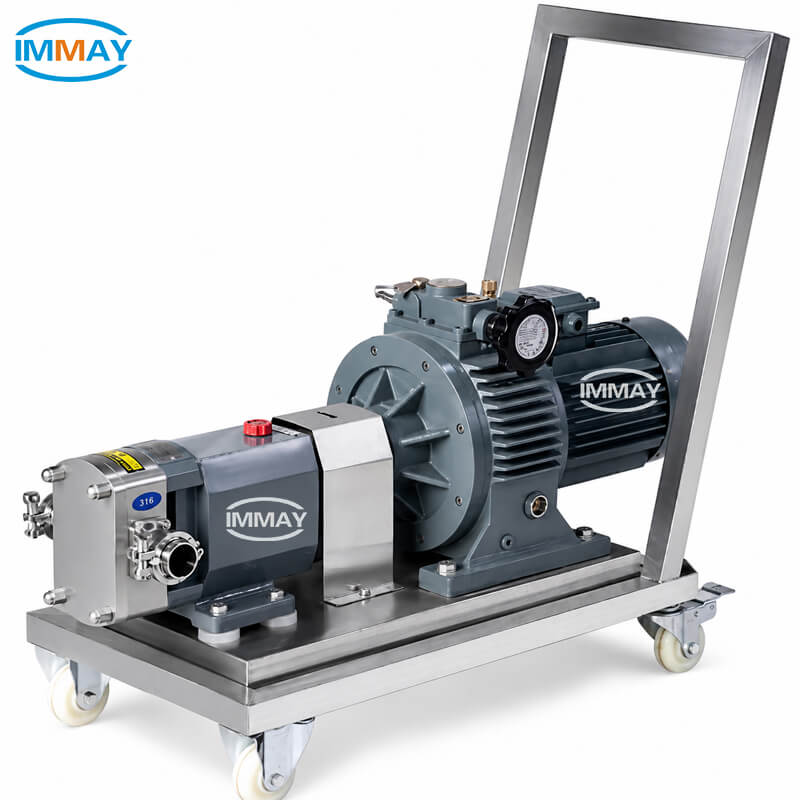
The Rotor Pump is a positive displacement pump designed for transferring liquids and semi-viscous products at a controlled flow rate. Its rotary pumping principle makes it suitable for applications where stable product transfer is required, particularly when handling liquids with different viscosities.
Rotor pumps can be used in cosmetic, personal care, food, pharmaceutical, chemical, and other liquid processing applications. Depending on the product characteristics and production process, the pump can be used for transferring materials between mixing tanks, storage tanks, filling machines, and other processing equipment.
What Is a Rotor Pump?
A rotor pump is a type of positive displacement pump that uses rotating components inside the pump chamber to move liquid from the inlet to the outlet.
As the rotor rotates, the internal pumping chambers continuously draw product into the pump and move it toward the discharge side. Unlike centrifugal pumps, which rely primarily on rotational velocity to generate flow, a positive displacement rotor pump transfers a defined volume of product during each rotation.
This operating principle makes rotor pumps particularly useful for liquids that require controlled and relatively stable transfer.
The actual pumping performance depends on factors such as product viscosity, temperature, flow rate, pump speed, inlet conditions, and the properties of the material being transferred.
How Does a Rotor Pump Work?
The working principle of a rotor pump can be understood through four basic stages:
1. Product Enters the Pump
Liquid enters the pump chamber through the inlet as the rotor begins to rotate.
2. The Rotor Creates Pumping Chambers
The rotating rotor creates changing internal spaces that capture and carry the product through the pump.
3. Product Moves Toward the Outlet
As the rotor continues to rotate, the captured liquid is displaced toward the discharge side of the pump.
4. Continuous Product Transfer
The pumping cycle repeats as long as the rotor rotates, providing continuous transfer from the supply vessel to the receiving equipment.
What Products Can a Rotor Pump Transfer?
Rotor pumps can be considered for a wide range of liquid and semi-viscous products.
Common applications include:
Cosmetic creams and lotions
Liquid soap
Shampoo
Shower gel
Facial cleanser
Detergent
Food sauces
Syrups
Edible oils
Pharmaceutical liquids
Chemical liquids
Other viscous or semi-viscous formulations
The suitability of a rotor pump should be evaluated according to the actual product. Sensitivity to shear, temperature, flow requirements, and the required transfer distance can also affect pump selection.
For products with special characteristics, providing a product sample or detailed formulation information to the equipment supplier can help determine whether the proposed rotor pump is suitable.
How to Choose a Suitable Rotor Pump?
For buyers purchasing a rotor pump, the selection process usually starts with the product and transfer requirements. Providing these details to the supplier allows the pump manufacturer to recommend a suitable model and configuration.
1. Identify the Product to Be Pumped
Start by telling the supplier what product the rotor pump will transfer.
Common examples include shampoo, shower gel, lotion, liquid soap, sauces, syrups, edible oils, and other liquid or semi-viscous products.
The product name is useful, but additional information such as viscosity, temperature, and flow will give the supplier a clearer basis for pump selection.
2. Provide the Product Viscosity
Provide the viscosity of the product under the actual pumping conditions.
If the product is heated before transfer, give the viscosity at the pumping temperature. Some products become significantly less viscous after heating, which can affect the required pump configuration.
For products whose viscosity changes during production, explain the normal operating range to the supplier.
3. Specify the Required Flow Rate
Tell the supplier how much product you need to transfer per hour.
For example, the requirement may be 2,000 L/h, 5,000 L/h, or 10,000 L/h.
4. Provide the Transfer Conditions
The supplier will also need to know how the product will travel through the production system.
Useful information includes:
Horizontal transfer distance
Vertical lifting height
Pipeline diameter
Number of elbows
Valves and other pipeline components
Inlet and outlet locations
A simple pipeline layout or process flow diagram can provide this information clearly.
5. Explain the Product Characteristics
Tell the supplier whether the product contains suspended or solid particles.
For products containing particles, provide the approximate particle size, concentration, and hardness where possible. These characteristics can affect the rotor design, operating speed, and suitability of the pump.
For shear-sensitive products, this should also be mentioned during the quotation stage.
6. Confirm the Required Pump Material
Buyers should specify the required material for product-contact parts according to the product and production application.
For cosmetic, food, pharmaceutical, and chemical applications, the material of the wetted components should be discussed with the supplier before ordering.
If the pump is being added to an existing stainless steel processing system, provide the material requirements together with the connection specifications.
7. Check the Inlet and Outlet Connections
Confirm the connection size and type required by the existing pipeline or production equipment.
If the rotor pump will be installed between a mixing tank and storage tank, or between a storage tank and filling machine, provide the relevant connection dimensions.
Equipment drawings or photographs of the existing connections can help the supplier confirm the configuration.
8. Ask the Supplier to Recommend the Pump Model
Once the product and process information has been provided, ask the pump manufacturer to recommend the appropriate model.
The supplier can evaluate the required displacement, pump speed, motor power, connection size, and other configuration details according to the application.
This information gives the supplier a complete picture of the intended application and makes it easier to prepare a rotor pump configuration and quotation that match the production system.
Technical Specifications of The Rotor Pump
Parameter |
Specification |
Installation Type |
Horizontal / Vertical |
Inlet Connection |
Customized according to process requirements |
Outlet Connection |
Customized according to process requirements |
Power Supply |
380 V 50 Hz 3-Phase or customized |
Flow |
According to configuration |
Product Contact Material |
Stainless Steel |
Applicable Products |
Liquids and Semi-Viscous Products |
Application |
Cosmetic, Personal Care, Food, Pharmaceutical, Chemical and Other Liquid Transfer Applications |
Recommended Products